




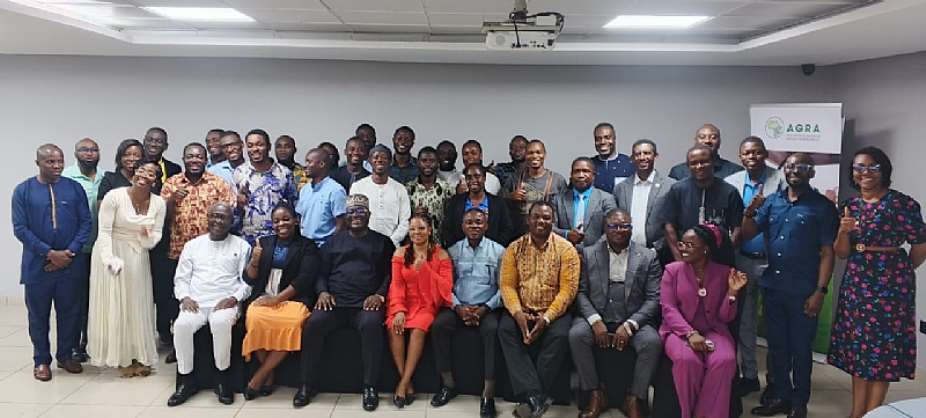
Food systems stakeholders in Ghana have expressed confidence that AGRA’s Climate Vulnerability Assessment Tool (ClimVAT) will strengthen climate adaptation and resilience efforts.
At a national stakeholder domestication workshop on the tool in Accra, participants reviewed its functionality and explored how it can be applied to inform climate-resilient agricultural planning and decision-making in Ghana.
Climate change is increasingly affecting agricultural systems across Africa through rising temperatures, more frequent droughts, shifting rainfall patterns, and extreme weather events. To respond effectively, governments and development partners require reliable evidence that identifies where climate risks are most severe and what factors drive vulnerability in different regions.
The ClimVAT platform, developed following a climate assessment exercise conducted by AGRA across Ghana between 2024 and 2025, provides this evidence by combining climate, soil, and socio-economic data to generate spatial maps of climate exposure, agricultural sensitivity, and adaptive capacity. These maps allow users to visualize patterns of climate vulnerability across different geographies, agricultural systems and time scales.
ClimVAT will support national governments, local government institutions, development partners, non-governmental organizations, extension services, agribusiness development initiatives, among others, to make climate-resilient agricultural planning and investment decisions.
“This tool will help people developing projects to have insider information on how they manage policies on climate change in their districts. It helps map out which areas in specific districts are vulnerable to climate change so they could roll out programs to mitigate such challenges,” Bashiru Musah, Program Officer at AGRA Ghana, said.
Dr. Shaibu Baanni Azumah, Climate Policy Consultant explained the tool “provides regional and on spot information on vulnerability hot spots. You could compare national indices and local ones. You can assess sensitivity and exposure to climate change.” “The tool allows you to do prioritization of climate adaptation policies. Simple navigation can help you see what and where to focus on. It tells you which areas are most vulnerable and have least of adaptation programs so you could center your efforts around those areas,” he added.
Stakeholders also noted vulnerable people in society will benefit greatly from the tool, as it will give policy makers evidence-based data to plan. “With this tool, policy makers are able to tell which districts and communities we should shift support to. Without data, it is difficult to plan. With this tool, we are able to tell which places where women, youth and persons with disability are suffering. So, it can help us make informed decisions that support youth and vulnerable in society,” Dr. Paul Yao Anani, Gender Consultant said.
Dr. Kindie Tesfaye Fantaye, Head of Climate Adaptation and Resilience at AGRA explained ClimVAT also features “the vulnerability index that shows different areas and levels of vulnerability. It helps decision makers on where to invest. It helps focus on vulnerable crops, sectors, etc. using data visualization tools, and using that to plan appropriately.”
“Without dealing with climate change, poverty issues cannot be dealt with. So, we need to have proper planning for climate issues. This is important for climate decision making,” he added.
Principal Research Assistant and Maize Breeder at the West Africa Centre for Crop Improvement (WACCI), University of Ghana, Dr. Mawulawoe Awity, said the tool will be particularly useful for plant breeders. “For us, as breeders and persons in the agricultural space, what are the adaptive tools that we can come up with? This is an important tool for us to know the kind of strategies we can come up with to ensure our farmers are supported to mitigate the effects of climate change.”
As part of the next steps, AGRA is working to get ClimVAT embedded in Ghana’s national policy framework, so institutions such as the Ministry of Food and Agriculture and Environmental Protection Agency could use them in designing various national and sub-national initiatives.
The national stakeholder domestication workshop in Accra was the second after an earlier one in Tamale. At the workshop, participants were capacity built on how to interpret and apply climate vulnerability data and review high-resolution risk maps. They also explored how to translate these insights into actionable, gender-responsive planning and investment decisions while strengthening national coordination. AGRA will conduct similar workshops in Kenya, Tanzania, Uganda and Zambia.

 Alagumgube welcomes Gurene as BECE subject, calls for more teachers and learning...
 Mahama calls for return of Africa’s cultural heritage at UNGA 81 side event
 ECOWAS directors meet in Lagos to align 2027–2029 expenditure plans
 Lordina Mahama urges African leaders to build stronger healthcare systems for wo...
 Speaker Bagbin summons Parliament for September 29 sitting
 Kwesi Pratt warns against abuse of free expression amid Ghana Jollof controversy
 PURC keeps electricity, water tariffs unchanged for fourth quarter
 EOCO heads must be removed over ‘abusive conduct’ – Bobby Banson
 GES transfers funds for SHS 1 perishables, recurring items
 Putin using citizens from 47 countries to fight Ukraine, Zelensky tells UN


