




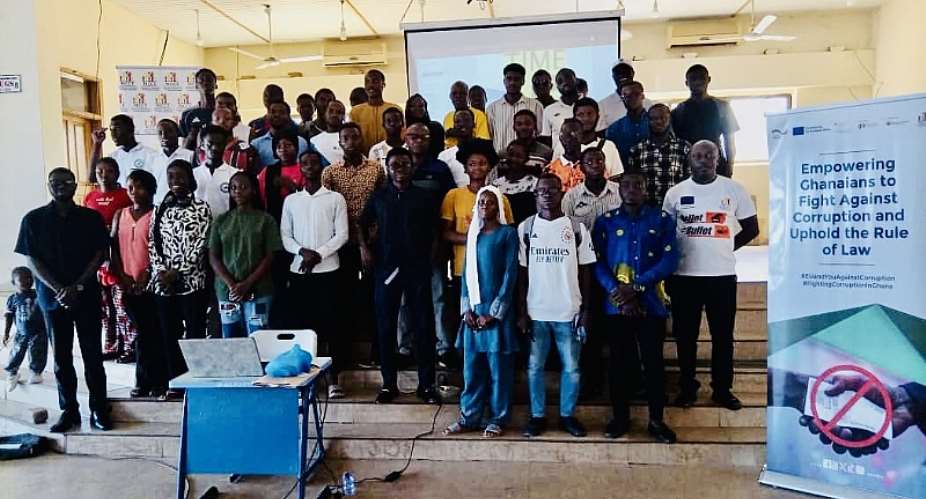
The Upper West Regional Office of the National Commission for Civic Education (NCCE) has held a one-day symposium on the rule of law, corruption and public accountability with Civic Education Club members and students of the University for Business and Integrated Development Studies (UBIDS) in Wa.
The symposium, held on April 25, 2026, at Lecture Hall 2A of the university, brought together members of the Civic Education Club and selected students from all eight faculties to deepen their understanding of transparency and accountability.
Participated by a total of 67 students, the engagement aimed at empowering the youth to actively contribute to the fight against corruption and promote good governance.
In his opening remarks, the Deputy Regional Director of the NCCE, Mr. Yibile John, said the objective of the programme was to enhance awareness among young people on the need for transparency, accountability and respect for the rule of law.
He noted that citizen participation remains key to ensuring accountability, stressing that over the years, a top-down approach where only institutions render accountability has proven ineffective.
Mr. Yibile explained that such an approach alienates citizens and contributes to corruption, conflict of interest, influence peddling and weak ethical leadership.
He therefore urged the students to actively participate in governance processes as future leaders to help promote transparency and inclusiveness in society.
The Wa Municipal Programs Officer of the NCCE, Mr. Frederick Bondong, took participants through key concepts including social auditing, rule of law, corruption and public accountability.
He explained that social auditing is a process where citizens examine how public funds and resources are used to ensure transparency and prevent corruption.
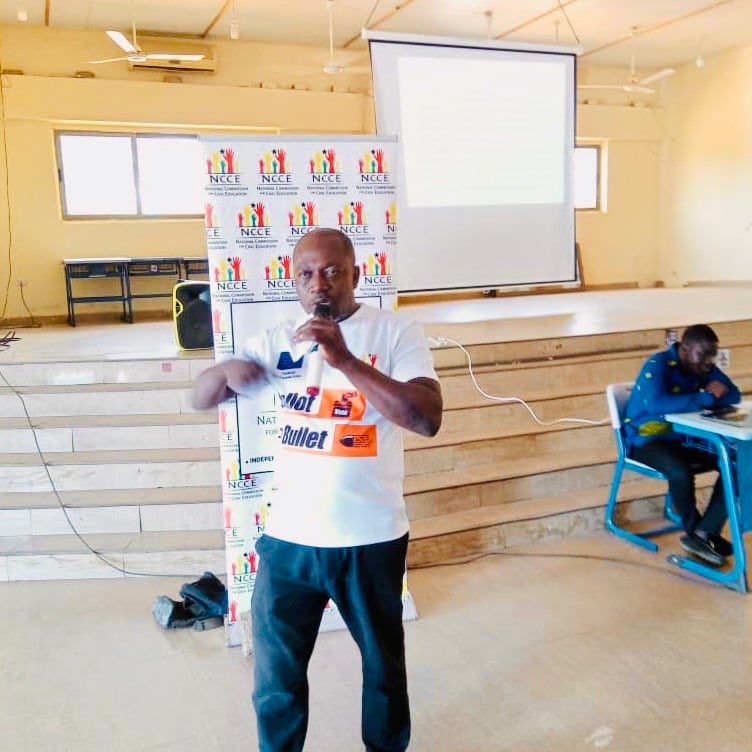 Mr. Frederick Bondong, Programs Officer, NCCE Wa Municipal
Mr. Bondong said social auditing could involve community members, civil society organizations and state institutions checking whether projects promised by authorities are actually delivered.
On the rule of law, he noted that it is the principle that everyone, including leaders, must obey the law, emphasizing that no one is above the law.
He explained that corruption involves the abuse of entrusted power for private gain, citing examples such as bribery, embezzlement and favoritism in the awarding of contracts and jobs.
Mr. Bondong indicated that corruption can occur in various sectors and often thrives in secrecy and weak systems.
He outlined measures to fight corruption, including promoting transparency, strengthening institutions, enhancing education and encouraging social auditing and accountability.
He added that accountability requires leaders to explain their actions and take responsibility for their decisions, noting that it builds trust and promotes development.
Mr. Bondong further highlighted challenges in Ghana such as low public awareness, fear of victimization, weak law enforcement and limited access to information.
The Deputy Regional Director of the Commission on Human Rights and Administrative Justice (CHRAJ), Mr. Sabastine Ziem, spoke on conflict of interest and ethical leadership.
He explained that conflict of interest occurs when a public official’s private interests interfere with their public duties.
Mr. Ziem identified causes of conflict of interest including nepotism, financial interests and outside employment.
He also outlined different types of conflict of interest and emphasized the need for public officials to uphold ethical standards in their work.
He explained that ethics involves determining what is right or wrong conduct and is essential in promoting integrity in public service.
He further took participants through legal frameworks for combating corruption in Ghana, including the 1992 Constitution, the Criminal Offences Act, and the Public Procurement Act.
Some students who participated in the symposium said the programme had enhanced their understanding of corruption and accountability.
They indicated that the knowledge gained would help them become more responsible citizens and contribute to promoting transparency and the rule of law in their communities.
The symposium was supported by the German Federal Ministry for Economic Cooperation and Development, co-financed by the European Union and the Swiss State Secretariat for Economic Affairs, and implemented by GIZ in collaboration with the Ministry of Finance, Ghana, with the NCCE serving as an implementing partner.
 UTAG suspends planned strike following breakthrough in talks with govt
 Policewoman under investigation over alleged phone-kicking incident in Akomadan
 Respect police stops; they can save your life – Drivers told
 Revised national curriculum to introduce AI, robotics and coding at basic level ...
 Greater Accra Regional Hospital clarifies viral post on patient's death
 Govt plans to decentralise medical education — Haruna Iddrisu
 Floods affect 70 PWDs in Keta Municipality
 Engineers open Kedzi-Azizadzi Floodgate to ease flooding in Keta Municipality
 Interior Ministry issues flood alert as rainfall expected across Greater Accra t...
 GFL demands urgent retooling of GNFS to tackle disasters
