




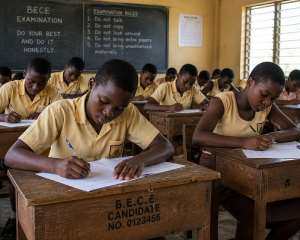
Somewhere in Ghana right now, a JHS 3 student is sitting under a flickering bulb trying to hold ten subjects in his head at once. He has been at it since eight in the evening. His mother has gone to bed. His notes are spread across the floor. He is not studying anymore, not really. He is just staring and hoping that something, somehow, will stick before Monday morning. Monday, May 4, is when the BECE begins.
I have seen that child. I have taught versions of that child for years. And every time this examination season comes around, the same question comes back to me: who designed this thing, and did they ever sit down and think through what they were actually asking?
Run the Numbers and You Will See the Problem Immediately
Three years of Junior High School. Ten subjects. Five days to account for all of it. That works out, on some days, to two papers in a single sitting. And these are not light subjects. Each one carries its own weight of topics, subtopics, definitions, dates, formulas, processes. A child who has been in school since Basic One has been building toward this one moment, and the system gives him roughly a hundred and twenty hours to reproduce thirty-six months of everything he has learned.
I am not sure when we decided that was reasonable. I am not sure anybody actually decided it, to be honest. It just continued, the way bad systems tend to continue when nobody with power is willing to say the thing out loud.
So let me say it: the BECE, as it is currently designed, does not give us an honest picture of what a child knows. What it gives us is a measure of how well a fourteen-year-old can hold their nerve under conditions that would unsettle most adults. Those are two very different things, and we have spent years pretending they are the same.
Not Every Subject on That List Belongs There
Here is something we rarely say plainly in policy circles: some of the subjects these children are being examined on have no real connection to where their lives are going. A boy who has known since Form One that he wants to go into ICT or engineering is still spending serious study hours on content that will not show up again in any meaningful way across his academic or professional future. A girl determined to pursue nursing or fashion is graded on material that neither her secondary school programme nor her career will ever ask of her again.
We talk about career-aligned education constantly. We put it in strategic plans. We say it at workshops and conferences, and everybody nods. But then the same ten-subject examination rolls around and nobody connects those two conversations. The child who is being told that education should prepare him for life is simultaneously being graded on subjects that have nothing to do with the life he is trying to prepare for.
That is not a small irony. That is a fundamental contradiction at the heart of how we run basic education in this country.
On Cheating: We Are Blaming the Fire and Ignoring Who Poured the Fuel
After every BECE season there are stories. Invigilators who looked the other way. Papers that left secure rooms before the examination date. Students with answers written inside wristbands, on the undersides of rulers, across palms that had been scrubbed clean enough to pass a pre-exam check. Teachers who helped because they could not face watching children they had taught for three years walk out empty-handed. Parents who paid money they did not have for whatever somebody was selling.
Ghana has been running this same conversation about examination malpractice for decades. We arrest a few people each year, release statements, set up committees, and then do nothing structural before the next cycle begins. The reason the conversation never ends is that we have decided it is a moral problem when it is, in large part, a design problem.
Think about what we have actually built here. We have told every child in Ghana that this one examination, taken across five days at the end of Basic Nine, is the gate to Senior High School. Pass it and the door opens. Fail it and figure out what happens next on your own. Then we loaded that gate examination with ten subjects of dense content and gave the child five days to perform. We created, by design, a situation where the stakes are maximum and the odds feel impossibly compressed.
People in desperate situations find ways out of desperate situations. Some study with everything they have. Some find other ways. The system produced both of those responses. We punish the second one without ever asking whether the system that produced it deserves any scrutiny at all.
What I Think We Should Do Instead
I am not asking anyone to throw away the BECE. I understand that you cannot dismantle a national examination overnight and that the downstream effects of doing that poorly would be serious. What I am asking for is a much more limited, more deliberate change to what we examine and how many things we examine.
Five compulsory subjects. English Language, Mathematics, Integrated Science, Social Studies, Computing. That is the core. Every child in Ghana who is heading into Senior High School should be able to demonstrate competence in those five areas. They cover the foundations: communication, numeracy, scientific thinking, civic knowledge, digital literacy. Nobody who goes on to any programme, vocational or academic, will find those five irrelevant.
Then one optional subject, chosen by the student in the first term of Form Two. The choices: French, Creative Arts, Career Technology, Ghanaian Language, Arabic. Five options. Pick one. Declare it early, commit to it, be assessed on it at the end of Form Three. Six subjects total.
The student going into sciences picks French because she already knows she will need it for research exposure down the line. The one who has been drawing since Primary Four picks Creative Arts and spends two years actually developing that skill rather than cramming it into a final-term revision schedule. The student from a family that speaks Nzema at home picks Ghanaian Language and studies it as something that belongs to him, not as an obligation sitting at the end of a long list of things he must somehow get through.
Early choice does something that late-stage cramming never can. When a child knows from Form Two what he is being assessed on at the end of Form Three, he has time to actually build something. Not memorise. Build. That distinction matters enormously and our current system, by its structure, makes it almost impossible.
The People Who Will Say This Narrows the Child's Education
I know this objection. I have heard it in staff rooms and at GES forums and from well-meaning curriculum people who genuinely believe that studying more subjects produces a more complete person. I used to half-believe it myself.
But look at what ten subjects across three years actually produces under examination pressure. A child covering enormous ground without real depth in any of it. Topics touched and moved on from before they have settled. A kind of knowledge that lasts long enough to be reproduced in an examination hall and then fades because it was never connected to anything the student cared about or was likely to use. That is what we are calling a broad education. It is not broad. It is thin, spread wide.
A child who finishes JHS with solid competence in five core subjects and genuine depth in one area she chose for herself is not a narrower person than one who scraped through ten subjects under maximum stress. She is a more prepared one. She has something she actually owns.
And for teachers, smaller focused groups mean you can actually teach rather than race through syllabuses to get ahead of the BECE calendar. The current system punishes careful teaching. A reform like this one would reward it.
This Examination Was Not Built for the Country We Are Running Now
The BECE was conceived in a Ghana where the expectation was that most children would not make it through to SHS. The examination was built to sort, not to certify. To thin the pipeline, not to measure genuine readiness. We have changed nearly everything around it since then. Free SHS opened the door wider. School feeding brought more children in at the basic level. Infrastructure has expanded. Teacher numbers have grown. But the gate examination at the end of it all is still doing the job it was designed for decades ago: keeping most people out.
We have invested enormously in getting children into school and keeping them there. Then at the end of nine years of basic education, we use a five-day, ten-subject ordeal to determine who deserves to continue. The examination has not kept pace with what the country has decided education is for.
What gets measured at that gate matters. Right now, what gets measured is not knowledge or readiness or potential. It is mostly the ability to survive five days under enormous pressure with ten subjects competing for space in a fourteen-year-old's head. We have given that performance a certificate and called it education. We should be more honest with ourselves about what it actually is.
Before the Next Batch Goes In
Papers on reforming the BECE have been written. Committees have sat. Recommendations have been submitted. The examination runs this week in almost exactly the same format it has always run, and next year it will run again, and the children who go through it will deal with the same compressed anxiety and the same impossible ask that every cohort before them has dealt with.
I am a school principal. I see what this examination does to students in the weeks before it. I watch teachers who are good at their work reduced to drilling past papers because the system gives them no other choice. I watch children who are genuinely curious and capable turn nervous and hollow by the time May arrives. Something is going wrong before they even enter the hall, and we have accepted it as the cost of doing business.
The Ghana Education Service and the Ministry of Education are capable of doing this differently. The knowledge is there. The research exists. What has been missing, for years, is the political will to touch a national examination that nobody wants to be blamed for disrupting.
But disruption is not what I am describing. Six subjects instead of ten. One of them chosen by the child himself, early enough to matter. That is not a radical overhaul. That is just designing the thing with the child in mind, which is the one thing the current version has never really done.
The student under that flickering bulb will sit his papers starting Monday. I hope he does well. I genuinely do. But I also hope that whoever is responsible for the next version of this examination is somewhere asking themselves whether what we are putting him through is the best we can do. Because it is not. Not even close.
About the Author
Alpha Osei Amoako is an educational leader, school administrator and education columnist based in Accra, Ghana. He writes regularly on education, society and public affairs for modernghana.com, one of Ghana's leading online platforms for commentary and analysis. He also engages a wide Ghanaian audience through social commentary on Facebook, where he addresses issues at the intersection of education, culture and national development.
[email protected]
+233208007439


 Brazil's President Lula da Silva beats Flavio Bolsonaro to win re-election
 Nurse rescues mother and baby after unplanned delivery in bush
 McCarthy-Mallam road rehabilitation begins amid commuters’ complaints of heavy t...
 TOR briefs IMF on recovery efforts, inherited debt and sustainability plans
 Aseidu Nketia urges NDC contestants to unite after constituency elections
 EC yet to announce Dormaa Central NDC constituency results
 Baaba Cann questions Obuasi SHTS handling of sexual misconduct allegations again...
 Obuasi SHS headmaster case: “It is better to pay for sex with prostitute than ra...
 NDC not worried about NPP’s Kojo Bamba, he is small boy – Azorka
 Resource exploitation fuelling Africa’s conflicts – Mahama



Comments
Great piece worth of emulating.... Keep soaring higher