




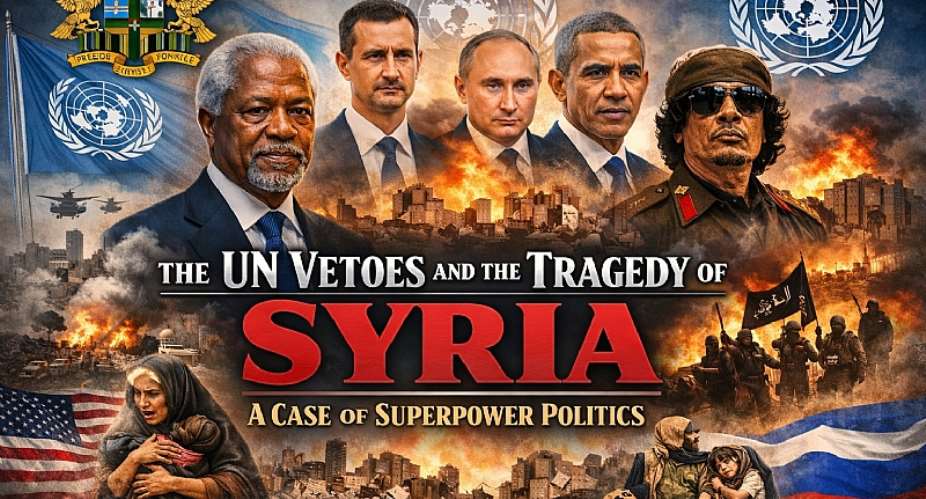
The early years of the 21st century have been marked by wars and interventions that reshaped entire regions, leaving behind instability and human suffering. The Syrian Civil War, which erupted in 2011, and the NATO-led intervention in Libya the same year, stand as stark examples of how global powers, through vetoes, preconditions, and military actions, have perpetuated chaos rather than peace. For Ghanaians and the international community, these events are not distant tragedies—they are lessons in the dangers of unchecked geopolitical rivalry and the arrogance of nations that claim to police the world.
The Kofi Annan Six-Point Peace Plan for Syria (2012)
Proposed by UN-Arab League envoy Kofi Annan in March 2012.
Called for an immediate ceasefire, humanitarian access, and a Syrian-led political transition.
Initially endorsed by the UN Security Council.
Collapsed due to disagreements: critics like Jeffrey Sachs argue the U.S. blocked progress by insisting Assad step down immediately; Western diplomats counter that Russia’s repeated vetoes shielded Assad.
Timeline of UN Vetoes on Syria
October 2011: Russia and China vetoed condemnation of Assad’s crackdown.
February 2012: Russia and China vetoed Arab League plan for Assad to step down.
July 2012: Russia and China vetoed sanctions resolution.
May 2014: Russia and China vetoed referral of Syria to the International Criminal Court.
October 2016: Russia vetoed resolution demanding end to Aleppo airstrikes.
December 2016: Russia vetoed resolution for a seven-day ceasefire in Aleppo.
April 2017: Russia vetoed resolution condemning chemical weapons use in Khan Sheikhoun.
November 2017: Russia vetoed resolution to extend chemical weapons investigations.
April 2018: Russia vetoed resolution establishing new inquiry into chemical weapon attacks.
(Russia has used its veto power 17 times on Syria-related resolutions, often joined by China, blocking international consensus.)
Human Cost of Syria
Over 500,000 deaths since 2011.
More than 12 million Syrians displaced, creating one of the largest refugee crises in modern history.
Libya: The NATO Intervention and Its Aftermath
In March 2011, NATO launched airstrikes under the guise of protecting civilians during Libya’s uprising.
Colonel Muammar Gaddafi was killed in October 2011, ending his four-decade rule.
The intervention, hailed as a success by Western powers, left Libya fractured, with rival militias, jihadist groups, and foreign mercenaries vying for control.
The collapse of Libyan state institutions created a breeding ground for terrorism, arms smuggling, and human trafficking across North Africa and the Sahel.
Alternative Perspectives
Critics argue the U.S. and NATO interventions in Syria and Libya undermined regional stability and blocked diplomatic solutions.
Western diplomats maintain Russia’s vetoes and Assad’s refusal to halt military offensives were the primary obstacles.
The collapse of the Annan peace plan, the repeated use of vetoes in the UN Security Council, and the invasion of Libya reveal a disturbing pattern: global powers prioritize dominance over diplomacy. The killing of Colonel Gaddafi, far from bringing peace, became the icing on the cake—unleashing unending instability, jihadist insurgencies, and terror attacks across Africa and the Middle East. The Syrian tragedy and Libyan chaos underscore a broader question: why has America arrogated to itself the role of the world’s police, intervening in Iraq, Afghanistan, and Iran, often leaving mayhem and instability in its wake? For Ghanaians and the international community, this is a call to demand a fairer, more accountable global order that values peace over power.
Final Appeal for Global Peace
The world yearns for peace, not domination. The time has come for the United States of America to heed the cries of humanity and withdraw from the practice of political interference that has destabilized nations from Iraq to Libya, from Afghanistan to Syria. True leadership lies not in coercion but in cooperation; not in bombs but in dialogue. Let America lead by example—by respecting sovereignty, fostering diplomacy, and allowing the world to heal from decades of imposed wars and engineered chaos. Only then can the promise of peace become reality for all nations.
✍️ Retired Senior Citizen
For and on behalf of all Senior Citizens of the Republic of Ghana 🇬🇭
Teshie-Nungua
[email protected]

 Assemblyman raises alarm over alleged illegal ECG charges in Ho
 GIS defends Asikuma–Sogakope checkpoints, cites security and border management
 Dr. Zenator Rawlings elected 2nd Vice President of Pan African Parliament
 Fake online businesses dupe victims of GHS266k between January and April — CSA
 BoG's 2025 spending was necessary in saving a near collapse economy — Majority
 Ghanaians need solution to the current dumsor, not your excuses — Oforikrom MP t...
 NACOC intercepts GHS5million tablets of Tapentadol in major drug bust
 Oti Region: Police arrest two over alleged illegal possession of firearm
 Victor Smith engages Boeing on rebirth of Ghana Airways
 We were told dumsor would end with the levy – Dr Zaato fumes


