




From the Inside
A homegrown Nigerian defence-tech startup is building drones, robots, and autonomous systems to protect the continent's critical infrastructure and the world is paying attention
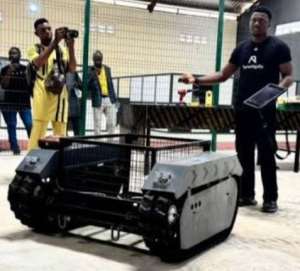
Inside a factory in Idu, an industrial district about 16 kilometers from central Abuja, a masked engineer welds steel onto an armored robot. A few meters away, young technicians carefully package drones for delivery to customers across Nigeria and beyond. The scene looks like something out of Silicon Valley except it is unambiguously, defiantly African.
This is Terra Industries. And it may be one of the most consequential startups on the continent.
A Company Born Out of Necessity
Terra Industries was founded in 2024 by two exceptionally young Nigerians: Nathan Nwachuku, now 22, who serves as Chief Executive Officer, and Maxwell Maduka, 24, the company's Chief Technology Officer. Their starting point was not a market opportunity identified in a spreadsheet. It was a problem they had lived with their entire lives.
Africa, Nwachuku has said, is on the edge of an industrial revolution. The continent is urbanizing, industrializing, and attracting investment at a pace not seen in decades. Young populations, vast critical mineral reserves, and annual infrastructure investment approaching $100 billion make the case for optimism almost irresistible.
"At the same time," Nwachuku told TechCrunch at the company's public launch, "the continent still struggled to address what was one of its biggest Achilles' heels: terrorism and insecurity." He was not overstating it. Africa records more terror-related deaths than any other region in the world. In Nigeria alone, the security landscape is a compound crisis Boko Haram remnants in the northeast, banditry and kidnapping across the northwest and north-central belt, separatist agitation in the southeast, and a fragile oil region in the south. Each of these theatres drains resources, discourages foreign investment, and costs lives.
Terra's thesis is straightforward: Africa's problem is not a lack of weapons. It is a lack of sovereign intelligence. The continent's governments have long depended on surveillance technology and intelligence supplied by foreign powers China, Russia, the United States, and India creating a dangerous dependency that compromises data security and reduces strategic autonomy. Terra intends to change that.
What Terra Actually Builds
Terra's product line is deliberately multi-domain, designed to monitor threats from the air, on the ground, and eventually at sea.
In the air, the company manufactures long-range and short-range drones, including the Archer, a vertical take-off and landing (VTOL) drone built for extended surveillance missions at critical sites such as mines and oil pipelines. On the ground, it deploys autonomous sentry towers including a system called Kallon capable of identifying, detecting, and tracking threats up to three kilometers away, running 24 hours a day on solar power with 360-degree pan-tilt-zoom coverage. The company also produces unmanned ground vehicles, effectively robotic sentinels that patrol perimeters without putting human security personnel in harm's way.
Underpinning all of these systems is ArtemisOS, Terra's proprietary software platform. ArtemisOS aggregates data from every deployed system in real time, applies AI-driven analysis to identify potential threats, and immediately alerts response forces when action is needed. The goal, as Nwachuku has put it, is to "geofence all of Africa's critical infrastructure and resources" creating a persistent, intelligent security layer over the continent's most vital assets.
Already Protecting Billions in Assets
Terra has not been waiting for funding to start working. By the time the company officially launched publicly in January 2026, it was already protecting infrastructure assets valued at an estimated $11 billion. Current deployments include the Geometric Power Plant in Aba, two hydropower plants in northern Nigeria, and gold and lithium mining operations across Nigeria and Ghana. The company is now rapidly expanding into counterterrorism and border security more complex, higher-stakes terrain.
About 40 per cent of Terra's engineering team are veterans of the Nigerian military. Maduka himself is a former Nigerian Navy UAV engineer who founded a drone company at the age of 19, which was later acquired by an automotive manufacturer. The company's leadership, in short, combines elite technical expertise with direct operational experience of the security environment they are trying to transform.
$34 Million and Counting
The investment world has taken notice. In January 2026, Terra emerged from stealth with the announcement of an $11.75 million seed round led by Silicon Valley venture firm 8VC the firm co-founded by Palantir's Joe Lonsdale. The round drew participation from Valour Equity Partners, Lux Capital, SV Angel, Nova Global, and a range of African investors. Alex Moore, a defence partner at 8VC and board director at Palantir, joined Terra's board.
The momentum did not slow. Less than six weeks later, Terra announced a further $22 million extension, bringing its total seed raise to $34 million closed, remarkably, in under a fortnight. The company's valuation has entered the nine-figure range.
"We believe in a future where local defense technology prevails, because security is the prerequisite for all economic growth," said Brandon Reeves, partner at Lux Capital, in a statement accompanying the second raise. It is a sentiment that captures exactly what Terra represents: not charity, not foreign aid, not yet another externally-designed intervention but an African company building African solutions to African problems, funded on terms that reflect real commercial confidence.
Nwachuku has confirmed that a Series A is on the horizon, and has described it as "a big one."
The Bigger Picture
Terra's ambitions extend well beyond Nigeria. The company has sealed a landmark agreement with DICON (the Defence Industries Corporation of Nigeria) and is expanding into Saudi Arabia. Plans are underway to open Africa's largest drone factory in Ghana, which Terra says will produce up to 50,000 aerial systems by 2028. Software offices are being established in San Francisco and London, while manufacturing remains firmly rooted on the African continent a deliberate choice that Nwachuku frames as a matter of principle: job creation and industrial sovereignty must go hand in hand.
The broader geopolitical context adds another layer of urgency. The Trump administration in Washington has been increasingly focused on Nigeria's security situation, particularly the wave of kidnappings affecting rural communities. US investment in drone technology for African security partners is growing, with experts noting that autonomous systems are becoming central to American security partnerships precisely because they reduce the need for a physical US military footprint.
But Terra's founders are clear that they are not building a company for American interests. They are building it for Africa.
"It's clear Africa today is undergoing what I see as an epic struggle for its very survival," Nwachuku has said. "The only way for us to truly break ourselves from the shackles that have held us back for the last decade or two is ensuring the core resources, the core infrastructures of the continent, are entirely protected."
A New Kind of African Institution
Terra Industries is something genuinely new: an African defence prime, vertically integrated, manufacturing on the continent, staffed largely by veterans of African armed forces, and answerable primarily to African governments and African communities. It challenges the long-standing assumption that serious defence technology must come from abroad.
Nigeria's security crisis is not going to be solved by any single company. The structural drivers poverty, ethnic tension, historical grievances, political marginalization require political solutions that go far beyond drones and surveillance towers. But Terra's proposition is not to replace governance. It is to give governments and infrastructure operators the technological tools to hold the line while those deeper solutions are pursued.
In Abuja's Idu industrial district, the welding continues. The drones are being boxed and shipped. A 22-year-old CEO is planning a Series A that could dwarf everything that came before it.
Africa is building its own shield. And it is being built by Africans.
Mustapha Bature Sallama.
Medical/ Science Communicator,
Private Investigator, Criminal investigation and Intelligence Analysis.
International Conflict Management and Peace Building.USIP
[email protected]
+233-555-275-880


 Ayitey Powers arrested over alleged death threat against Yaw Ampofo Ankrah
 It lies with Sammy Gyamfi to prove his extortion allegation against Afenyo-Marki...
 ‘I’m ready to submit myself for investigation into Sammy Gyamfi extortion allega...
 Osahen Afenyo-Markin sues Sammy Gyamfi, others over extortion allegation
 CID yet to submit report on alleged assassination attempts on Kissi Agyebeng – M...
 NDC’s ‘love’ will soon end as Ghanaians demand results — Bryan Acheampong
 Court adjourns Tuba murder case to September 28 as Police prepare to forward doc...
 Mother seeks justice after four daughters allegedly abused by father at Gomoa Do...
 Muntaka reveals how prime suspect in 2024 Tolon election violence wins NPP const...
 'I have not landed GoldBod contract to provide platform for buying and selling g...


Comments
An Igbo man brain, a rejected stone