




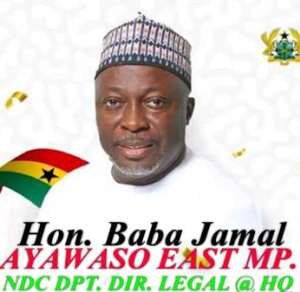
By Issaka Sannie, Zongo Caucus Coordinator, NDC UK & Ireland Chapter
London, United Kingdom
There is a building in London that Ghanaian politicians have been visiting for decades. Whether they come in the comfort of office or the uncertainty of opposition, they find their way to the Ghana Muslim Welfare Centre. Samia Nkrumah has been there. Akufo-Addo has called on the elders there. Bawumia has prayed and sought their blessing. The Chief Imam of Ghana has stood in that space and delivered sermons. Senior Nigerian Islamic scholars have visited. It is where Ghanaian political life acknowledges that something larger than power exists. The community calls it the Mecca of Ghanaian politicians in London, and the name has been earned.
On Tuesday April 21st, 2025, Honourable Baba Jamal, Member of Parliament for East Ayawaso constituency and a figure with a long record in Ghanaian public life, added his name to that list. He came to London with a schedule that left little room. Party obligations, family commitments, and the demands that follow any senior official travelling abroad had already claimed much of his time. Nonetheless, he cherished the Zongo community enough and translated that into a well-deserved visit.
The community elders led by Alhaji Baban Yara Haidara received him as all distinguished visitors are received: with the generosity that defines this community and the seriousness that comes from knowing who they are. These are men and women who built something permanent in a country that was not their birthplace, who kept Ghanaian Zongo identity alive through decades of migration and change, and who have counselled politicians from every party without owing loyalty to any of them. Their presence at the gathering on a working day was itself a statement.
Baba Jamal opened by acknowledging exactly that. He expressed appreciation for the reception, noted that the elders had sacrificed productive hours to host him, and then moved without delay into the substance of why he had come: to speak honestly about conditions at home and to listen.
On the economy, he reported that the currency has stabilised since the NDC took office, and that this stabilisation is working through the system in practical ways. Businesses can plan when they know what the cedi will be worth tomorrow. Procurement decisions become possible when exchange rates do not swing unpredictably. He stated that prices of goods have seen some reduction while wages have been retained, an improvement in purchasing power that he said is being felt by ordinary Ghanaians. These are contested political claims in any environment, and the community will draw its own conclusions from what it observes when members travel home. What was notable was the directness with which he presented them.
On accountability for the previous administration, he was careful. The room wanted to hear that people responsible for what many see as the plunder of the state will face consequences. Baba Jamal said they will, but he asked for patience with a judicial process that must, by its own logic, establish guilt before imposing punishment. Deprivation of liberty, he said, is not something to be rushed. That is not the answer the audience wanted, but it was an honest one, and the elders receive honesty well.
He outlined the Big Push infrastructure project, which targets a reduction of the Accra-Kumasi travel corridor to just over two hours, with consequences for commerce, access to raw materials, and the movement of services across the country's two largest cities. He pointed to improvements in educational performance as evidence that governance quality has shifted since the last election, framing it as a before-and-after comparison that he believes the data supports.
His account of why he returned from an ambassadorial posting to contest a parliamentary seat was the part of the afternoon that stayed with me longest. He described a constituency with profound challenges and a concrete plan to address them: interest-free loans drawn from his own capital that have already supported hundreds of women in business; free legal assistance for citizens who cannot claim retirement benefits they are owed; and a data-mapping initiative that will document every household in East Ayawaso, identify points of need, rank them by severity, and direct resources accordingly. These are not policy promises. They are programmes already running.
The conversation turned to an issue that the Zongo community in Ghana carries silently and that Baba Jamal has decided to carry publicly. When census officials and government representatives collect data in Zongo communities, they encounter a problem of their own making. A man born in Nima, whose parents were born in Nima, whose grandparents settled in Nima before Ghanaian independence, answers questions about his hometown and his origins by naming Nima. Officials, trained to expect a village or a region somewhere else in the country, do not know how to record that answer. Some Zongo people, caught in a bureaucratic logic that does not recognise their history, end up recorded as nationals of other West African countries. The friction this causes when accessing public services is real and cumulative. Baba Jamal said he intends to make this a national campaign for civic education and administrative reform. It is work that is long overdue.
There was not enough time to address everything. The question of a diaspora quota for Ghanaian Muslims wishing to join the national Hajj contingent deserves a proper hearing. So does the need for closer High Commission engagement with the difficulties our people face in accessing consular services. Those conversations will need to continue.
The community imam, Mallam Abul Razak, closed the gathering with a prayer that named what leadership demands guidance, wisdom, and resilience, yes, but also accountability in this life and the next. The weight of public office, the imam reminded everyone present, does not end when the term does.
Baba Jamal acknowledged the warmth he had received, committed to maintaining the connection, and left for Birmingham, where another Zongo community was waiting to receive him.
What struck me, as someone who has been part of this community's work for over two decades, was the quality of the exchange. A senior politician came to listen as much as to speak. Elders engaged as equals, not supplicants. Issues were raised that go beyond party politics into the basic recognition of who Zongo people are and what they have built, in Ghana and here. That is what good engagement between leadership and community is supposed to look like.

 Obuasi SHTS alleged sexual abuse: Kwasi Kwarteng criticises Education Minister o...
 ECOWAS’ $250,000 flood relief donation arrives in Ghana – Ablakwa
 Kennedy Agyapong has not resigned from NPP – Kwasi Kwarteng
 State failure, not GoldBod, driving galamsey – Daryl Bosu
 A Rocha Ghana raises alarm over human rights abuses in mining communities
 ECOWAS, AfDB discuss ways to advance West Africa’s development priorities
 October 16: Cedi gains against dollar, sells at GHS12.25 on forex market, GHS11....
 Galamsey: Ghana’s rivers now run chocolate and milk colour — Sam Jonah
 A nation of job-seekers will always be poor — Sir Sam Jonah
 “If you attack us with pepper spray, we’ll fight back” — NDC Yakubu Tony Aidoo w...



Comments
What a load of nonsense.