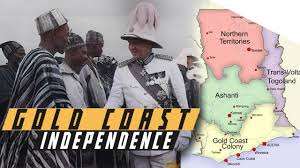
When we teach our children that Ghana gained independence on March 6, 1957, we tell a proud story. But we rarely tell the full one. We speak as if one unified country rose under one flag, marched behind one leader, and stepped confidently into nationhood. That is not what happened. What became Ghana was a carefully assembled colonial construct, built over decades, for imperial convenience, out of four very different territories: The Gold Coast Colony (1874); Ashanti (1901); Northern Territories Protectorate (1902); and Trans-Volta Togoland (1919). They were not equal in status. They were not equal in development. They were not equal in opportunity. And when independence came, they were merged into a single state --- politically united, economically uneven. To understand modern Ghana, particularly persistent regional disparities, we must confront an uncomfortable truth. Ghana was born unequal by deliberate colonial design.
The Gold Coast Colony (1874): The Revenue Engine
In 1874, following British victory in the Third Anglo-Asante War, Britain formally established the Gold Coast Colony. This was a Crown Colony, fully annexed and legally part of the British Empire. It mattered enormously. Because where Britain saw revenue potential, Britain invested. The coastal areas had established Atlantic trade networks, access to shipping, European merchant presence, early missionary penetration, and agricultural potential. By the early 20th century, cocoa transformed the colony into the world’s leading producer. Railways were constructed linking Accra to Kumasi and Sekondi to Tarkwa. Takoradi Harbour opened in 1928. Elite educational institutions emerged, including Mfantsipim School and Achimota School. An African intelligentsia developed --- lawyers, journalists, clergy, and civil servants. These were the early nationalists. The Gold Coast Colony became Britain’s model West African possession. Investment followed profit.
Ashanti (1901): Conquered but Strategically Developed
The Asante Empire was not easily subdued. After the War of the Golden Stool (1900) and the exile of Prempeh I, Ashanti was annexed in 1901 and declared a Crown Colony. The British understood that Ashanti could not be treated casually. It had a centralized monarchy, administrative sophistication, strong military tradition, and deep cultural cohesion. The British ruled indirectly but cautiously. Once rail infrastructure connected Kumasi to the coast, cocoa farming expanded rapidly. Ashanti became economically vital. Development here was not generosity. It was economic rationality. Where returns were guaranteed, roads and rails followed.
Northern Territories Protectorate (1902): Underdevelopment by Policy
Now we must confront the most sensitive chapter. In 1902, the Northern Territories were declared a British Protectorate. Not a colony, but a protectorate. That distinction was not symbolic. It shaped destiny.
Colony vs Protectorate --- Why It Mattered
- A Crown Colony was legally British territory. It justified infrastructure investment and integration into imperial systems.
- A Protectorate was administered indirectly, cheaply, and without the same obligations.
The Northern Territories was governed for stability, not prosperity. Colonial memoranda reveal the logic clearly. The North was not viewed as revenue-generating. It lacked export agriculture, significant mineral extraction at the time, and had dense missionary educational networks. But it possessed one crucial asset. Labour was in abundance. Young men --- Dagomba, Mamprusi, Gonja, Frafra and other communities migrated seasonally the south to work on cocoa farms, gold mines, and railway construction sites. Historians describe this as the creation of a “labour reserve.” Colonial authorities deliberately limited educational expansion in the North, fearing that higher literacy and local economic growth would reduce labour migration southward. Infrastructure investment remained minimal. Few secondary schools existed for decades. Medical facilities were sparse. Industrial development was negligible. This was not oversight. It was strategy. Underdevelopment was engineered.
Trans-Volta Togoland (1919): The Mandate Territory
Following Germany’s defeat in World War I, German Togoland was divided. The western section was placed under British administration as a League of Nations Mandate. Trans-Volta Togoland was neither colony nor protectorate. It was an international trust territory. Its future had to be decided by plebiscite. In 1956, under United Nations supervision, its residents voted to integrate with the Gold Coast rather than join French Togoland. That vote permanently shaped Ghana’s eastern boundary. But like the Northern Territories, this region did not enjoy the same depth of early infrastructure as the core colony.
The Structural Imbalance Before 1957
By the 1940s, disparities were entrenched. The South possessed rail networks, ports, secondary schools, teacher training colleges, a professional class, and commercial agriculture. The North possessed administrative stations, basic primary education, and seasonal labour migration. Revenue generated in the South often funded administration in the North. But reinvestment was not proportional. The British invested where profits flowed. Governance was structured around extraction. Balanced development was not an imperial priority.
Late Colonial “Correction” --- Too Little, Too Late
After World War II, Britain introduced development plans for the North under the Colonial Development and Welfare Acts. Road construction increased. Agricultural extension programs expanded. Tamale was strengthened as an administrative hub. But these interventions were modest compared to decades of southern advancement. By independence, the developmental gap was deep and structural.
Should Independence Have Been Simultaneous?
This question makes many uncomfortable. In 1957, all four territories became independent together as Ghana under Kwame Nkrumah. But were they equally prepared? Educationally --- No. Economically --- No. Administratively --- Not equally. Some historians argue that staggered integration might have allowed targeted catch-up development. But such a move could have fragmented nationalist momentum, encouraged separatist pressures, and created multiple fragile states. Northern leaders voted in 1956 to join independence. Unity was chosen. But it was a political decision layered upon economic inequality.
Comparative Perspective: Ghana Was Not Alone
Ghana’s experience was not unique. In Nigeria, the British similarly developed the South (especially Lagos and the cocoa belt) more aggressively than the Northern Protectorate. In Kenya, settler areas received disproportionate infrastructure compared to African reserves. Colonial governance across Africa followed a pattern: Invest where returns are high. Extract where labour is available. Stabilize where resistance is possible. Equity was not part of the equation.
The Present-Day Echo
Nearly seventy years later, regional disparities persist. Northern Ghana continues to face higher poverty rates, limited industrialization, migration pressures, and infrastructure gaps. But we must confront another hard truth. Colonialism explains origin. It does not excuse permanence. Ghana has been governed by Ghanaians since 1957. Post-independence governments have had decades to recalibrate investment. There has been progress. Universities in Tamale, Navrongo, Bolgatanga and Wa. Expansion of road networks. Electrification. Decentralization. Social intervention programs. Yet the structural imbalance remains visible. Why? Because correcting historical inequality requires sustained, intentional redistribution, not sporadic projects.
The Dangerous Temptation
There is a temptation to weaponize history, and to inflame regional resentment. That would be disastrous. Understanding colonial architecture is not about reopening wounds. It is about designing better policy. We must ask: are current budget allocations need-sensitive? Is infrastructure expansion correcting historical neglect? Is educational investment targeted where it was historically weakest? Are we building industries in labour-supplying regions to break migratory dependency? History should inform planning. Not divide citizens.
The Responsibility Has Shifted
The British designed unequal foundations. But they departed in 1957. Responsibility now rests with Ghanaian leadership, past and present. If disparities persist after seven decades of self-rule, we must interrogate policy priorities, resource allocation formulas, political incentives, governance accountability, and colonialism planted inequality. Governance determines whether it continues.
My Thoughts: A Final Word to the Youth
When you hear Gold Coast, Ashanti, Northern Territories, and Trans-Volta Togoland, understand that these were not mere names. They were administrative categories. They were economic strategies. They were instruments of imperial design. Ghana was assembled from territories intended for different purposes. Our unity was an achievement. Our equality remains unfinished. History does not imprison us. But ignorance of history ensures repetition. Ghana was born unequal. The challenge before this generation is simple. Will we continue managing inequality, or will we finally design a republic that corrects it? That is the real independence struggle.
FUSEINI ABDULAI BRAIMAH
+233208282575 / +233550558008
[email protected]

 AG withdraws charges against former buffer stock CEO Hanan and wife as EOCO re-a...
 Images and videos of military clearing lands for Accra–Kumasi expressway project
 What should give you satisfaction is that your work has helped saved Ghana from ...
 ECG announces emergency maintenance in Ashanti, Western Regions today
 Police arrest two cocoa purchasing clerks for allegedly short-changing farmers i...
 Korle-Bu doctors strike suspended, OPD services resume Tuesday
 May 5: Cedi sells at GHS12.15 on forex market, drops to GHS11.23 on BoG interban...
 NAiMOS cracks down on multinational galamsey syndicate in Mankraso
 Amin Adam runs to IMF to take action on BoG recapitalisation, gold sales and mon...
 PNDC era second gravest crime against humanity after slavery — Miracles Aboagye