




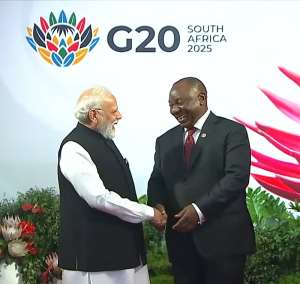
South Africa’s assumption of the G20 presidency in 2025 marks a historic inflexion point for both Africa and the broader Global South. As the first African country to host a G20 Leaders’ Summit—and the final link in the unprecedented four-year Global South Troika of Indonesia, India, Brazil, and South Africa—the role carries both symbolic weight and immense responsibility. This moment offers an opportunity not only to amplify African priorities but also to consolidate the developmental agenda advanced by India during its influential 2023 presidency.
In many ways, India’s experience offers South Africa a strategic blueprint for navigating geopolitical tensions, crafting inclusive development solutions, and enhancing the relevance of the G20 as a premier forum for global governance.
From India’s Vasudhaiva Kutumbakam to South Africa’s Ubuntu Diplomacy
India’s G20 presidency was anchored in the philosophy of Vasudhaiva Kutumbakam—“the world is one family.” South Africa enters with the African moral worldview of Ubuntu, a parallel ethos of shared humanity, interdependence, and collective wellbeing. These normative frameworks are not mere slogans; they provide an ethical foundation for coalition-building among a diverse membership grappling with mistrust and fragmentation. India demonstrated how value-driven diplomacy can bridge divides: the unanimous adoption of the New Delhi Leaders’ Declaration, despite deep splits over geopolitical conflicts, reflected strategic patience, consensus-building, and empathic leadership.
South Africa inherits this approach at a far more volatile moment. With conflicts such as the Russia–Ukraine war and the Gaza crisis polarising global politics—and with the announced boycott of the 2025 summit by the President of the United States—South Africa will need to lean on the same moral framing India employed. Ubuntu diplomacy, much like India’s inclusive ethos, can help shift conversations toward cooperation, shared risks, and collective gains at a time when multilateralism is under acute strain.
Building on India’s Structural Achievements
India’s presidency produced several structural outcomes that now form the scaffolding upon which South Africa can build.
- Permanent membership of the African Union (AU) in the G20
India championed Africa’s representation at the global high table, ensuring the AU’s permanent seat. South Africa can now translate this symbolic milestone into substantive influence by positioning the AU as an active contributor to all G20 tracks, particularly in areas such as development, climate change, and digital governance.
- The rise of Digital Public Infrastructure (DPI) as a global public good
India globalised its domestic success with Aadhaar, UPI, and CoWIN, turning DPI into a central plank of the G20 agenda. South Africa can leverage this momentum by adapting the DPI model to African needs—expanding financial inclusion, enabling social protection delivery, and strengthening public health systems. South Africa can also showcase Africa’s emerging innovations, such as mobile money ecosystems and regulatory sandboxes.
- Voice of the Global South institutionalisation.
India’s Voice of the Global South Summit brought over 125 developing countries into the G20 conversation. South Africa can sustain this by creating a G20–Africa consultative forum or an annual Global South Development Dialogue that channels developing-country perspectives directly into G20 working groups.
Advancing South Africa’s Priorities with Indian Lessons
South Africa’s 2025 agenda focuses on addressing inequality, ensuring food security, governing AI, managing critical minerals, and promoting debt sustainability. In each area, lessons from India’s presidency are relevant.
Tackling inequality with coalitions and evidence.
India used data-driven coalitions—such as Global Biofuels Alliance and disaster-resilient infrastructure partnerships—to build critical mass. South Africa’s proposal for a permanent global panel on inequality can follow a similar model: mobilising think tanks, multilateral banks, and Global South ministries to create an evidence-based platform that endures beyond 2025.
Food security through resilience and innovation.
India’s focus on millets, climate-resilient agriculture, and global food system reform has shown how local innovations can spur a global impact. South Africa can promote drought-resistant crops, indigenous African farming systems, and new agri-technology collaborations, positioning Africa as a hub of future food solutions.
AI governance through inclusive norm-setting.
India steered global debates toward open access, safety, and equity in digital technologies. South Africa can extend this to AI governance by advocating for global standards that prevent digital dependency, ensure fair data flows, and promote AI designed for developmental objectives.
Green transitions and critical minerals.
India’s experience in solar alliances, clean tech diffusion, and climate finance mobilisation can help South Africa lead a minerals-for-development agenda. South Africa can promote beneficiation, regional value chains, and technology partnerships that prevent Africa from remaining a raw-material exporter.
Debt sustainability through practical reforms.
India worked relentlessly to revive discussions on reforming global financial institutions and improving liquidity support for developing economies. South Africa can further push this forward—strengthening the G20’s Common Framework, creating flexible restructuring tools, and elevating the findings from the African Panel on Debt to influence G20 finance tracks.
Using the G20 Troika for Stability and Continuity
The Global South Troika—Indonesia, India, Brazil, and now South Africa—has ensured unprecedented continuity in promoting Southern priorities. India’s success in maintaining consensus despite geopolitical fractures offers South Africa a playbook for its own diplomatic negotiations. The Troika can serve as a stabilising force, backing South Africa on agenda-setting, climate finance debates, and negotiations over debt and digital governance.
Conclusion
South Africa’s G20 presidency is not just a national milestone; it is a continental and civilisational moment. By inheriting the baton from India, South Africa stands at the intersection of symbolism and substance—tasked with elevating Africa’s voice while safeguarding the G20’s legitimacy amid global discord. India’s experience provides essential diplomatic, institutional, and technological lessons that can guide South Africa in delivering an inclusive, solutions-driven, and resilient presidency. If leveraged effectively, South Africa’s G20 leadership may reshape global governance by demonstrating that the future of multilateralism lies not in exclusion but in collective humanity—from Vasudhaiva Kutumbakam to Ubuntu.
[1] Dr Samir Bhattacharya is an Associate Fellow at Observer Research Foundation, India


 1,568 new lawyers must use law to advance justice — Chief Justice
 GH¢800,000 worth of goods lost in Kia Rhino truck fire at Amanfrom
 I never said Ghana has more nurses than it needs — Akandoh
 I have tried reaching Boakye Agyarko after NPP chairmanship race, but to no avai...
 Ghana’s Corporate Illusion: Why We Celebrate Professional Titles More Than Natio...
 Sam George, Armah-Kofi Buah, Phyllis Naa Koryoo and OPK among 1,568 lawyers call...
 Visa scandal: 'Ampofo Ankrah’s suspension not enough; Kofi Adams must also step ...
 'Let integrity, discipline guide your conduct' — Samson Lardi tells new lawyers
 Labour Minister optimistic teachers will suspend strike by close of day
 Dr Ato Forson urges MMDCEs to eliminate waste in public spending


