




Abstract
This creative–critical essay examines my poem Invisible Ink as both a lyrical artefact and a mode of inquiry into the hidden dimensions of pain, resilience and self-disclosure. Through a close, line-by-line analysis, the essay traces how the poem renders suffering as a private script inscribed beneath the surface of daily life, visible only under the pressures that bring it temporarily to light. The work explores how pain acquires its own language, how that language remains largely unread by the outside world and how poetry becomes a medium through which the invisible finds form and voice. Drawing on the poem’s recurring metaphors of ink, script and narrative, the essay considers how writing transforms silence into articulation, secrecy into recognition and endurance into authorship. The poem becomes a reflective terrain where the concealed interior life enters relation with the world beyond it. Through narrative interludes, thematic synthesis and extended reflection, the essay argues that invisibility is not simply absence but a complex state of partial legibility in which pain marks the self even when the world cannot see it. Invisible Ink ultimately proposes that writing is both witness and intervention, allowing the hidden script of suffering to become a declaration of presence, agency and renewal.
Introduction: Writing What Cannot Be Seen
There are forms of suffering that do not announce themselves. They move quietly beneath the surface of ordinary days, leaving marks that do not bruise the skin but inscribe the interior. Such pain does not demand attention. It learns to fold itself into the margins of a life, concealed behind composure, competence or the simple mechanics of getting through the day. Its presence is steady yet discreet. It occupies space without occupying view.
Invisible Ink emerged from this territory. It was written during a period when pain did not erupt but accumulated, a private weight carried without spectacle. I found myself living in two temporalities: the outward surface of daily function and the inward script of discomfort that no one else could read. This doubleness created a tension I could not articulate directly. The poem became the first place where that tension found language.
Writing Invisible Ink was not an attempt to confess or to explain. It was an attempt to recognise. I sensed that the pain I carried had become a kind of secret text, one that shifted in intensity, flared under pressure and faded when others looked. It was not invisible because it was absent, but because it existed in a register the world was not attuned to. The poem provided a medium through which that hidden register could be traced.
This essay returns to the poem with a dual awareness. As the poet, I remain close to the emotional impulses that shaped its images. As a reflective observer, I now see how the poem constructs a conceptual architecture for understanding pain not as spectacle but as inscription. The poem imagines suffering as a script written on and through the body, legible only from within. It also suggests that writing becomes the means by which that script slowly enters the light.
Rather than treating invisibility as emptiness, the poem frames it as a condition of partial revelation. Pain flickers, appears, withdraws. It is momentary illumination rather than constant display. The poem moves within this rhythm, exploring how the self learns to live with what remains unseen, how resilience forms without recognition and how language can begin to reveal what the world has not witnessed.
This introduction sets the stage for a deeper inquiry. Through the close reading that follows, the poem will unfold as both document and dialogue, revealing the quiet labour of living with an ink that marks even when it does not show.
Method: Reading the Unseen
To analyse Invisible Ink, I adopt a reflective stance that acknowledges both proximity and distance. Proximity allows me to recognise the emotional textures that shaped the poem’s imagery. Distance allows me to observe its structure, rhythms and underlying propositions without collapsing into autobiography. This essay is therefore neither personal confession nor detached commentary. It is a conversation between the poem and the consciousness that revisits it.
The method begins with close reading. Each line is treated as a deliberate gesture, revealing how the poem constructs pain as language, as narrative and as hidden script. Attention is paid to diction, rhythm, metaphor and tonal shifts, not to decode a message but to understand how the poem thinks and feels through its form.
The analysis is interwoven with narrative interludes that situate the poem’s concerns within lived experience. These moments do not explain the poem but illuminate the emotional conditions that informed it. They offer glimpses into the unseen margins where the poem first took shape.
The essay then expands to thematic synthesis, drawing together the poem’s central threads: invisibility, inscription, resilience and revelation. Extended reflections consider how hidden pain shapes identity and how writing becomes both witness and transformation.
Finally, meta-reflection examines the act of writing itself. It considers how composing the poem brought the invisible into relation with language and how that process changed the way I understood the quiet scripts of suffering.
This method is slow, attentive and patient. It mirrors the poem’s own movement, tracing the hidden until it becomes legible.
Line-by-Line Analysis
Stanza I
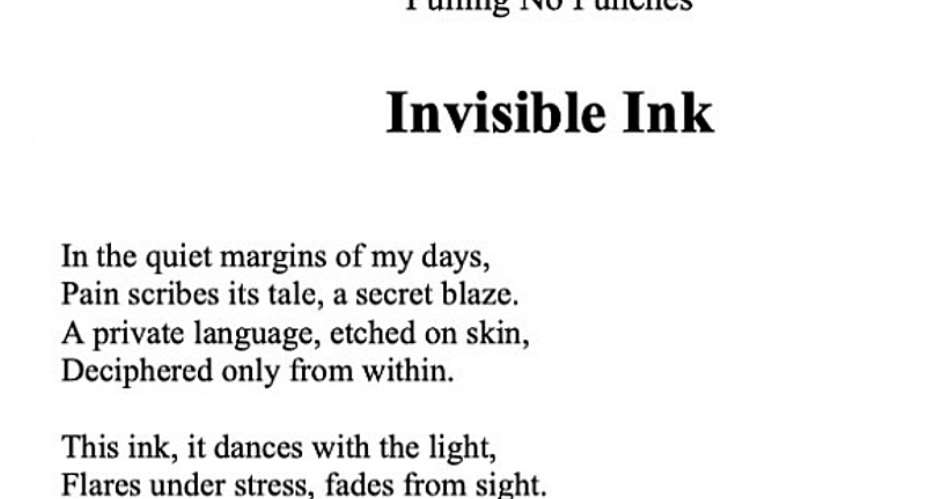
In the quiet margins of my days,
The poem opens not in the centre of life, but in its margins. Quiet margins evoke the edges of experience, the spaces overlooked by others. Pain begins here, not dramatically, but subtly. The line suggests that suffering first emerges in the intervals, the pauses, the unnoticed hours. It positions pain as peripheral yet persistent, shaping existence without overt declaration.
Pain scribes its tale, a secret blaze.
Here pain becomes a writer. Scribes implies deliberate marking, a record being kept. The tale is not spoken; it is written. Secret blaze introduces a paradox. Blaze suggests intensity, yet secret implies concealment. Pain burns, but it burns out of sight. The line frames suffering as both forceful and hidden, visible only to the self who bears it.
A private language, etched on skin,
Pain acquires linguistic form. It becomes a language, but a private one. Etched on skin suggests inscription, a mark that is both bodily and enduring. The poem implies that pain is not abstract. It is embodied, written into the very surface of being, even if others cannot read it. This marks the first appearance of pain as text.
Deciphered only from within.
The stanza closes by asserting that this script is illegible to outsiders. Deciphered only from within implies that understanding pain requires interior access. The self becomes both the page and the reader. This line establishes one of the poem’s central claims: suffering is often visible only to the one who lives it.
Stanza II
This ink, it dances with the light,
The poem shifts from inscription to movement. Ink, previously still and etched, now dances. This verb introduces dynamism, implying that pain is not fixed but responsive. Dancing with the light suggests interaction between visibility and concealment. Ink reacts to illumination, hinting that suffering sometimes reveals itself when conditions change. Light becomes a catalyst rather than a cure.
Flares under stress, fades from sight.
Here the poem articulates the fluctuating visibility of pain. Under pressure, pain flares, becoming momentarily vivid. When stress recedes, it fades again. This oscillation captures the lived reality of invisible suffering. It is not constant in its expression, though constant in its presence. Pain is rendered as episodic illumination, unpredictable yet patterned.
A script that yearns for knowing eyes,
Pain becomes a script with desire. It yearns to be witnessed, to be understood. This line acknowledges the emotional dimension of invisibility. Hidden suffering often longs for recognition, not for pity, but for validation. Knowing eyes implies a reader who sees beyond surface appearances, someone capable of interpreting the concealed text. The poem introduces a subtle ache for connection.
To read beyond the well-worn guise.
Guise evokes a mask, an outward persona maintained for others. Well-worn suggests habit, repetition and perhaps exhaustion. The line implies that the self has presented a familiar exterior for so long that it has become a kind of costume. To read beyond this guise is to penetrate the performance of normalcy. The poem invites the possibility of being seen without disguise, though it remains uncertain whether such seeing will occur.
Stanza III
The narrative begins, a whispered sigh,
The poem reframes pain as narrative. It begins, suggesting progression, structure and unfolding. Yet the beginning is quiet, marked by a whispered sigh. Pain does not erupt into narrative. It enters softly, almost imperceptibly. Whispered sigh conveys exhaustion and resignation, hinting that the story of suffering starts not with drama but with depletion.
Of weary limbs and dreams denied.
Here pain becomes bodily and aspirational. Weary limbs anchor suffering in physical fatigue, while dreams denied introduces emotional and existential loss. The line recognises that pain affects not only the body but the trajectory of a life. It speaks to deferred aspirations, postponed futures and the quiet erosion of possibility.
Each verse, a line of discomfort’s art,
Pain becomes art. The poem suggests that discomfort shapes expression, line by line. Verse as art implies that suffering, though unwanted, produces form. This is not romanticisation. It is recognition that pain leaves patterns, rhythms and marks that can be read. Discomfort’s art acknowledges that the poem itself emerges from pain’s shaping force.
Each rhyme, an echo of a burdened heart.
Rhyme becomes echo, reinforcing repetition. Burdened heart underscores emotional heaviness. The line suggests that even the poem’s musicality is shaped by weight. Echo implies that pain reverberates across time. It does not vanish. It returns, softened but present. The stanza positions poetry as a mode of echoing what cannot be spoken plainly.
Stanza IV
The plot grows thick with jargon’s weight,
Plot invokes narrative complexity, suggesting escalation. Jargon’s weight introduces the language of diagnosis, medicine or bureaucracy. Jargon is heavy, opaque and often distancing. Pain becomes entangled in external systems that name but do not necessarily understand. The line critiques the way institutional language can obscure lived experience.
Diagnoses clash, a strident spate.
Clash suggests conflict. Multiple diagnoses collide, creating confusion rather than clarity. Strident spate evokes noise, intensity and excess. The poem recognises the dissonance that arises when the medical or social interpretation of pain multiplies without resolving. The line underscores the alienation felt when one’s suffering is spoken about rather than spoken from.
Yet through the din, a refrain resounds,
Din continues the imagery of noise. The world’s interpretations are loud, intrusive and overwhelming. Yet introduces contrast, signalling emergence. A refrain resounds suggests a steady, recurring truth that persists beneath external noise. The poem locates resilience not in triumph but in persistence.
Of resilience, a strength that knows no bounds.
Here resilience becomes the steady refrain. Strength is not forceful; it is boundless endurance. The line reframes resilience as the capacity to continue, to bear, to remain. It responds to misdiagnosis, misunderstanding and external noise with quiet, limitless survival. The stanza offers the first clear affirmation within the poem, yet it remains subdued rather than celebratory.
Stanza V
In darkest stanzas, a chorus rings,
The poem turns inward again, invoking darkness. Darkest stanzas evoke both poetic structure and emotional descent. A stanza becomes a chamber of experience. A chorus rings suggests that even in darkness there is sound, resonance, a collective voice. Pain is not silent. It contains its own music, however muted or mournful. The line suggests that suffering, though isolating, is not devoid of expression.
Of days illumined by enduring wings.
Enduring wings introduces a surprising lift. Wings signify ascent, protection, or transcendence. Enduring suggests persistence rather than flight. Days illumined implies that even within darkness there are brief illuminations. The line balances heaviness with possibility. Wings do not erase suffering but accompany it, hinting at unseen supports.
A harmony of hope, a song of light,
Hope becomes audible. Harmony suggests alignment rather than dominance, indicating that hope does not overpower pain but moves alongside it. A song of light continues the musical imagery. Light becomes not just visual but sonic, implying that illumination has a rhythm that permeates the internal world. This line marks the poem’s gradual shift toward emergence.
Amidst the shadows of this silent fight.
Shadows return the poem to concealment. Silent fight captures the private nature of invisible pain. It names the struggle without spectacle, the battles waged internally and unseen. Amidst suggests coexistence: hope and shadow are not rivals but companions. The stanza recognises that resilience does not require visibility.
Stanza VI
As verses draw to their final close,
The poem approaches closure, acknowledging temporal movement. Verses draw suggests an active pulling together, as though the poem gathers its threads. Final close indicates an ending that brings reckoning rather than release. The poem signals readiness to reveal what has remained hidden.
The ink reveals its vibrant prose.
Ink, once invisible, now reveals. Vibrant prose contrasts with earlier invisibility. The pain that previously faded from sight becomes pronounced, colourful, alive. Prose suggests clarity. The poetic metaphor of invisible ink culminates in legibility. The poem reframes revelation as a moment of self-recognition rather than external validation.
A hue that glows with acceptance bright,
Hue introduces colour, marking a shift from monochrome suffering to chromatic affirmation. Acceptance bright aligns emotional acceptance with illumination. The glow implies warmth and visibility. Acceptance becomes radiant, reframing the relationship between the self and its pain. The line suggests that acceptance does not dull suffering but transforms its meaning.
No longer hidden from the world's sight.
This line marks a decisive turn toward visibility. Pain emerges from secrecy into shared space. No longer hidden suggests agency as well as inevitability. The poem recognises that self-disclosure can be both risk and liberation. The world’s sight implies external witness, yet the poem remains careful not to equate visibility with validation. The emphasis is on emergence rather than approval.
Stanza VII
The closing lines, a vow declared:
A vow introduces commitment. The poem transitions from description to assertion. Closing lines marks a ceremonial moment. Declared signals intention spoken aloud, breaking the silence that has shaped earlier stanzas. The vow prepares the reader for a redefinition of identity.
I am not the pain that I have beared.
This line separates identity from experience. I am not rejects conflation. Pain that I have beared acknowledges endurance while insisting that suffering does not define the self. The grammar’s slight roughness carries emotional authenticity. The line is an act of self-differentiation, a refusal to be reduced to what has wounded.
Not the ignorance that would efface,
Ignorance implies misunderstanding, dismissal or denial by others. Efface suggests erasure. This line rejects the gaze that fails to see or trivialises suffering. The poem claims agency against misrecognition, whether societal, medical or interpersonal. It asserts a right to exist beyond others’ limited readings.
The courage in my words, the truth I chase.
Courage becomes anchored in language. Words are framed as the vehicle of truth-seeking. Courage is not dramatic but persistent. Truth is not declared as possessed but chased, indicating an ongoing pursuit rather than final attainment. The line positions writing as both act and aspiration.
Stanza VIII
With every line, I write my way,
Writing becomes movement, direction and navigation. My way suggests authorship of one’s path. Each line of poetry becomes a step toward self-definition. The poem draws a direct connection between expression and agency.
From margins to the light of day.
Margins evoke exclusion, invisibility and peripheral existence. Light of day signifies full visibility, legitimacy and presence. The movement from margins to light is both literal and metaphorical. The poem names its own emergence, acknowledging the journey from hidden suffering to articulated identity.
My voice, my pen, my existence clear,
Clarity replaces concealment. Voice, pen and existence align. Expression becomes ontology. The line affirms that writing renders the self visible not only to others but to oneself. The repetition of my emphasises ownership and reclamation.
A poem of triumph, a life made dear.
Triumph is not conquest but valuation. A life made dear suggests self-worth restored. The poem recognises its role in affirming the preciousness of existence after invisibility. Triumph resides in articulation, not in victory over pain.
Stanza IX
No longer bound by invisibility's shroud,
Bound evokes captivity. Shroud suggests burial cloth, implying that invisibility mimics a kind of living death. No longer bound marks emancipation. The poem acknowledges the suffocating nature of concealment and celebrates release.
I stand, a storyteller, resilient and proud.
Standing signifies presence, stability and visibility. Storyteller reframes the self not as patient or sufferer but as narrator. Resilient and proud affirm dignity reclaimed. Pride here is not arrogance but recognition of survival.
My narrative, a beacon, a guiding star,
Narrative becomes illumination. Beacon and star suggest navigation, hope and orientation. The poem proposes that personal truth can serve as guidance for others who face similar invisibility. Narrative becomes communal resource.
For all who navigate pain’s hidden spar.
Pain’s hidden spar invokes a ship’s spar beneath deck, unseen but integral to structure. Hidden spar suggests unseen support and unseen struggle. Navigate reinforces the metaphor of journey. The poem positions itself as companion to others enduring silent battles.
Narrative Interlude: Writing in the Space of Silence
There are moments in a life when language falters, when the body speaks more clearly than the voice ever could. Long before Invisible Ink became a poem, it existed as sensation: a tightening in the chest, a heaviness in the limbs, the dull throb of a day carried rather than lived. There were no words for it then. Only a quiet pressure, like unwritten script waiting beneath the surface of the skin.
Silence became a companion. Not chosen, but learned. There is a particular discipline to living with pain that others cannot see. One learns to measure footsteps, to conserve expression, to smile as a kind of shield. The world rewards smooth surfaces. It does not ask for the rough text beneath. In those years, invisibility was not an idea. It was a condition. Pain was present, insistent, yet unnamed. I carried it the way one carries a secret inscription, knowing it is there, knowing it marks you, yet knowing it remains unread.
Writing began not as declaration but as necessity. A single line scribbled late at night. A phrase that trembled more than it settled. I did not think of poetry. I thought of survival. If I could capture a fragment of what pressed against my ribs, perhaps I could lessen its weight. The page became the first listener. The ink the first witness. Even then, I sensed that writing was not only expression, but translation: the attempt to render an internal burn into external form.
There was a strange comfort in the act. Words did not erase pain, but they shaped it. They gave contour to what had been amorphous. They allowed me to look at what I had only felt. In that shift from sensation to language, something changed. The silence loosened. The pain did not vanish, but it became legible, if only to me.
Yet even as the poem took shape, doubt lingered. Would anyone understand? Would anyone read beyond the well-worn guise of apparent strength? Could language truly hold what had lived so long in the margins? These questions shadowed the writing process. They reminded me that visibility is not simply an external condition. It is an internal permission. One must allow oneself to be seen before the world is capable of seeing.
The moment I wrote the line I am not the pain that I have beared felt like a hinge. It was not triumph. It was recognition. Pain had shaped me, but it was not the sum of me. I realised that writing was not merely documenting suffering. It was separating identity from affliction. It was the quiet work of reclaiming the self from the script pain had tried to author in silence.
When the poem finally arrived in its full form, it was not an ending. It was an opening. The act of naming the invisible created a passage from margin to daylight. The ink, once hidden, became a declaration. It was then I understood that the poem did not speak only for my own experience. It echoed the silence of others whose battles are unseen, whose stories are whispered, whose resilience is held in private rooms of endurance.
This interlude is not confession. It is context. The poem emerged from the tension between concealment and articulation, between endurance and expression. It was written in the space where silence presses against language, where pain becomes symbol, and where narrative becomes a bridge out of isolation.
Writing Invisible Ink was not an act of bravado. It was an act of honesty. To speak what had once been hidden was to step into visibility, not for applause, but for truth. The poem marks that step. It stands as the trace of a journey from quiet margins toward the light of day. And in that journey, I learned that even the faintest line of ink, once revealed, can guide a way forward.
Thematic Synthesis: Visibility, Voice and the Architecture of the Unseen
As the poem unfolds through its shifting registers of darkness, disclosure and ascent, a set of interwoven themes begins to emerge. These themes do not operate in isolation. They form an architecture that shapes the emotional and philosophical life of Invisible Ink. The poem becomes a study of how unseen suffering structures experience, how language responds to silence and how visibility becomes both risk and release.
At its core, the poem interrogates invisibility as a lived condition. Pain that cannot be witnessed by others carries a particular weight. It is not only the pain itself that burdens, but the absence of recognition. The early stanzas dwell in this tension, portraying the body as a manuscript whose inscriptions remain hidden beneath the surface. The ink that marks the self is present, insistent and formative, yet it remains unread. The poem here suggests that invisibility amplifies suffering not because pain requires spectacle, but because every human life seeks acknowledgement. To exist unseen is to risk erasure.
This invisibility extends beyond physical affliction. It touches identity, dignity and belonging. The poem’s repeated gestures toward masks, guises and margins reveal how the self adapts to a world that sees only what it is prepared to see. The well-worn guise becomes a survival mechanism. It shields the individual from scrutiny, yet it also restricts authenticity. The poem exposes this paradox with quiet clarity: concealment protects, but it also confines. The self must choose between safety and truth, between invisibility’s shelter and expression’s exposure.
Running parallel to this theme of invisibility is the poem’s insistence on voice. Voice is not represented as loudness, but as presence. It begins as a whisper, a sigh, a muted note. The poem acknowledges that articulation often starts in uncertainty. Yet even the faintest expression signals resistance to erasure. As the stanzas progress, voice gains density and resonance. It shifts from whispered narrative to vow declared, marking the gradual reclamation of agency. The poem presents voice not as a singular event but as an unfolding process. Expression grows through repetition, through persistence, through the courage to continue speaking even when the world remains indifferent.
Another major theme is resilience, rendered not as triumphal overcoming but as sustained endurance. The poem reframes resilience as the capacity to remain, to persist, to survive in silence. It refuses to equate resilience with visibility or recognition. Instead, it locates resilience in the inner architecture of the self. Strength here is quiet, steady and unbound by external validation. The refrain of resilience that resounds through the noise of jargon and diagnosis reflects this understanding. The poem does not deny the confusion, conflict or alienation imposed by institutional discourses. It simply refuses to let them define the inner narrative.
Alongside resilience stands acceptance. Acceptance is introduced not as resignation but as illumination. As the ink reveals its vibrant prose, the poem suggests that self-recognition is a form of light. Acceptance marks the moment when the self no longer disowns its pain but integrates it without surrendering identity. This thematic shift signals a crucial transformation: suffering moves from secret to spoken, from hidden burden to articulated truth. The poem argues implicitly that acceptance is a turning point in the journey from invisibility to presence. It does not remove pain, but it changes the relationship to it.
Finally, the poem gestures towards collective implication. The closing stanzas expand the poem’s scope beyond the singular self. Narrative becomes beacon, guiding star. The individual story becomes a point of reference for others who navigate hidden battles. This shift from solitary endurance to shared orientation marks a movement from isolation to connection. The poem recognises that invisible suffering is not a private anomaly but a common human experience. By naming it, the poem breaks the silence that isolates and opens a space for shared recognition.
Together, these themes form the poem’s central proposition. To articulate the unseen is to reclaim existence. To speak the silent script is to step from the margins toward the light. In this sense, Invisible Ink becomes not only a poem about pain but a framework for understanding how hidden experiences shape identity, language and belonging. It offers a vision in which the movement from invisibility to voice is an act of profound dignity, and in which the written word becomes both witness and companion on that journey.
Extended Creative–Critical Reflection: Rupture, Reflection and Renewal
To reflect on Invisible Ink is to reflect on a condition that extends beyond poetry. The poem is not merely a record of pain. It is an encounter with the structures that shape how pain is lived, perceived and narrated. Its lines trace the quiet geography of unseen suffering, revealing how rupture becomes both an emotional state and a method of knowing. In this space, brokenness does not stand as failure. It stands as evidence of endurance, a mark of having remained when silence might have erased.
Rupture in the poem is not a single event. It is ongoing. It is the repeated moment when the self discovers that what it feels internally does not align with what the world sees. The body aches, yet the face smiles. The spirit tires, yet the voice remains polite. This misalignment creates a fissure between experience and appearance. The poem rests in this fissure. It neither rushes to repair it nor attempts to deny it. Instead, it listens. It observes the quiet tension between the visible and the hidden. In doing so, rupture becomes a site of inquiry rather than shame.
This process of reflection requires a particular kind of attention. It is not analytical distance alone, nor is it unfiltered immersion. It is a movement between the two, a rhythm in which the poet steps closer to the wound, then steps back to see its shape. The poem enacts this rhythm. It leans into silence, then speaks. It acknowledges invisibility, then names it. It exposes a whisper of pain, then draws strength from that whisper. Reflection here is not simply thought. It is the act of witnessing one’s own internal life without turning away.
Such witnessing reveals that the hidden narrative of pain is often fragmented. It does not offer a single cohesive story. It surfaces in flashes: a flare under stress, a whispered sigh, a weary limb, a dream denied. The poem honours these fragments. It does not force them into a linear progression or a redemptive arc. Instead, it suggests that meaning arises in the spaces between fragments, in the pauses, in the breaths that carry what cannot yet be spoken clearly. These fragments become the building blocks of self-understanding. They form a mosaic that may be fractured, but still coherent in its own quiet way.
Renewal emerges within this fractured space. Not as triumph, not as conclusion, but as subtle shift. The poem does not claim that revelation eradicates suffering. It claims that revelation changes the relationship to it. When the ink reveals its vibrant prose, the poem recognises that what once felt like private burden becomes articulated truth. This articulation is renewal. It is the moment when pain ceases to be solely endured and becomes understood. Renewal here is not victory. It is clarity. It is the ability to say, with calm assurance, that suffering has shaped the self but does not define it.
This movement from rupture to reflection to renewal marks a deeper philosophical stance. The poem suggests that the unseen is not empty space. It holds memory, knowledge and resilience. Invisibility does not signify absence. It signifies complexity. To become visible is not simply to be seen by others. It is to see oneself with honesty and compassion. It is to acknowledge the story that has been carried in silence and to grant it legitimacy.
The poem recognises that this process carries risk. Visibility can expose vulnerability. It can invite misunderstanding, judgement or dismissal. Yet the poem insists that the risk is necessary. Silence may protect, but it also confines. To speak is to step beyond confinement, even if the ground is uncertain. The vow declared in the final stanzas marks this step. It is an affirmation that identity survives rupture. That voice can emerge from silence. That existence, once hidden, can stand clear.
In this light, Invisible Ink becomes more than a poetic artefact. It becomes a map of interior navigation. It charts the movement of a self that has lived in the margins and begins to walk toward daylight. It demonstrates that the journey from invisibility to presence is not linear, nor swift, nor free of ambivalence. It is a journey marked by hesitation, by whispered beginnings, by repeated returns to silence. Yet through these movements, a new solidity forms. A life made dear, as the poem states, is not forged through erasure of pain, but through the acknowledgement that pain has been borne and survived.
Rupture, reflection and renewal are not stages. They are ongoing states that coexist and inform each other. Rupture sharpens attention. Reflection deepens understanding. Renewal sustains the will to continue. The poem inhabits all three, offering a vision of resilience rooted not in spectacle but in quiet endurance. It invites the reader to consider their own hidden narratives, their own invisible ink, and to recognise that every life contains text that has not yet been read.
When understood this way, the poem becomes an act of solidarity. It speaks not only from the self but toward others who navigate pain’s hidden spaces. It stands as a beacon, not blazing, but steady. It suggests that even the faintest markings of experience carry meaning, and that within the quiet ink of our private histories, there is a story that deserves to be seen.
Meta-Reflection: Writing the Unseen Self
As I look back on the process of writing Invisible Ink and the analysis that followed, I recognise that the poem did not simply emerge from experience. It altered the way I understood that experience. The act of writing became a mirror, not one that reflected the surface of my life, but one that revealed the hidden structures beneath it. In this sense, the poem was not only the product of reflection. It was the instrument that made reflection possible.
There is a particular difficulty in writing about what has been unseen. Invisible pain resists language. It dwells in sensations that do not easily convert into words. It remains ambiguous, private, sometimes even incoherent. To write such pain requires a kind of translation. The poet becomes both witness and interpreter, tasked with rendering the internal into a form that can be encountered from the outside. This translation demands honesty, but it also demands patience. One cannot rush the articulation of what has remained silent for so long.
During the writing of the poem, I found that my relationship with invisibility shifted. What began as concealment gradually revealed itself as complexity. I had assumed that to be unseen was to be overlooked. Yet as the poem developed, I realised that what is hidden often holds the most intricate truths. Invisibility became not only a burden but a repository. It stored the accumulations of endurance, the quiet knowledge gained through surviving what could not be named. Writing allowed me to enter that repository and draw from it.
There was a paradox embedded in this process. To write about invisibility is to make it visible. The poem became a threshold between two states. Before writing, pain lived largely within the body. After writing, it lived in language. That shift did not eliminate pain, but it relocated it. It placed suffering into form, where it could be examined, held, even questioned. The poem became a container, a structure that could hold what had once threatened to overwhelm. In that containment, there was calm. Not resolution, but steadiness.
I also became aware of the tension between immersion and distance. As the poet, I was inside the experience. As the analyst, I stepped outside it. The poem required both positions. Immersion allowed me to feel the contours of invisible pain. Distance allowed me to understand its shape. The movement between these positions became a kind of rhythm, mirroring the oscillation of pain itself: sometimes flaring, sometimes fading, always present. This dual stance taught me that understanding does not require detachment. It requires balance.
In writing the poem and the analysis, I also confronted the question of identity. For many years, pain threatened to define me. It lingered like a watermark on every aspect of life, always present though rarely acknowledged. The act of writing I am not the pain that I have beared was therefore more than a poetic line. It was a declaration of separation. It marked a moment when the self stepped forward, distinct from what had wounded it. That moment revealed that identity is not forged solely by suffering, but by the choices one makes in response to it.
Yet perhaps the most profound realisation was this: the unseen self is still a self. It does not require external validation to exist. It does not need recognition to be real. Writing affirmed that truth. The invisible ink of experience was not blank. It was full, layered, intricate. The poem illuminated that fullness. It reminded me that the internal world, though hidden, contains its own clarity, its own logic, its own form of truth.
In this way, Invisible Ink became more than a poem about pain. It became an invitation to recognise the unseen parts of the self not as voids but as archives. Within those archives lie the traces of endurance, fragments of strength, remnants of dreams and the quiet evidence of having lived through silence. Writing allowed those traces to surface. It allowed the unseen self to step into the light without losing its depth.
This meta-reflection does not claim that writing transforms pain into beauty or meaning. It suggests instead that writing allows pain to be witnessed. And to be witnessed, even privately, is to be acknowledged. In that acknowledgement, there is dignity. In that dignity, there is the beginning of renewal.
Conclusion: From Hidden Script to Living Voice
As Invisible Ink reaches its final lines, it becomes clear that the poem has traced more than a private struggle. It has charted a passage from silence to articulation, from unseen endurance to spoken existence. What began as a metaphor for invisible pain evolves into a testimony of presence. The journey it maps is not about overcoming suffering, but about transforming the relationship to it.
The poem recognises that pain which remains hidden acquires a particular force. It shapes behaviour, thought and identity from within, often without acknowledgement from the outside world. Invisibility can make suffering feel unreal, even to the one who bears it. The poem confronts this condition by giving it language. Through each line, invisible experience becomes mark, rhythm and voice. The poem teaches that articulation is not a luxury. It is a form of survival.
By revealing what had long remained concealed, the poem breaks the quiet contract of silence. It steps into visibility, not to demand sympathy, but to assert existence. This emergence is cautious, gradual and honest. It does not present healing as a dramatic transformation. Instead, it honours the slow work of recognising pain as part of one’s history rather than the entirety of one’s identity. The declaration I am not the pain that I have beared marks a turning point. It separates the self from the wound without denying the wound’s reality.
The poem also affirms that visibility carries responsibility. Once pain becomes language, it enters the world. It can be heard, misheard, understood or dismissed. Yet the poem does not measure its value by how others receive it. The act of writing itself becomes the measure. To speak what was silent is to claim authorship over one’s own narrative. It is an act of agency that resists erasure.
As the poem closes, it shifts from the singular to the collective. The narrative becomes a beacon, a guiding star for others who navigate silent battles. This gesture acknowledges that invisible suffering is not unique. It is shared across countless lives. By naming it, the poem opens a space where others might recognise their own hidden scripts and feel less alone. In this way, Invisible Ink becomes a companion text. It stands beside those whose voices tremble, offering quiet solidarity.
The final movement of the poem affirms life made dear. This does not imply perfection or resolution. It suggests value. It declares that a life shaped by endurance is no less worthy, no less luminous, than one untouched by pain. The poem does not glorify suffering. It honours survival. It honours the courage required to live in the margins and the strength required to step into the light.
In the end, Invisible Ink asks the reader to consider what remains unseen in their own lives. What scripts have been written beneath the surface? What truths wait for illumination? The poem suggests that even the faintest markings carry meaning and that every hidden line holds the possibility of becoming voice.
From hidden script to living voice, the poem traces a quiet but profound arc. It reminds us that visibility is not merely a public condition. It is an inner recognition. To see oneself clearly, even in fragments, is to begin again. And in that beginning lies the quiet promise of renewal.
Author Bio
William Gomes is a British Bangladeshi poet, researcher and human-rights advocate whose work explores the emotional, ethical and psychosocial dimensions of lived experience. His writing centres themes of invisibility, endurance, trauma, resilience and the quiet labour of renewal. Drawing from both creative practice and reflective inquiry, his poems and essays examine how hidden forms of suffering shape identity and how language can serve as witness, structure and companion in the movement from silence toward voice.
His work seeks to honour the complexity of human vulnerability while resisting narratives that reduce individuals to their wounds. Through attentive engagement with metaphor, rhythm and introspection, he explores how brokenness and unseen pain can become sites of knowledge rather than erasure. He is committed to writing that invites dignity, connection and recognition, offering readers a space to encounter their own untold narratives with honesty and care.
Living and working in the United Kingdom, he continues to develop poetry and creative–critical scholarship that foregrounds the value of inner experience and the transformative potential of articulation. His poem Invisible Ink forms part of this ongoing exploration, tracing the passage from hidden script to living voice.


 EOCO returns seized £6,700, ¢2,750 cash, phones and laptops to Hanan Abdul Wahab
 Africa launches own credit agency in bid for cheaper borrowing
 'We want new friends who'll treat us as equal partners' — says Foreign Affairs M...
 ‘Let’s not be too hard on civil Society groups who are still critical of us’ — A...
 Trump says he will speak to Putin over reported plague death in Russia
 'I will not share NPP strategies with my twin brother Alhassan Abanga in NDC' — ...
 Afenyo-Markin insists National Cathedral should be completed
 ‘GoldBod’s structure encouraging galamsey, buys whatever aggregators bring’ – Af...
 Mahama holds discussions with India's External Affairs Minister
 Afenyo-Markin cautions NPP members against acts that undermine the party


