




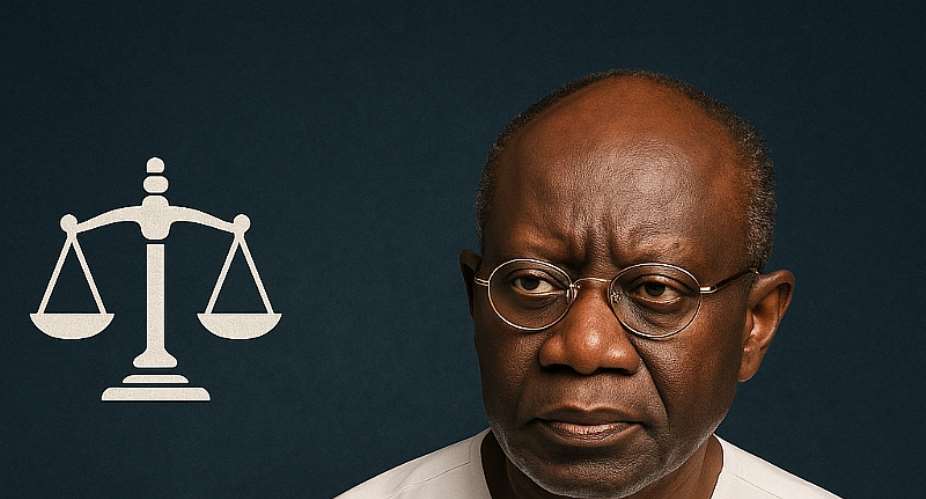
“If the snake fails to show its venom, children will use it to tie firewood.”, Ghanaian Proverb. “Nearly all men can stand adversity, but if you want to test a man’s character, give him power.”, Abraham Lincoln
These two truths, one rooted in Ghanaian ancestral wisdom, the other in American democratic thought, converge on a singular principle, unchecked power breeds impunity. In a nation where public officials often mistake prestige for protection, the tale of Ken Ofori-Atta forces a reckoning with the fragility of our accountability systems and the urgency to reaffirm the rule of law.
The sprawling saga involving Ghana’s former Finance Minister, Ken Ofori-Atta, raises urgent questions about corruption, accountability, and the rule of law in democratic governance. At the heart of the controversy lies a lucrative web of government contracts, particularly the Strategic Mobilisation Ghana Limited (SML) deal, which has exposed disturbing lapses in procurement oversight, value-for-money principles, and conflict of interest regulations. The cumulative evidence from Fourth Estate investigations, KPMG reports, and the prosecutorial efforts of the Office of the Special Prosecutor (OSP) points to a damning pattern, systemic manipulation of public revenue systems, disguised as “revenue assurance,” and rubber-stamped at the highest levels of government.
Other Investigations: Beyond the SML Contract
While the SML case remains the most prominent controversy tied to Ken Ofori-Atta, it is by no means the only one under scrutiny. The Office of the Special Prosecutor (OSP) is also probing a string of high-stakes deals and procurement breaches allegedly linked to his tenure, each raising critical questions about oversight, value-for-money, and abuse of discretionary power in the management of public funds.
National Cathedral Procurement Scandal: The OSP is investigating procurement irregularities related to the construction of the National Cathedral of Ghana, a project spearheaded under the financial stewardship of Ofori-Atta. Over GHS 800 million (approximately USD 58 million) in taxpayer funds have reportedly been spent without parliamentary approval, triggering accusations of financial mismanagement and violations of procurement law.
ECG and Beijing Jao Loss Reduction Contract: Another investigation involves a $100 million contract between the Electricity Company of Ghana (ECG) and Beijing Jao. The deal was purportedly aimed at reducing technical and commercial losses in Ghana’s power sector. However, the OSP is assessing whether due process was followed and if the contract yielded any measurable benefit or instead resulted in losses to the state.
Health Ministry’s Contracts with Service Ghana Auto Limited (Ambulance Deal): The OSP is reviewing the award of contracts for ambulances under the Ministry of Health to Service Ghana Auto Limited. While not directly signed by Ofori-Atta, the financing and approval processes fall under the Ministry of Finance, which he headed. Contracts totalling over GHS 135 million are under scrutiny for possible breaches of procurement protocols and the mismanagement of funds earmarked for critical health infrastructure.
These ongoing investigations collectively form a disturbing mosaic of alleged fiscal recklessness, opacity, and governance failures. They expand the scope of concern beyond the SML deal, deepening national anxiety over the integrity of Ghana’s financial leadership during Ofori-Atta’s time in office.
What Lawyers, Activists, and Journalists Are Saying
Journalists like Manasseh Azure Awuni, Evans Mensah, and policy analysts like Bright Simons have repeatedly framed the SML contract as emblematic of elite impunity. Legal scholars and anti-corruption campaigners argue that SML was fraudulently positioned by insiders, allegedly including Ken Ofori-Atta and close associates without competitive bidding, in violation of procurement laws.
The contract awarded to SML allowed the company to receive millions in "assurance fees" for tasks already handled by state institutions like the GRA and the NPA. The KPMG audit later discredited the claim that SML saved the nation over GHS 3 billion, confirming instead that its figures were inaccurate, duplicative, and lacked any measurable impact. The audit also flagged the lack of needs assessment, value-for-money analysis, and regulatory input from key oversight bodies like the Petroleum Commission and Minerals Commission.
Activists and legal experts insist this was not a mere lapse in judgment. It was a calculated breach of fiduciary responsibility, aided by dubious sole-sourcing procedures and post-facto rationalisations. If left unpunished, they argue, it would institutionalise corruption under the veil of technocratic reform.
Despite widespread public outcry, the former Finance Minister has refused to return to Ghana to face questioning by the Office of the Special Prosecutor (OSP), citing ill health and the need for treatment abroad. Yet, as recent history both in Ghana and globally shows, illness has never served as a valid excuse for evading justice.
When Illness Meets the Law: The Ghanaian Precedent
In Ghana, several high-profile figures have faced prosecution despite serious medical challenges. A striking case is that of Tsatsu Tsikata, former CEO of the Ghana National Petroleum Corporation, who endured a protracted legal battle lasting over eight years. Despite suffering from severe asthma that required hospitalisation, he was tried and sentenced before receiving a presidential pardon.
These cases reflect a consistent principle, health may be considered in court, but it does not halt the wheels of justice. And Ghana is not alone. Across the globe, democracies have demanded accountability from even their most powerful, regardless of age, health, or former office.
Global Standards: Justice Beyond Borders and Status
Globally, democracies have repeatedly demonstrated that political status and claims of ill health do not shield individuals from legal accountability. In the United Kingdom, former Prime Minister Boris Johnson was questioned and fined in June 2022 during the "Partygate" investigation for breaching COVID-19 rules. Despite his stature, he did not hide behind his office or cite health concerns as an excuse to evade scrutiny.
In France, former President Nicolas Sarkozy was convicted in March 2021 on charges of corruption and influence-peddling. He faced trial, was found guilty, and sentenced, without exemption based on his former office or age. The justice system treated him as it would any citizen.
Malaysia offers a particularly striking example. Former Prime Minister Najib Razak, though often appearing in court with medical documentation and citing poor health, faced multiple trials over the infamous 1MDB scandal, a massive global fraud involving the embezzlement of over $4 billion from a state development fund. He was found guilty in July 2020 and began serving a 12-year prison sentence in August 2022 after exhausting key appeals. His health concerns did not halt proceedings.
And in the United States, former President Donald Trump has faced indictments since 2023 across multiple jurisdictions. Neither his age nor his previous status has insulated him from depositions, arraignments, and court appearances. He remains under legal scrutiny in several ongoing cases.
Each of these cases underscores a vital principle, when public interest and judicial integrity are at stake, justice must proceed without fear or favour, and certainly without delay.
The Ghanaian Implication: Institutional Fortitude or Failure?
Ken Ofori-Atta’s refusal to return raises grave concerns about Ghana’s ability to enforce anti-corruption laws at the highest levels. His reluctance to comply, despite repeated invitations and a court-backed warrant, undermines not only the OSP but the nation’s broader institutional integrity.
By all legal and moral standards, Ken Ofori-Atta must be held to account. Ghana's Office of the Special Prosecutor (OSP), after repeated requests, officially declared him a wanted man and a fugitive from justice. In a historic escalation, the OSP secured an INTERPOL Red Notice against him, an international alert that demands his provisional arrest wherever he may be found. This development, confirmed by outlets including the BBC, underscores the gravity of the allegations and Ghana’s willingness, at least institutionally to follow through. The OSP’s authority is constitutionally grounded and mirrors best practices in international law enforcement. When Boris Johnson, a sitting Prime Minister, was questioned by UK police over “Partygate” and fined, there was no notion of executive immunity or indefinite medical evasion. The precedent must hold true in Ghana.
While Ofori-Atta's lawyers claim medical incapacity (citing prostate cancer), the OSP maintains that no verifiable medical report was provided indicating he is unfit to travel. Ghanaian law does not permit suspects to dictate investigation terms. The offer to be interviewed via Zoom lacks precedent in criminal matters requiring arrest, caution, and court jurisdiction.
If this case is allowed to fizzle, it would confirm fears that Ghana's anti-corruption apparatus is designed to catch the small fish while shielding the politically connected.
Ghana Must Choose: Elite Impunity or Institutional Integrity
This case is not merely about one man. It is a litmus test of Ghana’s anti-corruption machinery. The country’s chronic failure to prosecute high-ranking officials undermines public trust and emboldens future looters. Institutions such as EOCO, CHRAJ, and the OSP must coordinate, not compete, lest justice be strangled by institutional turf wars.
The saga deepens when one considers that under previous leadership, EOCO was reportedly lukewarm to documentation submitted by the OSP regarding Ken Ofori-Atta’s financial dealings. However, with new leadership in place, EOCO is said to have reopened interest in previously sidelined files signalling potential for renewed institutional will, if not yet definitive action.
The judiciary, too, must rise above technicalities. In the Cecilia Dapaah money laundering case, where staggering sums of foreign currency were infamously discovered hidden in her residence, the court dismissed key aspects of the OSP’s procedure, allowing a powerful figure to slip through legal loopholes. Such outcomes embolden impunity and foster public cynicism.
Parliament must act by closing sole-sourcing loopholes and mandating transparent inter-agency cooperation. Ghana’s judiciary must show courage to prosecute, not protect, elite actors. Without that, the law becomes a tool of spectacle, not substance.
A Trial for All Governments, Not Just NDC or NPP
This is not a partisan issue. Ofori-Atta's trial must set a national precedent, that no individual, no matter how accomplished or politically affiliated, is above the law. It would be a powerful signal to future appointees and ministers, public office is a trust, not a licence for self-enrichment.
This must not be reduced to partisan theatrics, whether an NPP embarrassment or an NDC vendetta. It is a republic’s reckoning with truth. It must be seen as Ghana’s moment to renew confidence in its democratic and legal systems.
A Balanced Legacy? Contributions vs. Complicity
Undeniably, Ken Ofori-Atta’s role in Ghana’s financial history is not without merit. He pioneered Databank, contributed to the development of Ghana’s capital markets, and championed Eurobond issuances and macroeconomic reforms. But these achievements cannot shield him from scrutiny. A truly patriotic citizen does not flee accountability when called upon to explain public financial decisions. Neither cancer, nor reputation, nor religiosity should immunize any individual from the law.
What Is at Stake
“The arc of the moral universe is long, but it bends toward justice.” Martin Luther King Jr.
Dr. King’s timeless words remind us that justice, though sometimes delayed, is never irrelevant. Ghana stands at that very bend in the arc, where moral conviction must meet institutional courage. The question is no longer whether the system knows what is right, but whether it has the will to act upon it. Ken Ofori-Atta’s saga is more than a personal or political storm. It is Ghana’s test of political maturity and legal fortitude. It is a chance to demonstrate, once and for all, that justice in Ghana does not bend to power, prestige, or privilege.
Ofori-Atta’s fall from grace must signal a turning point in Ghana’s accountability journey. His ordeal must mirror global examples, investigated, confronted, and, if culpable, prosecuted. A transparent trial, accommodating legitimate health needs but uncompromising on due process, would set a continental standard for accountability across all governments. The nation, and its democracy, deserve nothing less.
If Ghana is serious about fighting corruption, the trial must proceed, health considerations duly acknowledged but not used as a cloak against the law. History, both domestic and international, has shown the way. Now, Ghana must follow it.
By: Kennedy Opoku
NDC-Dome-Kwabenya Global 2A Communication Officer, Political Activist, and Vice President of Solids for JDM

 Israel votes in first election since October 7 attack as Netanyahu faces crucial...
 US-EU trade truce at risk over $3.4 billion Airbus loan, Trump official warns
 Flavio Bolsonaro vows to lead opposition after Brazil court imposes travel ban
 Mecca pact nations hold talks with Iran to prevent renewed Middle East war
 New DStv sports package will save subscribers over Ghc500 monthly – Sam George
 Your past prescriptions never helped developing countries - TOR MD tells IMF
 Crude Distillation Unit turnaround was funded from TOR's internally generated fu...
 Trump offers $1 million for tipoffs leading to vote fraud conviction as midterms...
 UN cites 'ethnic cleansing' concerns around Israel's Palestinian displacement op...
 'Irresponsible media coverage is hurting Obuasi SHTS abuse probe' – Gender Minis...


