




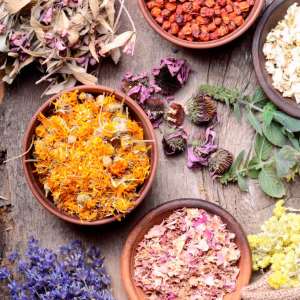
The integration of herbal medicine into Ghana’s national healthcare system can be done in one of the following three ways: First, it can be incorporated as an integral part of a country’s formal health care system, with each being separately recognized as legitimate forms of health care within the same framework. Second, it can be practice integrated with modern medicine by individual health care practitioners. Third, traditional and modern practices can be integrated as two branches of medical science, with the ultimate incorporation of elements of both to form a new branch. The incorporation of traditional and modern evidence-based medicine (EBM) as integral parts of a country’s formal health care system is most likely to be achieved and has been demonstrated to be practicable in many countries, particularly in Asian countries such as China, Japan, Korea, and India, among others.
However, the incorporation of traditional medical modalities such as herbal medicine into modern or EBM by either the second or third method of health care integration is not easily achieved for a host of reasons, including scientific, cultural, educational, and legal. For decades, the People’s Republic of China has touted a system of medical education in which its modern medicine practitioners have been required to receive some formal training in traditional Chinese medicine (TCM), so that they are aware of suitable approaches in TCM during their practice of Western medicines. However, documentation of its successful integration in clinical practice is lacking. In Western countries, such as the United States, Australia, Canada, and members of the European Union, the popular use of herbal medicine in the form of complementary and alternative medicine (CAM) in the last two to three decades has led to a multinational, multibillion dollar industry, professional and trade organizations, national and international practice and research conferences, establishment of specialized integrated medicine practices and clinics in pain management and adjunctive cancer therapy, incorporation of CAM courses in conventional medical colleges, introduction of CAM degree-level education programs, and establishment of research funding agencies such as the U.S. National Institutes of Health(NIH) National Center for Complementary and Alternative Medicine, and the Australian National Institute of Complementary Medicine. As a result of these developments, the issue of integration of CAM medicine, including herbal preparations, into modern medicine has been the subject of ongoing international discussions in the last few years. However, proof of efficacy or safety for the vast majority of herbal medicine has not been fully established through an evidence-based approach. Further, other issues, such as scientific, cultural, educational, economical, and legal, need to be addressed.
There seem to be some kind of inertia when it comes to implementing policies when there is lack of national direction and coordination. Thus, the Directorate of Traditional and Alternative Medicines which has been tasked with strengthening coordination of Traditional Medicine Practice in the Country must be up and doing. This notwithstanding, TM continues to grow in the entire world. Therefore there is the need for political will on the part of African leaders to pay serious attention to global trends in TM discourses for the benefit of all and sundry. This would require that both TMPs and OMPs acknowledge their areas of strength and weakness from which they operate in order to minimise the current distrust and the perceived paranoid between them.
By MH/Dr Ernest Aggrey, 0543999776/[email protected]
References:
1.Benzie, I.F. and Wachtel-Galor, S. (2011).Herbal medicine: Bimolecular and Clinical Aspects, Herbal Medicine; An Introduction to Its History, Usage, Regulation, Current Trends, and Research Needs. Second Edition; CRC Press. Pg 5-8,453-454
2.Abdullahi, A.A. (2011). Afr. J. Traditional Complementary and Alternative Medicine. 8(5 suppl):115-123Publised online 2011 Jul 3.doi: 10.4314/ajtcam.v8i5S.5

 Korle Bu Teaching Hospital to introduce IVF and Corporate Clinic before end of 2...
 Accra West: Sarpeiman, Medie and other areas to experience power outages on Sund...
 Accra West: Faulty transformer causes outage Pokuase Amanfrom and surrounding ar...
 Restoration of Akosombo turbines not automatic solution to current dumsor — Mira...
 We have enough capacity to meet electricity demand — Energy Minister
 May 2: Cedi maintains value, sells at GHS12.15 on forex market, GHS11.20 on BoG ...
 2024 outages not due to transformer overloads — Energy Minister defends past com...
 US to withdraw about 5,000 troops from Germany
 Rebels take key military base in Mali's north
 Middle East war's impact on shipping hitting refugee aid: UNCHR


