




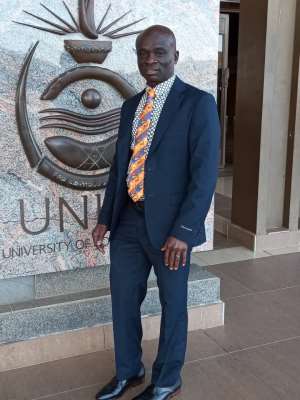
There are academics, and then there are outliers who bend the limits of what academia itself imagines possible. Professor Joseph Kwasi Agyemang belongs firmly in the latter category. His career is not simply a story of personal success; it is an illustration of what happens when intellectual curiosity is pursued with relentless discipline over decades. In a global academic environment that often rewards incremental specialization, his trajectory stands apart as something far more expansive, almost defiant in its scope and ambition.
At 50, he stands at a rare intersection of intellectual endurance, disciplinary mastery and global recognition. Widely credited with becoming the first individual to attain three PhDs in Accounting, a claim that, even in a world where fewer than one percent of the population holds a doctorate of any kind, places him in an exceptionally narrow scholarly tier; his career forces a reconsideration of what constitutes the ceiling of academic achievement. It is not merely the accumulation of credentials that distinguishes him, but the consistency required to achieve them at the highest level.
The Discipline Behind Multiple Doctorates
The idea of earning even a single doctoral degree is, for most, the culmination of years of rigorous study, research and intellectual testing. Doctoral work demands originality, resilience and a capacity to engage deeply with complex theoretical frameworks. To complete three such programmes within the same discipline requires not just persistence, but an unusual ability to rethink, refine and extend one’s intellectual approach across different research cycles. It suggests a mind that does not settle into comfort, but continually seeks new analytical ground.
In an era where specialization often narrows horizons, Agyemang’s trajectory reflects the opposite: depth without confinement. Rather than becoming constrained by the boundaries of a single research focus, his academic journey demonstrates a capacity to explore multiple dimensions of accounting as both a technical and conceptual field. This is particularly significant in a discipline that sits at the intersection of mathematics, economics, law and organizational governance.
The Rarity of Doctoral Achievement
The numbers alone tell part of the story. Globally, doctoral attainment rates remain strikingly low. According to widely cited estimates, fewer than two percent of adults in advanced economies hold a PhD and the proportion is even smaller in developing regions. Within accounting, a field often perceived as technical rather than theoretical, the pipeline to doctoral-level scholarship is thinner still, with many countries producing only a handful of PhDs annually. This scarcity reflects both the difficulty of the discipline and the limited institutional capacity in many parts of the world.
Against that backdrop, earning one doctorate is an accomplishment; earning three in the same discipline signals not just persistence, but an unusual capacity for sustained intellectual production and methodological reinvention. It requires the ability to engage repeatedly with peer review, defend complex arguments and contribute meaningfully to a body of knowledge that is constantly evolving.
Recognition Beyond Credentials
Yet credentials, however extraordinary, are only meaningful when translated into influence. This is where Agyemang’s profile becomes even more compelling. His recent recognition by the Global Academic Awards as Outstanding Educator in Accounting and Auditing underscores a second dimension of his legacy: impact. Academic distinction, in its highest form, is not measured solely by degrees or publications, but by the ability to shape how knowledge is understood and applied by others.
Teaching excellence in higher education is notoriously difficult to quantify. It involves not just the delivery of content, but the ability to inspire critical thinking, encourage intellectual independence and bridge the gap between theory and practice. Global award bodies typically evaluate a mix of student outcomes, research integration, curriculum innovation and peer-reviewed contributions. To be recognized at that level suggests a sustained commitment to educational quality.
Bridging Theory and Practice in Accounting
In accounting education specifically, the challenge lies in translating abstract principles into real-world application. Regulatory frameworks evolve, financial systems become more complex and ethical considerations grow increasingly central to professional practice. An effective educator in this field must therefore do more than teach rules; they must cultivate analytical thinkers capable of navigating uncertainty and interpreting data with precision.
Agyemang’s recognition suggests that he has consistently met this challenge. It points to an educator who not only understands the technical demands of accounting, but also appreciates its broader implications for governance, transparency and economic stability. This dual awareness is critical in preparing students for roles that extend far beyond the classroom.
The Scholar-Educator Advantage
This dual identity, scholar and educator, places him within a small but influential class of academics who shape both knowledge and its transmission. Research and teaching are often treated as separate domains within academia, but their most powerful impact emerges when they intersect. Scholars who remain actively engaged in research bring a dynamic perspective to the classroom, exposing students to the latest developments and encouraging them to think beyond established frameworks.
Studies consistently show that students taught by research-active faculty demonstrate stronger analytical and problem-solving skills. This is particularly true in fields like accounting and auditing, where standards and practices evolve rapidly in response to global economic changes. By integrating research into teaching, educators create a learning environment that is both rigorous and relevant.
Influence Beyond the Classroom
In that sense, Agyemang’s influence likely extends far beyond lecture halls. The students he has taught carry his intellectual imprint into professional spaces, including audit firms, corporate boardrooms, regulatory bodies and public institutions. Each graduate represents a node in a broader network of influence, applying the principles and analytical approaches acquired during their education to real-world challenges.
This ripple effect is one of the most powerful aspects of academic work. While publications contribute to scholarly discourse, teaching shapes the individuals who will ultimately implement and adapt those ideas. Over time, the cumulative impact of this process can be substantial, particularly in fields that play a central role in economic governance.
CA National Asset in Human Capital Development
There is also a broader geopolitical dimension worth noting. Ghana, like many emerging economies, continues to invest in human capital as a driver of development. The quality of a nation’s institutions, its financial systems, regulatory frameworks and governance structures, is closely linked to the expertise of the professionals who operate within them. Accounting and auditing, in particular, are critical to ensuring transparency and accountability.
International development organizations have repeatedly emphasized the importance of tertiary education and professional training in strengthening these systems. High-level expertise in accounting contributes directly to investor confidence, fiscal discipline and the efficient allocation of resources. In this context, the emergence of a scholar of Agyemang’s caliber carries significance beyond individual achievement.
Redefining Global Academic Geography
His career can be seen as part of a broader narrative about the development of intellectual infrastructure within Ghana. As universities expand their research capacity and produce highly trained professionals, they contribute to the creation of a knowledge economy capable of supporting sustainable growth. Scholars who achieve international recognition play a particularly important role in this process, serving as both symbols of possibility and catalysts for further advancement.
Even so, his achievements challenge a persistent narrative within global academia: that excellence is geographically concentrated. While institutions in North America and Europe continue to dominate global rankings, the rise of scholars from other regions achieving world-first distinctions complicates that picture. It highlights the distributed nature of intellectual potential.
Longevity, Relevance and Intellectual Endurance
This shift has important implications. It suggests that talent, when supported by appropriate institutional frameworks and opportunities, can flourish in diverse contexts. It also underscores the importance of investing in education systems that prioritize research, innovation and academic freedom. The global academic landscape is gradually becoming more inclusive, but figures like Agyemang demonstrate that there is still significant progress to be made.
Turning 50, therefore, is more than a personal milestone for him; it is a moment that crystallizes a body of work defined by both rarity and relevance. Longevity in academia often correlates with influence, but only when paired with continuous output and adaptation. The ability to remain intellectually active over decades is itself a marker of distinction.
A Legacy of Measurable Excellence
By all available indicators: advanced qualifications, international recognition and sustained teaching impact, his career reflects that rare alignment. It is a trajectory marked not by isolated achievements, but by a consistent pattern of excellence. Each milestone builds upon the last, creating a cumulative legacy that is both measurable and meaningful.
Ultimately, what makes Professor Joseph Kwasi Agyemang remarkable is not simply that he has achieved more than most, but that his achievements sit at the convergence of effort, evidence and impact. In a discipline grounded in precision and accountability, his own career offers a fitting parallel: a ledger of accomplishments that is both verifiable and, by any reasonable standard, extraordinary.
The writer holds a PhD in Journalism. He is a journalist, journalism lecturer, and a member of the Ghana Journalists Association, the Society of Professional Journalists, Investigative Reporters and Editors, the Ida B. Wells Society for Investigative Reporting, and the African Journalism Education Network. Email: [email protected]

 We have cut cost of capital by more than half since Mahama took office – Ato For...
 Dr Bertha Ayi on how parents hurt children by raising them only on English
 Customs intercepts three firearms, 610 rounds of ammunition at Tema Port
 NDC to open nominations for 2026 regional executive elections on October 6
 Africa will be mostly self-sufficient in fuel by 2030: Dangote to AFP
 PRETAG threatens to intensify strike over unpaid teacher entitlements
 Lands Minister exits GoldBod Board as Minister's Chief Director takes over
 Court refuses bail for six accused in 3.9-tonne cocaine shipment case
 Philippines to open first-ever embassy in Ghana
 1992 Constitution review: Prof. Atsu Ayee and Dr Osae-Kwapong explain why Consti...



Comments
Great Article. Hopefully Prof Agyeman's Compensation matched his Dedicated Service