




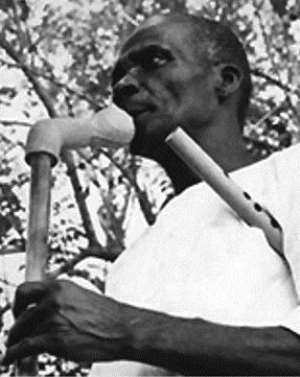
Let's face it – there are instances of real greatness to be found in the lives of some of our forebears.
Can you imagine a Ghanaian of today, born of Ewe stock and brought up at Peki, in the Volta Region, composing a song in the Twi language and doing it so eloquently that even natives speakers of Twi may be baffled by some of the linguistic dexterity displayed in the poesy inherent in the lyrics?
Well, that's what the musician, Ephraim Amu, did. I've said before that his song, Yen Ara Asaase ni, ought to have been adopted as the national anthem of Ghana at independence. But our predilection for everything Western made us choose, when we had the opportunity in 1957, music and words that were Western in content. Maybe the committee that planned the independence celebrations was too colonialist-dominated? I mean, after all, Eartha Kitt was given short shrift when she offered come and dance for us!
That's true – I personally heard the the Director of the Ghana Information Services, James Moxon, relate the story of the offer – and rejection – with a certain amount of amusement, if not satisfaction.
I myself actually entered the competition to provide the words for the new anthem in 1957! In English, of course.
(In those days, the idea of writing anything for national consumption in any language other than English, would have been laughed out of court as showing favour to the “tribe” in which language it was written. Speakers of Ewe, Dagbani, Hausa, Nzemaa Ga and other languages, were supposed to understand English when taught the language. But no-one seemed to think it possible to teach Twi – the language that is most widely spoken in our country – to those who did not speak it.)
Well, we adopted a national anthem with English words. And so unremarkable was the anthem that I cannot remember one word of it right now! (Apart from God bless our homeland of Ghana or something.) Yet I can recite the entire first stanza of Amu's song from memory, though I first learnt it in primary school around 1949!
Talk of staying power.
I have revealed above that I entered the contest for words to the new national anthem in 1957. I remember only two lines from my entry. (I forgot to keep a copy but even if I had, I doubt whether I'd find it today – I have lost massive amounts of manuscripts because I've been forced, in the past, to change my place of abode in rather peremptory circumstances – for political reasons!)
What I remember from my national anthem entry are these lines:
“Freedom is just
And justice is free....”
I admit that it's not a patch on Amu's great lines, but you may appreciate what I meant: what could be more just than to live in freedom? And in a free society, justice ought to be free, shouldn't it? I rather felt pleased with the play of words I'd contrived, focusing, as I did, on our national motto, Freedom And Justice. But the judges of the competition thought otherwise. I didn't even get an honourable mention when the competition's results were announced!
Did Ephraim Amu also enter the competition? I don't know. But if he did, he would have had to plagiarise himself, for what words can have a greater piquancy than:
Yɛn ara asaase ni;
Ɛyɛ aboɔden de ma yεn!
[Translation by Cameron: “This is our own land; It is a priceless thing to us!”)
Please note that Amu's use of the word “land”, in this context, does not merely denote an inanimate object called “land”, but a peopled entity cultivated and shaped into a cultural unit to which spiritual obeisance might be paid.
“I am going back to my own land” does not mean I am going to occupy a few acres of cultivated or uncultivated land, but the place that gave birth to me, and to which I therefore belong!
Amu defines the land for us thus:
Mogya na Nananom hwie gu
Nya de too hɔ maa yɛn;
[Cameron's translation: “Blood it was that The Ancestors spilled, To acquire and preserve it for us.]
Thus, in just two lines, Amu gives us the reason why we would be justified if we were, currently, to round up all the galamsey operators who are destroying our lands and water-bodies and liquidate them. For the land and rivers they are despoiling in such a blatant manner did not descend, of itself, from heaven unto the feet of the blessed people of Ghana, but were acquired, through the shedding of blood in warfare, by our Ancestors, and endowed to us.
Our Ancestors chose, settled on, and defended this heritage of ours with their verylives because the land was fertile and had plenty of water on it to sustain life eternally.Many of them had endured cruel episodes of migration in the past, and so they did not want their progeny too to ever have to be subjected to hazardous migration. But now, look! The galamsey operators are busy digging the earth from under our very feet.
Adu me ne wo nso so,
Sε yɛbɛyɛ bi atoa so.
[It is now the turn
Of you and me
To do our bit
To continue to safeguard
What The Ancestors
Left to us.]
Yes – Amu is enjoining us to remember that the land is not only there to be enjoyed by our generation, but to be a cherished heritage treasured and passed on, in the same way our Ancestors had done.
We all have to ask ourselves: “Are we fulfilling this sacred duty that history has deemed it our turn to carry out?”
Ephraim Amu goes on:
Nimdeɛ ntraso, nkoto-krane
Ne apɛ-sɛ-me-nko-menya,
Adi yɛn bra mu dεm,
Ama yɛn man ho dɔ atom’ sɛɛ.
[Cameron's translation:
“I know! I know!”
Or too much claim to superior foreign knowledge,
As well as hypocrisy
And unconscionable selfishness
Have convoluted our character
And thereby diluted the love
That we should bestow on our Nation!)
Unconscionable selfishness. Isn't that what makes a chief, or other prominent member of a town or village, go out to seek Chinese fortune-hunters secretly to come and ravage the waterways and farms of his own ancestral land, in search of gold?
What else but hypocrisy (I love that word nkotokrane, which has a broader meaning than mere 'hypocrisy'; it also conveys the idea of 'not-being-straight-forward' and 'talking from both sides of one's mouth at the same time'!plus other manifestations of general villainy.) Yes, are these not among the social diseases that have brought galamsey to us to destroy our lands?
Owura Amu finally warns us:
Ɔman no, sɛ ɛbɛyɛ yie o
Ɔman no, sɛ ɛrennyɛ yie o;
Ɛyɛ sɛnnahɔ sɛ,
Ɔmanfo bra bɛkyerɛ.
[Cameron's translation:
Whether the Nation shall succeed,
Or become a failed state,
It is an incontrovertible fact
That it all hangs
On the character of its people].
“The character of its people”! How appropriate. I once heard a man of learning postulate that most of Ghana's problems arise from the fact that the most prominent 'hero' in our folklore is Kwaku Ananse, the mythical 'Spider', who resorts to unscrupulous deception, outwitting the weak and other forms of anti-social behaviour, to attain his selfish ends. We admire him because we think he is clever!
It is quite in character, then, is it not? (from this perspective) for a Ghanaian official to invent clever methods to steal money that has been entrusted to him/her; especially by the Government; to seduce other people's wives; to set up churches with the express purpose of milking the poor of their earnings by imposing tithes on them, and by charging them for exorcism from alleged witchcraft or juju curses? Or – passing oneself off as an outstanding patriot whilst carrying out galamsey or other infamous trades in absolute secrecy?
How many of us regard our national progress as something whose achievement devolves on the shoulders of other people, but not on ourselves? How many of us are capable of looking at our Nation in the eye and confronting the “incontrovertible realities” that face it today?
We have heard so many stories about how some of our past rulers gave out single-sourced contracts that have landed the Nation in both massive debts and shoddy execution of contracts. Is that not just what Kwaku Ananse would do, if he were with us today? Shouldn't Ghanaian officialdom be rechristened as Anansemma [Ananse's offspring]?
For indeed, our top offices are occupied largely by people whose only required qualification for their lucrative jobs – no matter how sensitive – appears to have been that they could flourish a paper certificate in front of the would-be employers. But did Albert Einstein, Thomas Edison, George Stephenson and other geniuses who moved their nations forward, rely on paper qualifications? Did they not consider academic qualifications as a means to engage in arduous research, that eventually produced results that revolutionised knowledge for all mankind?
As you recover from the festivities – such as they might have been – that marked the 60th anniversary of Ghana's independence, please let us carry out a little introspection and purge ourselves of any self-centredness that we may be afflicted with and which does not do our country any good.
In this age of mindless galamsey, our Nation needs to have all its intellectual hands on deck. We had a Prophet in Amu; a Prophet who warned us – long before independence was even conceived by our leaders – that the viability of our Nation (our priceless heritage) would depend on the character of each and every individual in it.
Currently, we are on the step-ladder to a total environmental apocalypse. Will we be able to pull back and thus, [possibly] save our Nation?
“It is a self-evident fact
That the character of our nationals
Will be the deciding factor,” said Ephraim Amu. We turn a deaf ear to him at our peril – or worse still, the peril of the children we are now nurturing, and the children theywill have to nurture, in their turn!

 NACOC intercepts GHS5million tablets of Tapentadol in major drug bust
 Oti Region: Police arrest two over alleged illegal possession of firearm
 Victor Smith engages Boeing on rebirth of Ghana Airways
 We were told dumsor would end with the levy – Dr Zaato fumes
 Did NPP use magic or witchcraft to keep our lights on? – Zaato jabs govt over du...
 Kofi Jumah sweats in EOCO custody as he struggles to meet GH¢55million bail cond...
 Cocoa prices to decline by over 50% globally in 2026 – World Bank
 Otumfuo urges feuding factions in Middle East and Europe to cease fire
 Adamus Resources Boss Angela List buys Otumfuo gold artwork for GH¢1million
 Our prudent economic management shields Ghana from global shocks – Asiedu Nketia...


