




After decades of independence, Africa today remains the poorest continent in the world, despite it being endowed with all the natural resources one could think of. One would ask, 'what is the cause of this?' But the answer surely is not farfetched.
Tune in to radio and television news channels and buy a newspaper and you will know exactly why Africa – after the liberation struggles of Pan Africanists like Dr. Kwame Nkrumah of Ghana, Nelson Mandela of South Africa, Desmond Tutu of South Africa, Emperor Haile Selassie of Ethiopia, Jomo Kenyatta of Kenya and Patrice Lumumba of Congo – lags behind the rest of the world in terms of development and growth.
This is not to say no African country is making progress when it comes to development and growth but the rate at which such progress is being made is quite slower than anticipated.
A continent endowed with natural resources like gold, diamond, manganese, silver, bauxite, oil, and many others, Africa should have been one of the most developed continents on this planet.
But today what do we see or hear? War, hunger, greed and corruption, sickness and crimes of the highest order have engulfed the entire continent.
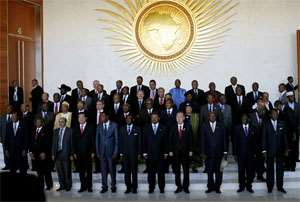
In the mist of all these, Africans continue to celebrate what is termed, 'African Union Day' on May 25 of every year even, though the unity we ostensibly celebrate continues to hang somewhere high in the sky whilst we are left with only conflict on the ground.
Sickness
When it comes to sickness, cholera is sweeping across countries like Sierra Leone, Guinea, Kenya, Sudan, among others, due to poor sanitation. Worst of it all now is the ebola virus that has destroyed lives in Guinea and Liberia currently.
Malaria, HIV/AIDS, Tuberculosis, are as well severely affecting the continent with huge sums of money that could have otherwise been channeled into developmental projects, finding their way into purchasing of drugs to combat these diseases.
Famine
On the issue of famine, countries like Somalia and Sudan are always in the headlines with millions of dollars in international aid being channeled to them each year as emergency food-aid. On October 17, 2012, the International Medical Corps reported that many areas in the Horn of Africa were extremely food-stressed with 13.3 million in need of emergency assistance in the region.
The International Medical Corps has been delivering a comprehensive health, nutrition, water, sanitation and hygiene response to these regions over the years but the case seems to be far from ending anytime soon.
War
Turning a focus on war, the African continent remains one of the most destabilized in the world today.
Countries like Sudan, DR. Congo, Egypt, Tunisia, Nigeria, Somalia, Central African Republic and Mali are going through periods of civil unrest. In these countries, there are militant groupings such as the Islamic Militant Group, Boko Haram of Nigeria and the Al-Shabaab of Somalia who continue to terrorize innocent citizens mostly due to religious and tribal differences.
According to available statistics, millions of innocent lives have been lost on the continent over the past few decades due to such wars. For instance, between 1991 and 1992, there were reported 350,000 deaths in Somalia due to starvation and warfare; 750,000 in Sudan between 1955 and 1972 and 2 million as of April 2001; 800,000 during the Rwandan 1994 massacre, which is considered by the international community as the worst atrocity against the human race in the 21 st century; and 1million civilians plus 1million military in the Nigeria-Biafra war between 1967 and 1970.
Those who survived such wars had to undergo hardships as refugees in neighbouring countries. The Rwandan war for instance, reportedly produced a total of about four million refugees who had to suffer in DR. Congo.
Liberia, Sierra Leone and Cote D' Ivoire recently got themselves out of the 'murder-sport' and are trying to rebrand themselves as peace-loving countries, even though the chain of corruption is tightly tied around the necks of Liberia and Sierra Leone. Cote D' Ivoire is reportedly performing well economically.
Looking at these statistics, the question that comes to mind is 'Why?' But the answer is again quite simple: Africans, especially the leaders, have failed to effect certain key changes after independence. This gets the continent living in an era I consider as 'Modern Colonial Era' and with all countries on the continent now being seen as 'Modern Colonies'.
Failed Changes
Starting with the economic side to the story of Africa's crises, African countries before their independence from their cruel colonial masters some four to five decades ago, were exporting their resources to Europe and America at a no-value-added state. Today, the value is the same. Africans export especially agricultural produce to Europe, America and other parts of the world with sometimes just a little value being added.
In Ghana, Dr. Abu Sakara, the 2012 presidential candidate of the Convention People's Party (CPP), has tried to convince Ghanaian political leaders to ensure that their agricultural produce are refined by exportation but there has been no success story in this direction, even though it is the right thing that any African government can do to develop its country.
Capital Flight
Capital flight is yet another area where African leaders have failed to put on their thinking cap after all these years. Even as African countries became increasingly indebted from 1970 to 2004, they experienced large-scale capital flight. Some of these were legitimately acquired wealth spirited to safer havens abroad.
Available statistics shows that sub-Saharan Africa alone is a net creditor to the rest of the world, in that the sub-continent's private external assets exceed its public external liabilities: total capital flight amounted to $420 billion (in 2004), compared to the external debt of $227 billion. Econometric analysis indicates that for every dollar in external loans to Africa in this period, roughly 60 cents flowed back out as capital flight in the same year – a finding that suggests the existence of widespread 'debt-fueled' capital flight. The results also show a debt-overhang effect, as increases in the debt stock spur additional capital flight in later years.
Also, it remains a complete nightmare in the history of the Continent for any African political leader and/or president to finish a national project started by previous government. Many developmental projects are left 'half-way along the highway' in Africa due to change of government and the failure for many successor governments to end projects that were started by their predecessors.
Income inequality remains a major problem for the continent. The rich continue to get richer and the poor continue to get poorer with little or nothing being done to arrest the menace.
Social, Religious Platforms
Moving away from the economic frontier and heading towards the social and religious platforms, Africans appear to be sharply divided due to the mere fact that they all do not belong to the same tribes or religion. The war in Central African Republic is between Christians and Muslims and the Rwandan war between the nation's two major tribes – Tutsis and Hutus – and the conflicts currently ongoing in the northern parts of Ghana are clear attestations to this. Also, politicians continue to encourage the citizenry to vote on tribal lines rather than on issues.
Gender And Health
African leaders have as well failed to tactically address the issue of gender inequality and imbalance prevailing on the continent. African women continue to cry against marginalization and discrimination. Statistics show that majority of the poor folks on the continent are women while the male chauvinistic few enrich themselves with reckless abandon.
Touching on health, there is a complete failure on the part of our leaders. They have failed to invest wisely on sanitation. Gutters in major cities are filled with waste products. Ensuring the proper disposal of waste materials seems to be one issue that they lack knowledge of.
There seems to be no light at the end of the tunnel for Africans because our leaders are visionless. The continent needs leaders who will have the political clout to turn things around.
BY Melvin Tarlue
 NACOC intercepts GHS5million tablets of Tapentadol in major drug bust
 Oti Region: Police arrest two over alleged illegal possession of firearm
 Victor Smith engages Boeing on rebirth of Ghana Airways
 We were told dumsor would end with the levy – Dr Zaato fumes
 Did NPP use magic or witchcraft to keep our lights on? – Zaato jabs govt over du...
 Kofi Jumah sweats in EOCO custody as he struggles to meet GH¢55million bail cond...
 Cocoa prices to decline by over 50% globally in 2026 – World Bank
 Otumfuo urges feuding factions in Middle East and Europe to cease fire
 Adamus Resources Boss Angela List buys Otumfuo gold artwork for GH¢1million
 Our prudent economic management shields Ghana from global shocks – Asiedu Nketia...


