




"One of the greatest tragedies of our time is this impression that has been created that science and religion have to be at war" Francis Collins.
Debates and dialogues on issues in religion and science are customarily contrived on a spectrum of opinions between two extremes, and the kinds of interactions that might arise between the two have been a subject of study since classical antiquity. However, even with the numberless studies within the area, getting a perspicacious understanding as to the relationship between religion and faith is difficult.
This is so because, much of what is addressed on the subject by the many philosophers, theologians, scientists and others is caught up in the legendary wedge between science and religion, which became widespread during the first half of the 20th century. Science and faith are more often than not incompatible because they offer conflicting elucidations as to the evolution of the universe and of the species within it.
Though the two generally deal with different realms (natural vs. spiritual), disagreements do arise about where the boundaries between these realms lie when dealing with questions at their interface. Clashes therefore are bound to occur lest we do some pigeonholing of a sort concerning the two. Galileo and the Scope trail is a well-known working example. But even this, as I will try to explain latter in this piece, is a gross caricature of both science and faith as things stand.
In the mind of religionists, or more correctly, fundamentalist Christians, science is but a mere accessory to the evil of consumerism that has bedeviled the world. They contend that if people elect to capitulate to the money-oriented and acquisitive progress of science, then the world is doomed to meet the same fate as Sodom and Rome. By this, believers mean to caution us that science simply has a self-centered and deficient outlook to issues of life. It does not look at the larger picture and accordingly, at what matters most in life.
On the other hand, and to make a case for their creed, religionists assert that religion does not only serve as an emotional unguent and life preserver, but it also works as the glue that holds one‟s identity together. It follows that religion is essentially about the question: "How does my life fit into the bigger picture". Several people for instance might be curious to know whether there is life on Mars. However, what every Tom, Dick, and Harry want answers tofrom the Christian to the humanistis: "do I have some sort of larger purpose and if I do, given that I have say a score of years to go, what is the best or most rewarding thing that I can do with what is left of that time?" Science fails to show up here where it matters most for simple reasons that, it is just powerless to satisfy certain needs unique to the human condition and it is misguidedly fixated on analyzing "what is", instead of "what ought to be", religionists often say.
1
Equally, for the scientist, religion has no right to maintain a moral high ground when it
comes to the impacts of its activities on the world. They suggest that more often than not in human history, religion or faith has contributed to wars, mayhem, domination and discrimination. They also attack the relevance of religion particularly organized religion, saying that in the event that it suddenly departs into nothingness, humanity would not endure the same fate i.e., lose its capacity to organize and subsist. Science can adequately shepherd our existence and fortunes until reckoning if it ever occurs. However, the question still lingers, can religion functionally fill in for science? Can it produce the many devices that help us easily navigate through life daily? No, scientists would fervidly maintain.
For religionists, science and its purpose or functions can best be described as a mere conglomerate of put out guesses made by intelligentsias concerning things of which they are uninformed or only superficially informed. Scientists do not share in this forbidding sentiment obviously. They insist that there is no other discipline or institution more au fait with real world issues and more organized to deal with them than science. Science and its applications through the arts has been the sole means of uplifting the human race from a crude, universal state of savagery to its present stage of culture, they are quick to add.
Personally, I have read and listened to many debates on this subject over the years and if this was a drolly world, I could certainly hold myself out as an authority on the subject, but alas, it is not, and this is no lightweight business either, the Peter Atkins and Callum Miller debate taught me just that. All of my knowledge on this issue thus far is theory based, i.e. I have not had the opportunity to observe the issue firsthand or through an everyday experience so to speak. Thankfully, recent events on the Ghanaian political landscape have helped me to see this mythical warfare in play or perceive it „filli filli,‟ as we colloquially say in Ghana.
The Curtain Raiser: The Bantama Vigil and Upshots
I saw them arrive at the party‟s modest Bantama premises dolefully cladded in red and black and yet, appearing spryly disposed to the task ahead. They came from far and nearby places and from the different castes that are representative of the culturally diverse personality of the New Patriotic Party itself. So that they can deal with business quickly and efficiently, they turned up at the party‟s soon to be converted into abbey regional headquarters with all the required accoutrements of worship readily at hand. Indeed, I saw most of them wielding missals, prayer beads and others as they filed in through the gates and although not bodily manifest, I got the sense that their purposely-whetted prayer tongues too, were ready to offer support. It had surprised many because on this particular occasion, they spared no time in responding to the summons of the party‟s bests. I tried to hazard a guess as to why this was the case, and after mulling over it for a while, one reason surfaced as the most plausible. The gathered, all of them, I remarked, perhaps understood almost immediately the seriousness of the rare task they were summoned to come carry out. They responded straight away to their leaders‟ clarion call because they understood the exigencies of the situation that has necessitated
2
such a bid. Moreover, I noticed that occasions like this tend to add some relish to the otherwise
uneventful life of a party foot soldier. It becomes an opportune time for them to get into a bit of the important action and in so doing, increase their stock in terms of the public‟s opinion of their work. We seldom appreciate their many sacrifices because we identify that when matched, unfairly though, against the inputs of the cream of the crop, theirs come out as rather trifling. Thus, on such rare days where they make the news, party foot soldiers strive to handle business with much fervor and propriety so as to sway the public‟s consideration to their side even if it lasts fleetingly. The case was the same for the assembled NPP loyalists, even as they came to terms with the subtleties of the impending exercise. They knew that they were bidden to be on their feet for long periods performing intercession prayers on behalf of their beloved but now embattled General Secretary, Mr. Kwadwo Owusu Afriyie, otherwise known as Sir John, and another party apparatchik, Mr. Hopeson Adorye. The two were in palpable trouble in connection with criminal contempt charges preferred against them by the Supreme Court hearing the 2012 election petition. The Court held that the two had behaved in a belligerent and openly menacing way toward the Justices and that, certain comments individually made by them in the media egregiously insulted the dignity of the Justices and the broader court system. Public opinion at the time was sharply divided between whether the two malefactors, if so found guilty, deserved custodial or deferred sentences.
Meanwhile, proceedings at the party‟s office began in earnest with the worshipers, mostly females as is ordinarily expected, singing and praying aloud for God‟s persuasion to force the Court into handing out clement penalties to their beloved party men. This went on at the same tempo for some time save that in the midst of the delirium one could sense an aura of uncertainty furtively active in the background. One of the leaders noticed this as well, and when it became a concern, she stepped in to halt proceedings briefly and delivered a rather lengthy pep talk to inspire the prayers to soldier on without restraint. Again, I found this to be somewhat curious and I tried to question what could have encouraged the development of this strange trend. I did settle on one reason, which in fact, is a construction that I tend to put on how God manages prayer from us. In as much as most believers dread to admit, I believe that God in a manner of speaking does not answer all prayers. He, as I see it has his own preconceived benchmarks for picking out which of our many authored supplications he dignifies with a response. To top it all off, he does not afford any of us mere mortals the luxury of pipeline visibility. That is to say, there is no known natural means to track the progress of the prayers we address to him. All you can do is wait it out and sometimes hope against hope itself that he prioritizes your sort of prayer. For this, God has incurred much scorn and odium mainly from skeptics and freethinkers. Yet, I might be alone here, not everyone would accept this construal, for it is after all, a non-transcendent understanding of how things work. The NPP worshipers at best, proved this to me through how they perceived and approached the goings-on of the 13th and at the end of the day, they came out vindicated, or at least they would say. The two party leaders were found guilty of intentional criminal contempt, but were not to serve time in jail conditional on the payment of fines imposed on them. That condition as it
3
happened barely lasted for an hour. The eccentric Hon. P.C Appiah Ofori, unconditionally
signed a cheque to discharge it. In subsequent interviews involving some of the leaders of the worshippers, I heard them insist that the thought victory in court directly resulted from their prayer interventions and nothing else. In other words, we are to accept as true that the actions of these believers make a strong case for the superiority of faith over the dos of man.
Watching on my television, I could not help but accept this on the face of it. When I cursorily juxtaposed that with other merits of the whole issue though, I became not too convinced with their assertion. I believe that there is also a reasonable humanist outlook to the events of the 14th and you can only snub that deduction if either you bigotedly wish to or you just lack the logical ability to construe issues from this premise.
The Event Proper: Ayikoi Otoo's Victory for Science
Before I delve into it all, I would like to make certain facts known. Law originally is not science. Science and law are two distinct disciplines or institutions if you like, and no person can fail to recognize the difference(s) between them. The two actually have a difficult relationship due to a general dearth of understanding of each culture and these interactions often lead to a cognitive friction that is both worrying and costly to society. Science seeks knowledge through open- minded search for expanded understanding, whose truths are subject to revision. Law, too, conducts an open-minded search for expanded understandinghowever, it demands the definite finding of fact at given points in time. Overemphasizing this difference, for me, is nothing but a superfluous exercise because whether described as informed inquiry or organized skepticism, the process of questioning is a crucial connection between science and law. Today‟s technology savvy society has forced science and law to interact, if not merge, in the way they both set out to find facts. You can easily find lots of science in the administration of justice. Forensic science for instance, is a science pertaining to law used in criminal investigations and findings of which can lead to arrests and convictions. Additionally, science has found its way into the court and its processes by way of the introduction of ICT (Information and Communication Technology). In Ghana‟s case, there is the moniker of Fast Track Courts i.e. specialized courts fully computerized to harmonize and speed up court processes.
It is within these contextual circumstances that I judge the events of August 14, 2013 in court as a scientific experience. With all its faults, this equation of law to science you must take in as more allegorical than literal. Now that this is clear, below is my account and take on events of
August 14, 2013 in the Supreme Court of Ghana:
I tuned in to the live telecast of the court proceedings quite late in the day but just in time to watch this aspect of the proceedings. The first thing I observed was the fretful frown on Sir John‟s face. It was plain to see how tensed up he was at the time, and for someone who habitually comes across as self-assured and conceited so to speak, many Ghanaians were
4
awestruck by this other tranquil side of him. It would seem that he had resigned himself to the
idea that he was in the presence of a more imposing and weighty opponent and truly so, he was before the mainstay of judicial authority in the Republic. Therefore, he had no choice than to ham it up.
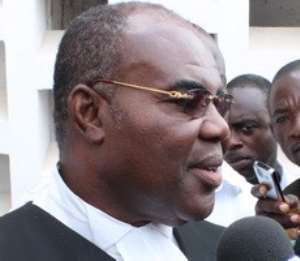
Closely after that, my eyes beheld yet another novel sight, which some others might reckon to be frivolous and yet, I consider crucial in the scheme of things. There positioned in the middle, directly in front of the other leading protagonist in the ensued case, Justice William Atugugba was Mr. Ayikoi Otoo, legal counsel for the two contemnors. He could have chosen to sit among the lawyers of his ilk i.e. sit at the petitioners‟ side yet, to accomplish some diversionary effect and positive receptivity, he chose to set up at this safe but easy to be misconstrued place. The symbolic quality in this you might not discern or worse, tote up as moot, but I see and accept as important. Scene analysis has a place in the courtroom; whatever happens in court must be for a purpose. For a lawyer, even where you keep your seat must be for a specific purpose, not merely the general purpose of being in the sight of the judges. The answer is to walk into the courtroom, find a chair in the appropriate place and sit down. This takes some pressure of you since you know you have accomplished the first thing to do and helps you to start on a positive footing. You already know something, and unless you have picked a wrong or inappropriate place to pitch camp, you know that at least you have one thing right from the start. What is more, looking at facial expressions and other nonverbal cues to determine whether a person is lying or not, have always being a widely used technique. In everyday life, it might just save you from being a victim of fraud or it could help you to know it is safe to trust your heart and get involved with an attractive stranger. Similarly, jury analyst use lie detection when assisting in jury selection, the police do it during interrogations and even judges use it to determine which side to rule in favor of. By setting up right in front of Justice William Atugugba, Mr. Otoo had symbolically assumed the „I have nothing to hide‟ and the „I mean what I say‟ posturing, all of which customarily acquiesces with the demeanor of a person that is saying the truth. It is not for corny reasons that Justice Atuguba himself, lamented on the comportment of Sir John in court that day. He said lots to the effect that, even before the ever- powerful court, he could not detect any pang of guilt or sign of repentance from the deportment of the NPP General Secretary. He was able to tell this just from observing his face and accompanying gestures. On any other day, this might have counted against him. However, for whatever human frailties Mr. Kwadwo Owusu Afriyie might have exhibited, his lawyer
compensated for by way of his unassuming demeanor and tactful oral advocacy in court.
When it came to his strategy of defense and his oral delivery in court, the seasoned lawyer was close to perfection. In subsequent interviews, he intimated that he did not contrive his defense strategy in court there and then, rather, he had decided on how to approach his clients‟ defense long before time. When it came to it, he went with a seamless damage control strategy, knowing that such a strategy firstly, would serve his clients‟ interest well and further, would offer him the space to do some necessary commentary on the provocative questions that characterize the
5
contentious issue of contempt. The Former Attorney General thought that tactfulness, rather
than, aggressiveness and belligerence is the winning strategy for defending criminal contempt before the Court and he did execute his clients‟ defense in court on the 14th exactly following this premise. "Your duty when your client is facing criminal trial is to do everything possible to get him out of misery", "it‟s a matter of strategy", he subsequently said. He added that, "If your client is facing contempt proceedings and you come to argue with the bench, you know,
showing them what is wrong with whatever they have done, [then] you are infuriating them".
Strategy in its original form, is exactly what it is; an abstraction lest it is animated and transformed into concrete action that achieves results for all to see.
At the core of the exercise to bring plans to life is effective communication, your plans ought to be relayed effectively to all actors that are involved in the enterprise, they must understand exactly what you intend to accomplish in order for you to get a good response from them. Lawyer Ayikoi Otoo gets this principle and he showed it in the way he addressed the court on the 14th. Overall, he spoke to the Law Lords in a placatory tone knowing that they were already piqued and might not be receptive to him and his clients.
Hitherto the dominant medium through which legal arguments are expressedoral advocacyis rarely given formal intellectual attention in this country, at least. I hear that it is not aggressively taught in our law schools and worse, there are some practicing lawyers who misconstrue it as akin to public speaking or debating. It is not any of those; it is an art and one that has to be mastered by all advocates on the job. It is not always about knowing the lawit is of course a necessary conditionbut not a sufficient one. Lawyers more importantly, should know how to present their case in court. It is requires a skill not adequately thought in the law school. Oral advocacy, as I have come to know via researching for this article, is something you acquire by doing. Ayikoi Otoo has acquired that over the years and he did not shun from flaunting it when the cameras were focused on him with the whole of Ghana watching.
In the same way, the NPP lawyer leveraged his good interpersonal skills to ensure that his clients did not end up spending time in jail at the end. It came off as obvious that he had a certain degree of social acquaintance with some members of the esteemed panel of Justices. However, what was more expressive is, he did not leave it at that, he exploited that privilege to his clients‟ benefit and the effects of this was plain for all to see. He often threw in some anecdotal comments, which he knew the Justices would be at ease with. I recall that at a certain point, he boldly reminded them that although they are a notch above him in terms of status within the legal profession, they are essentially first, "colleagues" and thus, there was no need for them to be overly antagonistic to his cause or his clients‟ thereof.
Lawyers and judges have traditionally been trained for operation within a fundamentally adversarial approach to the law. Students entering law school commonly have an adversarial conception of the law based on their experience of dramatic portrayal of court cases in popular literature and the media. In the teaching of the law, not so much tutelage is given to lawyers on the role of emotions in the practice of law. The teaching of interpersonal skills has also been
6
largely lacking. It is crucial to know that, for lawyers, whiles knowledge of the law, writing and
adversarial court advocacy skills are important, the significance of interpersonal skills must also be appreciated. The ability to listen, to be sensitive to the emotions of others, to express empathy, to be aware of body language, to be able to communicate effectively and sensitively with others are important interpersonal skills that assist in a therapeutic legal and judicial practice. They enable both lawyer and judicial officer to uphold voice, validation and respect, which research has found endorses litigant satisfaction and respect for the justice system. Again, the Former Attorney General has this ability in abundance and he thoughtfully applied it to his presentation and consequently, for his clients‟ benefit. In the end, an advocate is not an advocate of his own needs. An advocate is there for someone else‟s need.
Reflexions: The Victor and the Legal Deity
Personally, I believe that folks who still think that science and religion are mutually irrelevant need to realize that, the Berlin Wall has fallen; and I daresay like the era it represents, there is little prospect of reincarnation. Science and religion have since discovered that they have important mutual interests and important contributions to make to each other and those people who do not accept this can choose not to be part of the consequent dialogue, but that won‟t bring the dialogue to an end or show it to be meaningless. The stated philosophical and historical conflict between religion and science holds no sway in present times, I aver. It has been superseded by historical and contemporary propositions specifying a more nuanced understanding of the relationship between the two, I further argue. Though such clashes may garner print, airwave and bandwidth headlines, it is important to remember that, behind sights and out of the glare of publicity, many cases exist in which religious and scientific perspectives do not collide at all. If the Galileo and Scopes trial come to mind as examples of conflict, they were the exceptions rather than the rule and history would corroborate this. Accepting a scientific worldview need not require giving up religious faith and you do not have to be an atheist to practice science either.
Now back to the matter concerning Sir John and his seeming victory in court, and to the central question in this article: Is it a victory for science represented by Mr. Ayikoi Otoo in the context
that I have explained before now or is it a victory for faith represented by the NPP‟s Vigil?
I am tempted to assign the victory to science for straightforward reasons. First, from the events of the 14th, it is evident that what played out in court was the most influential and most talked about. You can fault me for not appreciating it more from clairvoyant angle, but I think doing that would imply making a ridicule of the input of Lawyer Ayikoi Otoo and the gains he made in court on that day. It would not be fair to allow the activity that received less attention from the public to be graded above what one and all saw happen and tacitly discern as the most practicable reason behind the supposed success in court.
7
Furthermore, I have sought some education in preparation for this article and now I understand
certain straight legal issues concerning contempt, which I believe endorses my proffered choice. For the most part, charges of criminal contempt of court are serious and should be dealt with immediately. Both criminal contempt charges and civil contempt charges are significant, although criminal contempt charges carry a much greater weight than civil charges. However, because the line between criminal contempt of court and civil contempt of court is often challenging to distinguish, you may be suddenly facing unjust charges. The difference between civil contempt charges and criminal contempt charges could be extremely consequential for your future. Since the determination between the two types of charges can be somewhat arbitrary, you could be facing life-changing penalties due to unwarranted charges. In addition, criminal contempt charges are not simply an add-on to the original criminal accusations; on the contrary, they are additional charges. Before you have time to react, you could be facing multiple accusations of criminal offenses.
That being said, there are defenses that can be developed to lessen or appeal the criminal contempt of court charge. These strategies will vary on a case-by-case basis, i.e. there is no standard strategy applicable to all situations. Then again, in the absence of clear delineations on the infraction obtainable from codes, statutes and the like, as is the case in Ghana, the contemnor‟s fate for the most part is at the mercy of the bench. Hence, for any given lawyer, where it is cognizable that the evidence that is being adduced against your client is well convincing, the smart play would be to attempt to mitigate rather than aggravate, other things being equal. In other words, the prudent thing to do in situations where adjudication is customarily done in a vacuum as it were is to tone down on the disputatiousness, show cause, and try to patch up with the bench. Mr. Ayikoi Otoo appreciates this demand as was evident in his approach to business in court on the 14th.
Can we by these goes, elevate him to the status of a „deity‟ amongst lawyers in the country? Well, for me, affirming this will be trying to over-egg the pudding. Besides, I am aware of the sensitivities here, so I would avoid proffering an opinion in respect of this. Nevertheless, I am highly confident that he would remain a reference point for how best to orchestrate defense in court for criminal contempt in Ghana for a long while.

 Korle Bu Teaching Hospital to introduce IVF and Corporate Clinic before end of 2...
 Accra West: Sarpeiman, Medie and other areas to experience power outages on Sund...
 Accra West: Faulty transformer causes outage Pokuase Amanfrom and surrounding ar...
 Restoration of Akosombo turbines not automatic solution to current dumsor — Mira...
 We have enough capacity to meet electricity demand — Energy Minister
 May 2: Cedi maintains value, sells at GHS12.15 on forex market, GHS11.20 on BoG ...
 2024 outages not due to transformer overloads — Energy Minister defends past com...
 US to withdraw about 5,000 troops from Germany
 Rebels take key military base in Mali's north
 Middle East war's impact on shipping hitting refugee aid: UNCHR


