




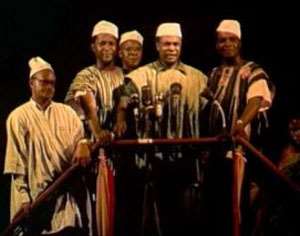
'The following are considered 'founding fathers' of Nigeria: Herbert Macauley (1864-1946); Professor Eyo-Ita (1904-); Alvan Ikoku (1900-1971); Dr. Nnamdi Azikiwe(1904-1996); Chief Obafemi Awolowo (1909-1987); Sir Ahmadu Bello (1910-1966); Sir Udo Udoma (1917-1998); General Murtala Mohammed (1938-1976); Al-Haji Aminu Kano(1920-1983); Joseph Tarka (1932-1980); Dennis Osadebay (1911-1994).
'The troika of Obafemi Awolowo, Nnamdi Azikiwe, Ahmadu Bello negotiated Nigeria's independence from Britain, aided by such figures as Chieftess Funmilayo Ransome Kuti'- Wikipedia.
To 'found' a village, or a town, or a city, or a country is to 'establish' it. The word 'found' is synonymous with 'build', 'establish', 'originate', 'institute, 'start'. The 'founder' of a place is the original builder. Much depends on who is talking or writing. When Alexander the Great of Macedon (Greece) in his expansionist campaign conquered Rhacotis and re-named it Alexandria (Egypt) in 331 BC, he massacred all the males in the city and allowed his military men to marry the females there. When Christopher Columbus went to America in 1492 and 'discovered' it, there were people living there; besides, there had been other 'discoverers' who had not made public their 'discoveries'. When the Portuguese Don Diego d'Azambuja, came to the Gold Coast and 'discovered' it in 1471, our forefathers were living here.
However, 'the general rule' is that the term 'national founding fathers' is ascribed to men (and women?) who are credited with establishing their nation, who played influential roles in setting up the systems of government, that is, the form of government and the constitution.
Ghana has had a chequered history ('chequered' in the sense of variations in fortunes; characterized by periods of trouble or controversy as well as periods of success).
The land-mass of Ghana was not simply annexed by any foreign power (Portuguese, Danes, British) as monolithic entity at the same time.
The southern Fanti States signed the Bond of 1844 with Captain George Maclean as a protectorate (that means they enjoyed British protection against Asante infiltration. Ashanti was beaten in the Fourth Anglo-Asante war by the British (in 1896 and 1901) which led to the Asantehene Prempeh I and a group of Asantes being taken away to the Seychelles Island. That opened the way for the annexation of Asante. The Northern Territories were annexed by Britain in 1896 as a pre- emptive move against the French and German infiltration. The Volta area which was known as Trans-Volta Togoland was granted to Britain as a trusteeship by the League of Nations in 1919 after Togo's conquering masters, Germany, had been defeated in World War I. (The eastern side of Togo was given to France as a trusteeship). The plebiscite of 1956 in the Volta area was only to affirm their linkage to Ghana since 1919.
The three territories of the Gold Coast - The Colony (the coastal regions); Asante and the Northern Territories became a Crown Colony. As far back as 4 th August, 1897, the Aborigines' Rights Protection Society, under the leadership of John Mensah Sarbah. Joseph Casely Hayford and others had been formed to fight the sequestration of native land under the Colonial Crown Lands Bill of 1897.
In 1920, one of the African members of the Legislative Council, Joseph E. Casely Hayford, convened the National Congress of British West Africa and demanded a wide range of reforms and innovations for British West Africa. The National Congress sent a delegation to London to seek the Colonial Office's consideration of the principle of elected representation. Notable leaders of the delegation included Africanus Horton, John Mensah Sarbah and SRB Attoh-Ahuma.
It was not until 1946 that Alan Cuthbert Maxwell Burns introduced the Burns Constitution (which replaced the Guggisberg Constitution of 1925), in which the Legislative Council, with only advisory powers, was composed of six ex- officio members, six nominated members and eighteen elected members, reserving all executive powers in the Governor.
The United Gold Coast Convention was the first nationalist movement with the mandate to seek self- government 'in the shortest possible time'. Founded in August 1947 by such educated African as J.B. Danquah, A.G. Grant, R.A. Awoonor-Williams, Edward Akufo-Addo, they picked Pa Grant as their chairman.
Indirect Rule which was being practised at that time was identified by these nationalists as satisfying colonial interests and the traditional past. Being professionals engaged in their private interests, Kwame Nkrumah was invited to Ghana upon Ako Adjei's recommendations to become General Secretary and charged to coordinate the activities of UGCC full-time. But Nkrumah had other plans and other ideas which were to reveal themselves later- he hardly had anything good to say about the UGCC which had engaged him; he rather used the resources provided by the UGCC to project his own agenda
There was an organized boycott of European imports in January 1948 with the aim in getting foreign traders then known as the Association of West African Merchants (AWAM) to reduce the prices of their goods. (AWAM has become synonymous with trickery, cheating and profiteering). In Accra, the boycott was organized by Nii Kobina Bonnie.
On 20 th February, 1948, Kwame Nkrumah and J.B. Danquah met and addressed the World War II veterans who had been agitating for their end-of-war benefits at the Palladium Cinema in Accra.
On February, 28 1948, the veterans sought to submit a petition to the Governor, Sir Gerald Creasy about their poor conditions, unpaid war benefits and neglect. When British Police Superintendent, Colin Imray ordered them to disperse and they refused, Imray shot and killed three of them: Sergeant Cornelius Frederick Adjetey, Corporal Attipoe and Private Odartey Lamptey. This sparked further rioting and looting.
That same day, the UGCC leaders sent a cable to the Secretary of State in London: '…unless the Colonial Government is changed and a new government of the people and their chiefs installed at the centre immediately, the conduct of masses now completely out of control … will continue and result in worse violent and irresponsible acts by uncontrolled people. The Working Committee of the United Gold Coast Convention declare that they are prepared and ready to take over the interim Government. We ask in the name of the oppressed, inarticulate, misruled and misgoverned people and their chiefs that a Special Commissioner be sent out immediately to hand over Government to the interim Government of chiefs and people to witness the calling of the Constituent Assembly.'
Following the riots, a Removal Order was issued by Governor Gerald Greasy for the arrest of the six leaders of the UGCC: Ebenezer Ako Adjei, Edward Akuffo-Addo, J.B. Danquah, Kwame Nkrumah, Emmanuel Obetsebi-Lamptey and William Ofori Atta. They were in prison between 12 th March, 1948 and 12 th April, 1948. A Commission of Enquiry chaired by Aiken Watson was set up to look into the riots and one of its recommendations was the preparation of a new Constitution. The Coussey Committee was set up for the purpose and this resulted in the 1951 Constitution. Meanwhile, Nkrumah had broken from the moderate UGCC and formed the radical Convention People's Party in June, 1949. Nkrumah commented: 'If the Coussey Committee does not find for self-rule now, we will shut this country down, we will strike, strike, strike'. Nkrumah continued: 'We prefer self-government in danger to servitude in tranquility'. Of course, CPP relied on other mottos: 'Forward ever, backward never', and 'Seek ye first the political kingdom and all things will be added to it'. In June, 1951, Nkrumah was invited to America where he received the honorary degree (Doctor of Laws) from his alma mater, Lincoln University.
With the wrangles between the Prime Minister Kwame Nkrumah and the UGCC leadership of J.B. Danquah, the Hansard of the House of Lords recorded Lord Rennell on 24 th July, 1952, as saying: 'I, for one, am perturbed to find that the Prime Minister, Mr Kwame Nkrumah is reported in the Press as having said on May 24 th , on what in the Gold Coast is called Anti-Imperialist Day, that anyone who identified himself with Opposition forces was a traitor to his race and to his country. He complained that Opposition Parties were trying to divide the country, and he added that the country was not going to tolerate a new Party…I submit that this is a dangerous attitude of mind'.
It will be an anathema for Ghanaians to disregard our heroes. Abraham Lincoln once said, 'A nation that does not honour its heroes will not long endure'. President John Fitzgerald Kennedy on his part noted, 'A nation reveals itself not only by the men it produces, but also by the men it honours, the men it remembers'. Is there a lesson to be learnt from the Nigerian example of honouring our heroes, noting that we charted the course of our political development along the same path: we were both colonized by Britain; both practised 'indirect rule'; at a time (1874) Accra and Lagos were being administered under one British governor.
Who are the makers of Ghana's political 'civilization'? All those who have contributed to the building of this nation need to be adequately rewarded. Pa Grant, 'The Big Six', Dr Busia, Baffour Akoto- you name them- have contributed their quota to obtain for us the multi-party democracy of which we are all proud. Kwame Nkrumah played his part: he has sufficiently been given his desserts (in spite of his one-party system and the Preventive Detention Act). But to make a day a holiday and celebrate it as if he founded Ghana is something I will protest about, and I will (like the 'citizen vigilante' Martin Amidu) carry the cross in this crusade!
PS: Last week's (October 4 th 2012) piece is corrected as: '…but being a day for a number of martyrs, the apostrophe lies after 's', that is, Martyrs's Day or Martyrs' Day.'
 Korle Bu Teaching Hospital to introduce IVF and Corporate Clinic before end of 2...
 Accra West: Sarpeiman, Medie and other areas to experience power outages on Sund...
 Accra West: Faulty transformer causes outage Pokuase Amanfrom and surrounding ar...
 Restoration of Akosombo turbines not automatic solution to current dumsor — Mira...
 We have enough capacity to meet electricity demand — Energy Minister
 May 2: Cedi maintains value, sells at GHS12.15 on forex market, GHS11.20 on BoG ...
 2024 outages not due to transformer overloads — Energy Minister defends past com...
 US to withdraw about 5,000 troops from Germany
 Rebels take key military base in Mali's north
 Middle East war's impact on shipping hitting refugee aid: UNCHR


