




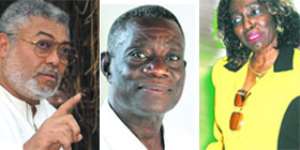
'The task ahead will not be an easy one. We will be fighting all kinds. If we are not fighting the opposition, you have the enemy also on one hand, and you have the traitor also on the other. So we have to remain vigilant.'- said Mr. Jerry John Rawlings when his wife, Nana Konadu Agyeman Rawlings handed to him her nomination form on May 3, 2011.
'The nomination forms mark the beginning of taking the country, Ghana, back to where it belongs.' - said Nana Konadu Agyeman Rawlings immediately after picking her nomination form to contest the incumbent President Atta Mills for the flagbearer position of the NDC.
Finally, the Delegates Conference of the National Democratic Congress is here with us, following months of vigorous campaigning to win the hearts and minds of the over 3,135 delegates, by Prof. John Evans Atta Mills, leader of the NDC and the sitting President, and Former First Lady, Nana Konadu Agyeman Rawlings, touted by many as 'Yaa Asantewaa,' due to her boldness.
The two frontrunners have been playing 'FONKAR GAMES' for quite some time now, but the moment of truth would be decided in the next forty-eight hours.
Below is the profile of the two candidates:
President John Evans Atta Mills
John Evans Fifii Atta Mills is the third and current President of the Fourth Republic of Ghana. He was inaugurated on 7 January 2009, having defeated the ruling party candidate Nana Akufo-Addo in the 2008 election. He was Vice President from 1997 to 2001 under President Jerry Rawlings, and stood unsuccessfully in the 2000 and 2004 presidential elections as the candidate of the National Democratic Congress (NDC).
Early life, education and academic career Mills is a Fanti from Ekumfi Otuam in the Central Region of Ghana but was born on 21 July 1944 in Tarkwa, located in the Western Region of Ghana. He was educated at Achimota School, where he completed the Advanced Level Certificate in 1963, and the University of Ghana, Legon, where he received a bachelor's degree and professional certificate in law in 1967.
In 1968, Mills studied at the London School of Economics and Political Science, and received a PhD at the School of Oriental and African Studies at the University of London. So began the pattern of the next twenty years of Mills' life, which was largely spent with spells both in Ghana & internationally as an academic. In Mills earned a Ph.D in Law from the School of Oriental and African Studies (SOAS) at the University of London after completing his doctoral thesis in the area of taxation and economic development.
Career as a lecturer
Mills' first formal teaching assignment was as a lecturer at the Faculty of Law at the University of Ghana, Legon. He spent close to twenty five years teaching at Legon and other institutions of higher learning, and rose in position from lecturer to senior lecturer to associate professor, and served on numerous boards and committees. Additionally, he traveled worldwide as a visiting lecturer and professor at educational institutions such as the LSE, and presented research papers at symposiums and conferences. In 1971, he was selected for the Fulbright Scholar Program at Stanford Law School in the United States of America.
At age 27, he was awarded his PhD after successfully defending his doctoral thesis in the area of taxation and economic development. He returned to Ghana that year, becoming a Lecturer at the Faculty of Law at the University of Ghana. He became a visiting professor of Temple Law School (Philadelphia, USA), with two stints from 1978 to 1979, and 1986 to 1987, and was a visiting professor at Leiden University (Holland) from 1985 to 1986. During this period, he authored several publications relating to taxation during the 1970s & 1980s.
Outside of his academic pursuits, Professor Mills was the Acting Commissioner of Ghana's Internal Revenue Service from 1986 to 1993, and the substantive Commissioner from 1993 to 1996.By 1992, he had become an Associate Professor of Law at the University of Ghana. Mills was also a Fulbright scholar at Stanford Law School.[2][3]
Vice-President of Ghana
For the inaugural Presidential Elections in 1992, the National Convention Party (NCP) had formed an alliance with the National Democratic Congress (NDC). Former Provisional National Defence Council (PNDC) Chairman, and leader of Ghana, Flight-Lieutenant Jerry John Rawlings chose the NCP leader, Kow Nkensen Arkaah, as his running-mate for Vice-President.
Having been elected in the 1992 elections, Arkaah served between 1992-1996.
However, on 29 January 1996, the NCP broke with the NDC, merging with the People's Convention Party (PCP) to form a rebirth of the Convention People's Party (the formerly outlawed political party of Ghana's first President, Kwame Nkrumah). Thus, in a bitter split, Arkaah would stand as candidate for the reborn CPP in the 1996 Presidential Elections against Rawlings. Rawlings selected Mills for the vacated Vice-Presidency in his bid for re-election to a second term in Ghana's 1996 Presidential Election Rawlings was re-elected to his second term in office, and Mills became Vice President of Ghana between 1996 to 2000.
Seeking for the highest office in Ghana
In December of 2002 John Atta Mills was elected by his party to be its flag bearer and lead them into the 2004 elections. In 2000, Mills became the NDC's candidate for the 2000 Presidential Elections after Rawlings had served his constitutionally mandated terms as president. At the time, and after essentially two decades of PNDC/NDC rule, the NDC's war chest for the upcoming elections was certainly much stronger than that of the NPP. The result would clearly between the NDC's popularity with the people, and Vice-President Mills' track-record alongside President Rawlings, and the veteran political experience that the NPP candidate would bring to the campaign. The main rival for Vice-President Mills' own bid for the Presidency would be against a veteran politician, John Agyekum Kufuor, who was running as the candidate for the New Patriotic Party (NPP). Kufuor was a former Member Of Parliament during the rule of Prime Minister Kofi A. Busia's Progress Party during his period of rule from 1969 to 1971, and served as the Deputy Minister Of Foreign Affairs. He had also been the Deputy Opposition Leader of the Popular Front Party (PFP) during the administration of Hilla Limann in the early 1980s. He had lost out to President Rawlings in the 1996 Presidential Elections, but gained a respectable 39.62% of the popular vote. Ghana's 2000 Presidential Elections went into two rounds. While in the first round, held on the 7th of December 2000, Mills gained 44.8% of the vote, Kufuor won the first round with 48.4%. This result forced the elections into a two-party run-off vote on the 28th of December 2000, where Kufuor crushed Vice-President Mills with a result of 56.9% of the vote. The NPP had won the election, and Kufuor was sworn in as President Of Ghana on the 7th of January 2001. In 2002, former Vice-President Mills was again selected as the candidate for the upcoming Presidential Elections in 2004. With President Kufuor's professional statesmanship evident, and Ghana beginning to show strong economical growth & attracting foreign investment, before votes were even cast, the result was largely being seen as a forgone conclusion. Subsequently, President Kufuor comfortably won the 2004 Presidential Elections by a margin of 52.45%, winning re-election in the first round of voting, and gaining even more parliamentary seats. It was almost without surprise that on the 21st of December 2006, that former Vice-President Mills became the NDC's candidate for the 2008 Presidential Elections, winning his party's ticket by a staggering 81.4% result. However, while NDC seemed to only have one serious candidate, the ruling NPP had two main contenders, Nana Akufo-Addo & John Alan Kyeremanten. Nana Akufo-Addo was the son of former President Edward Akufo-Addo (1969-1971), and former member of 'The Big Six', who were the pioneers of independence from Britain. Nana Akufo-Addo was an Oxford-educated barrister, and had served in the Kufuor administration as Attorney-General & Minister Of Justice from 2001 to 2003, and Foreign Minister thereafter.
John Alan Kyeremanten, more commonly referred to as Alan Cash, is a lawyer & businessman, as well as a former Ghana Ambassador to the United States Of America, and held several posts under the Kufuor administration, notably as the Minister Of Trade & Industry. Eventually, the NPP candidate became Nana Akufo-Addo, who won the most votes, but failed to get an outright result as preferred candidate. Nonetheless, as runner-up, Kyeremanten conceded defeat, and threw his support behind Nana Akufo-Addo as the NPP flagbearer. The campaign for the 2008 Ghana Presidential Elections was hard-fought. While the NPP pointed to their history of economic management, NDC pointed to issues such as corruption, and misappropriation of government funds. In the end, Ghanaians would be compelled to vote on how they compared the performance on the NDC's performance in government between 1992-2000, with NPP's performance in government between 2001-2009.
Although the elections would be viewed as largely peaceful, clashes did occur between NDC & NPP supporters, who were both as passionate as ever.
Early polls showed that Mills was the favourite, but in another poll taken just months before the first-round voting, Nana Akufo-Addo emerged as the favourite. Election campaigning was strong, particularly with advertising, which was clearly much heavier with the NPP candidate. The first round of voting occurred on 7 December 2008. In a very close result amongst all parties, Nana Akufo-Addo's NPP finished with 49.13% of the vote, painfully close to the outright margin required to win in the first round, while Mills' NDC finished with 47.92%. The other parties garnered only 2.37% of the votes. The result forced a second-round of voting between NPP & NDC on the 28th of December 2008. The result was a slim margin held by Mills, but due to problems with the distribution of ballots, the Tain constituency, located in the Brong-Ahafo Region, was forced to re-run its voting on the 2nd of January 2009. The voting in the Tain constituency led to a landslide victory to the NDC. For several days, the Electoral Commission of Ghana did not call the result to the NDC, and the NPP filed a lawsuit, claiming that 'the atmosphere in the rural district was not conducive to a free and fair election'. Eventually, the NPP bowed to the inevitable, and on the morning of 3 January 2009, the election result was finally called. Former Vice-President John Atta-Mills, who had failed to win in two previous campaigns, had won the 2008 Presidential Election, becoming the 3rd President of the 4th Republic Of Ghana.
Publications
Mills has produced several publications, including:
* Taxation of Periodical or Deferred Payments arising from the Sale of Fixed Capital (1974)
* Exemption of Dividends from Income taxation: A critical Appraisal (1977) In: Review of Ghana Law, 1997, 9: 1, p. 38-47
* Report of the Tax Review Commission, Ghana, parts 1-3 (1977)
* Ghana's Income Tax laws and the Investor. (An inter-faculty lecture published by the University of Ghana)
* Ghana's new investment code : an appraisal (1993) In: University of Ghana Law Journal, 1993, vol. 18, p. 1-29
He has held examiner positions with finance-related institutions in Ghana, including the Institute of Chartered Accountants, Institute of Bankers, and Ghana Tax Review Commission.
Contribution in sports
He has contributed to the Ghana Hockey Association, National Sports Council of Ghana, and Accra Hearts of Oak Sporting Club. He enjoys hockey and swimming, and once played for the national hockey team (he is still a member of the Veterans Hockey Team).
Presidency
On 21 December 2006, Mills was overwhelmingly elected by the NDC as its candidate for the 2008 presidential election with a majority of 81.4% (1,362 votes), far ahead of his opponents, Ekwow Spio-Garbrah, Alhaji Mahama Iddrisu, and Eddie Annan. In 2008, he was elected president of Ghana, after a keenly contested three round election.
Other activities and projects
Mills has been involved in various activities and projects such as:
* Member of the Ghana Stock Exchange Council
* Board of Trustees, Mines Trust
* Management Committee Member of, Commonwealth Administration of
Tax Experts, United Nations Ad Hoc Group of Experts in International Cooperation in Tax Matters, and United Nations Law and Population Project
* A Study on Equipment Leasing in Ghana
* Casebook preparation on Ghana's Income Tax
* Review of Ghana's Double Tax Agreement with the UK
* In 1988, John Evans Atta Mills became the acting Commissioner of the Internal Revenue Service of Ghana and named Commissioner in September 1996.
* In 1997, Prof. Mills received another important appointment when on January 7, 1997, he was sworn-in as the Vice President of the Republic of Ghana.
* In 2002, Prof. Mills was a visiting scholar at the Liu Centre for the Study of Global Affairs, University of British Columbia, Canada.
* In December 2002, John Evans Atta Mills was elected by his party to be its flagbearer and led them into the 2004 elections.
Personal Life
He is married to Ernestina Naadu Mills, an educator and has a 19 year old son, Sam Kofi Atta Mills with Ruby Addo.
He is a good friend to Pastor T. B. Joshua of The Synagogue, Church Of All Nations in Lagos, Nigeria and regularly visits his church. He said following his inauguration that T.B. Joshua had prophesied to him there would be three elections, the results would be released in January, and he would emerge victorious
NANA KONADU
Nana Konadu Agyeman Rawlings was born on the November 17, 1948 to the late J.O.T. Agyeman and his wife. She schooled at Achimota School, where she met her future husband Jerry John Rawlings. She continued at the University of Science and Technology, where she read Art, specializing in Textiles. She was a student leader and an executive of her Hall of residence,
Africa Hall
Nana Konadu got married to her sweetheart, Jerry John Rawlings an Airforce Officer Jerry Rawlings in 1977. She gave birth to her first child Ezenator Rawlings in 1978. Two other daughters and a son followed later; Yaa Asantewaa, Amina and Kimathi. She also has some grandchildren.
Nana Konadu Agyeman Rawlings came into the political limelight when her husband became Head of State briefly in 1979 and then from 1981 to 2001.
She became the president of the 31st December Women's Movement from 1982 to date. She was elected 1st Vice Chairperson of her party in 2009 during the second term of her National Democratic Congress (NDC) party's tenure in office under the current President of the Republic of Ghana, Prof. John Evans Atta Mills. She is now challenging the seating President of Ghana, John Evans Atta Mills for the party's flagbearership position at the party's congress taking place at Sunyani in the Brong Ahafo Region from 8-10 June 2011.
* Military – AFRC (1979).
* Military - PNDC (1981-1993).
* Multi-Party Democracy – NDC (1992-present).
* Profession: Artist.
* Religion: Roman Catholic.
Education
University of Science and Technology, Kumasi, Ghana, degree; advanced courses in London, England; Johns Hopkins University, Institute for Policy Studies, Baltimore, MD, certificate for fellows program in philanthropy and non-profit organizations.
Career
31 December Women's Movement (a non-governmental organization), president, c. 1980s.
Life's work:
31 December Women's Movement (a non-governmental organization), president, c. 1980s.
In a statement released by the Embassy of Ghana, former First Lady Nana Konadu Agyeman Rawlings stated, 'My desire is to see the emancipation of women at every level of development to enable them to contribute and benefit from the socio-economic and political progress of the country….
Women's vital role of promoting peace in the family, the country and the world at large must be acknowledged. And to do this, they must be empowered politically to equip them adequately for the challenges of critically identifying and assessing solutions for the betterment of society.'
This was the goal of the 31st December Women's Movement of which Nana Konadu Agyeman Rawlings was president. She described it as a 'broad based development oriented Non-Governmental Organisation that aspires to achieve these objectives through the effective mobilisation of women.'
In addition, her movement—two million strong—has set up more than 870 pre-schools in Ghana and has worked actively to stir up interest for the accomplishment of child development and family planning.
Ghana's former First Lady has said that she would continue to work in the women's movement even if her husband were no longer president. Her husband, Jerry Rawlings, led a military coup that seized power in 1981, although he was not established as head of state until the following year. The country successfully reverted to civilian rule in 1992 and held free elections. Calling the first lady 'an instrumental part of the revolution in Ghana's economy,' the Baltimore Afro-American reported that women were Ghana's largest labor force, and they wanted to be a central part of the country's redevelopment. 'Before December 31, 1981, they had no power of influence in law or politics—even the laws that pertained to them.' It was a grassroots movement, with women selling their land, clothes, and jewelry to get money.
Mrs. Rawlings was born on November 17, 1948 in Cape Coast, in the central region of Ghana. Both of her parents were professionals, her father serving as a prominent statesman and her mother as an educator. Mrs. Rawlings followed their lead, making education a primary concern in her own life. She attended one of the country's leading high schools, Achimota Secondary School in Accra, in the 1960s. In 1975, just three years after graduating with honors from the University of Science and Technology with a bachelors' degree in graphic design, she earned an interior design diploma from the London College of Arts. She would pursue her education into the next couple decades, acquiring a diploma in advanced personnel management from Ghana's Management Development and Productivity Institute in 1979 and a certificate in development from the Ghana Institute of Management and Public Administration in 1991.
When interviewed in Africa Report in January and February 1995, Mrs. Rawlings recalled that in the early 1980s, a few women approached her wanting to form a women's organization but after a few meetings, little happened. She said that after asking the women what they wanted to do as an organization, 'It was clear that we had to start with things that would earn money to develop their communities in the social sector. Most of the women wanted things like water.' Mrs. Rawlings spent time listening to women who came to her with their problems. Her movement taught Ghanaian women how to generate income and save money for community projects. It encouraged them to become part of the decision making process in their villages, and explained policies of health and education. It offered an adult literacy program to teach them to read and write—the majority of women could not do either. Too early marriages among female children were discouraged and programs were offered on nutrition and immunization. In 1991, through the efforts of Nana Konadu, Ghana was the first nation to approve the United Nations Convention on the Right of the Child.
Via the movement, Mrs. Rawlings also played a crucial role in the adoption of an 'Intestate Succession Law,' which is applicable to the survivors of anyone dying without a will. Traditionally, Ghanaian women had little or no rights of inheritance upon the death of their husbands. The new law provides a standard of inheritance.
Mrs. Rawlings movement has also taught village women to become involved in the electoral process. 'We literally just pounded it into them until they realized, hey, we don't want any of these people who are living outside our areas to come and stand in our areas to be elected,' she said in Africa Report. 'A lot of women are now on committees in their villages and districts, some are chairing the committees…. I can only say we've made a lot of impact, and I can see from the self-esteem and near arrogance of the women, that now we've actually been able to break through this thick wall.'
In 1992, 19 women were elected in parliamentary elections.
Pointing to the area of finance as one of their problems, Mrs. Rawlings told Africa Report: 'Most of the Western embassies said we were just a political group and they didn't take time to listen. It took a lot of time just getting people to understand…. The more women who enter politics, the better the world will be, because we don't think of wars and who is going to manufacture arms and who is going to kill the next person. We want to form linkages, network, and make the world a better place to live in.'
During 1995 Ghana's first lady traveled with her husband to cities, including New York, Chicago, Atlanta, Washington, D.C., Houston, Detroit, Lincoln, Pennsylvania, and Los Angeles, trying to encourage investment and trade with Ghana. Her husband was the first Ghanaian president to go on a nationwide tour in the United States.
The first lady of Ghana was in the United States for five weeks taking part in a fellows program in philanthropy and non-profit organizations at the Institute for Policy Studies at Johns Hopkins University in Baltimore, where she received a certificate after finishing the course of study, which included fundraising techniques, tax policy, and a course on community organization. In 1995 both she and her husband received honorary doctorate degrees at Lincoln University in Lincoln, Pennsylvania.
Noting Mrs. Rawlings's 'charm' and 'substance,' the New York Amsterdam News reported that she was praised by Ghana's permanent representative to the United Nations, George Lamptey, who said, 'For the past 12 years she has stood by her husband in the struggle to restore Ghana. She has led a group of active women to help empower Ghanaian women, freeing them from being hewers of wood and drawers of water to be[ing] actors in the political arena.'
Ghana's first lady is a member of the Ashanti tribe. She and her husband have four children, three girls and a boy. When not busy with her family or work, Nana Konadu Agyeman Rawlings enjoys swimming, reading, dancing, camping, and collecting dolls from around the world. She also devotes time and money to such charitable causes as the National Radiopathy Project, Friends of the National Zoo, and the Ghana Girl Guides Association to name a few.
Awards
Honorary doctorate from Lincoln University, Lincoln, Pennsylvania, 1995.

 Police arrest 64 suspects, recover firearms in special operation at Achimota Mil...
 Madina MP receives medical attention after GIMPA collapse
 Bolgatanga: Man found dead by roadside in Sumbrungu as police investigate
 Ghana concludes cocoa freight negotiations for 2026/27 season
 Blakk Rasta accuses Gushegu NPP MP Alhassan Tampuli of funding Ghana Jollof atta...
 €225m Cocaine Shipment: Court to rule on bail application of six accused in 3.9-...
 BoG pilots cedi-based payment system for Ghana-China trade
 2026 BECE: Ten schools score zero percent in Adaklu as girls outperformed boys
 ECG unions to stage nationwide protest over proposed private sector participatio...
 'Sceptics, naysayers, alarmists should be aware US ready to work with Ghana on r...


