




Having a roof over one's head has always been thought of as an opportunity, but not a fundamental human right, which the government is supposed to make sure of. However, if really the ability to have a roof over one's head is a fundamental human right, then the government has a lot of work to do in making sure people's right in this aspect is not abused in this country.
The government has been trying its best to make sure all rights of the people are rightfully fulfilled, but has mostly concentrated on domestic violence and other rights, but the right to housing has always been out of the question, even though very relevant, until recently, with the introduction of the STX Housing deal between the Ghana and Korean governments.
In a third world country like Ghana, it is not surprising that past governments have given little attention to housing issues, as they even have not been able to solve fundamental issues like unemployment.
Housing does not only means putting one's head under a roof, but giving the house in question certain qualities and features which will make life in it comfortable. A good housing system must be able to provide for the individual, a sense of privacy and security, and moreover, must have a good drainage system and clean environment to prevent diseases.
According to the International Covenant on Economic, Social and Cultural Rights (ICESCR) article 11, adequate housing systems include access to clean and affordable drinking water, energy for cooking, lighting and heating, as well as sanitation and washing facilities. Moreover, there must be adequate food, clothing, refuse disposal, site drainage and emergency services, and continuous improvement of living conditions.
The ICESCR further indicated that without adequate housing, the right to a good standard of living is less likely to happen.
If really, this is what good housing system entails, then, about 70 per cent of the Ghanaian population has their rights abused, in terms of housing rights.
Housing in Ghana
Housing in Ghana is not very adequate, as it has not been able to fulfill to the fullest the standards of the ICESCR housing system, and most times the only facilities that landlord are able to provide are energy for cooking, heating and lighting, with the rest of the standards not taken into consideration.
According to the United Nations Human Settlement Programme (UN HABITAT), there is currently about one billion people around the world living in slums. In Africa alone, over 60% of people living in urban areas live in slums, and it is estimated that by 2030, more Africans will be living in the cities than rural areas.
In Ghana, adequate housing system has always been the responsibility of the individual, after the regime of the first government. The concern of many governments, which come into power, is to secure homes and houses for government appointees, members of parliament, the security agencies and some workers of government institutions.
Even though that is the case, it is sad to note that those who feel fortunate to be living in government houses have their rights abused in terms of housing rights, as the quality of living is way below the standards of adequate housing provided by ICESCR. It is for some of these reasons that the government has thought it wise that the STX housing project will be of help, not for people in government, but for every citizen.
Slums in Ghana
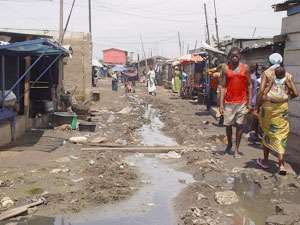
The slum is the commonest form of housing environment in Ghana, and many people find themselves living in slums due to lack of employment, the inability of people to afford decent homes, and the refusal of town planners to their jobs well.
According to 'homeinternational,' it is estimated that more than half of Ghana's population of over 21 million, live in the urban areas. Due to the increasing rate of urbanisation, the urban population is expected to double its figure of the year 2000 by 2015, and the majority of new urban dwellers will find themselves living in slum conditions and poorer settlements.
Research indicates that around 70 per cent of Ghana's urban residents live in slum conditions. The Sub Metro Director of Okaikoi South, Mr. Nathaniel Adzotor, has as well, confirmed that about one-third of residents in Accra live in slums, and as a result, do not enjoy adequate social services.
Walking through communities of Accra like Avenor, Nima, and Accra New Town, and two slum communities in Takoradi like New Takoradi and Kojokrom, are direct evidence of slum communities. Living in slums, according to Amnesty International, means living in densely crowded shacks, divided by rough paths and trenches filled with filthy water and rotting garbage, and that people living in slums are at risk of ill-health, poor sanitation, lack of privacy and security.
Slum dwellers live under constant forced evictions, being separated from friends and neighbours, and from access to jobs and school. The intensity of congestion, and the lack of proper planning on lands, makes way for heavy flood during the rainy season, which ends up destroying lives and property.
Amnesty international and housing rights
Slum settlements have resulted in various decongestion exercises, where the government always puts the blame on the people, and not town planners who refuse to give a constant reminder, or even put down indication or barriers which will prevent people from settling on a particular land, but rather allow them settle there for about 20 years, and just show up one day, and give the inhabitants three months period to leave the location.
As if that is not enough, they break rules such as undertaking the exercise at night, whereby the people are not available, or in a condition to take care of their belongings.
According to Amnesty International, just like any other rights, it will be considered a violation of a human right, if the right to adequate housing is not respected. To them, a housing right is violated when there is forced eviction, that is when people are thrown out of their homes unfairly and against their will, from homes and lands they occupy, either permanently or temporarily, without being provided with alternative housing, compensation and resettlement, or access to productive land.
Moreover, it is considered a human right violation when the evicted people do not have legal title to the house or land, that is to say informal settlers may not be forcibly evicted even if they are illegally occupying the land in question, or without the provision of, and access to appropriate forms of legal or other protection.
STX Housing Project
The introduction of the STX Housing deal is meant to partly solve the existing housing problems in the country, and to improve the standard of living of the people.
The STX Housing Project is a joint venture (JV) agreement between the Government of Ghana (GoG), STX Engineering and Construction Ghana Limited (STX), and HFC Bank Ghana Limited (HFC), in which the parties intend to develop 200,000 housing units in ten cities in Ghana, over a five year period.
In this principal agreement, the Government of Ghana (GoG) intends to off-take 90,000 of the units under the Off-taker Agreement.
The Home Finance Company (HFC) agrees to become the principal mortgage finance provider for 110,000 units, and STX agrees to find the financing, as well as build the 200,000 units, on a Build Lease Operate (BLO) basis. The total cost of the project is estimated at US$10 billion.
As part of it's obligation to off-take 90,000 units, the GoG, in a memorandum dated May 4, 2010, sent to Parliament a Supplier's Credit Agreement between the Government of Ghana and STX Engineering and Construction (Ghana) Limited, for an amount up to US$1,525,443,468 for the construction of an initial 30,000 units for the security agencies.
The terms of the credit agreement are that there will be a grace period of 5 years; a repayment period of 15 years; a maturity period of 20 years; an interest rate of 2% fixed; an arrangement fee of 0.75 per cent and a management fee of 0.5 per cent.
Conclusion
Poor housing system and slum communities in the country can be attributed to the poor housing facilities provided by house owners. The nature and plans with which house owners build houses for rental, creates congestion, resulting in slums in no time.
The STX housing project can go a long way to solve the issue of slum community development, when its implementation begins, however, in the mean time, the Sub Metro Director of the Accra Metropolitan Assembly (AMA), has stated that the assembly had directed all house owners in the metropolis, to provide toilet facilities in their houses, by the close of 2010.
He said this directive forms part of the implementation of the Urban Environmental and Sanitation Program l and II (UESP), and the Urban Poverty Reduction Project, initiated by the Central Government, in collaboration with the AMA and the World Bank.
This is a stepping stone towards the achievement of adequate housing, however, if one may ask, is this directive just spoken words, or will its implementation really take place?
It is up to the AMA to make sure this directive is taken seriously, and not be a nine day wonder. If really, Ghana, as a developing country, hopes to achieve the state of a developed nation, then the government must try to make the right to housing and adequate housing a priority, and part of its agenda of development.

 BECE papers must be reduced to just four subjects; ten is a torture — Kofi Asare
 Mahama, appointees donate GH¢6.1m to Medical Trust Fund
 Leading member of NPP says President Mahama is genuine
 Nkwanta South two BECE candidates involved in accident recovering well — Educati...
 Teachers of Adiewoso Basic School whipped in military operation against galamsey...
 It’s not true that ex-Buffer Stock CEO was denied access to his lawyers — Deputy...
 Greater Accra Regional Minister is not performing — Kwame Owusu Danso
 Gov’t weaponising state agencies against political foes — NPP’s Kamal-Deen
 Parliament should pass procedural safeguards limiting immediate rearrest after j...
 Police arrest six men accused of impersonating security operatives in Agona Swed...


