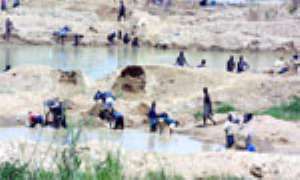
Poor men and women in Ghana, ex-militia fighters in steamy eastern Congo and farmers in Peru are among those joining the ranks of illegal miners and risking their lives as they seek to profit from soaring gold prices.
As a new gold rush spreads across the world's remotest corners, the face-off between illegal, small-scale miners and multinational firms has cost millions of dollars and claimed lives.
Not all small-scale miners work illegally, but as international firms move into ever more remote and politically risky countries, they sometimes tread on the toes of artisanal miners who have worked that land for years.
Alternatively, mining conglomerate's trucks and cranes can act as magnets that draw small-scale miners to a previously unexplored area.
Whatever the dynamic, the result can be explosive.
"The higher prices of gold have made illegal mining an issue in areas where there wasn't any problem before," said Olle Ostensson, chief of the natural resources section at the United Nations Conference on Trade and Development (UNCTAD).
Gold prices have tripled over the past five years. After coming off recent highs, spot gold rose to above $950 an ounce last week as tensions in the Middle East continued to encourage investors to seek safe haven in bullion.
There are between 13 and 20 million small-scale miners around the world, according to Communities and Small-Scale Mining (CASM), a group focusing on social and environmental problems facing artisanal mining communities.
They account for about 10 percent of the global production of metals and diamonds, and 75 percent of all gemstones. Around 100 million people are directly or indirectly dependent on small-scale mining.
In mineral-rich but often inaccessible parts of Africa, six to eight million people work as small-scale miners.
CASM says there are between 800,000 and 1.5 million artisanal miners in Democratic Republic of Congo, between 350,000 and 650,000 in Sierra Leone and between 150,000 and 250,000 in Ghana, with thousands more across the continent.
The intense battle for resources is sometimes causing violent clashes between multinationals and what some industry officials call “cowboys.”
In Ghana, Africa's second largest gold miner after South Africa, illegal miners, known as galamseyers, have disrupted operations in several mines and are costing companies millions of dollars.
Some of the miners are local men and women, but mining firms say others come in from nearby countries.
Some industry officials say rich backers are financing informal operators in some parts of Africa. Thieves are also targeting mines to steal diesel or copper cables, causing power cuts that can trap mine workers underground.
"Illegal mining in Ghana is increasingly larger in scale, they are using bulldozers ... they have big floodlights to work at night -- all of which means there is capital up front," said Chris Anderson, mining giant Newmont's Director of Corporate and External Affairs in Africa.
At least six illegal miners, aged between 14 and 20, died at AngloGold Ashanti's Obuasi mine in Ghana in the last month, officials have said.
In Peru, the world's leading silver producer and the fifth largest producer of gold, a growing number of small-scale farmers have turned to mining, UNCTAD's Ostensson said.
"Instead of earning $1 a day by farming the land, people prefer to earn $2-3 by standing in a river mining gold."
Reuters
 PURC increases electricity and water tariffs effective July 1
 GWL charges customer over GH¢74,000 for illegal reconnection
 Interior Ministry suspends Kantanka Security Services licence over Adwoa Safo sh...
 Torrential rains wreak havoc in Central Region as 18 killed, hundreds affected, ...
 Police invite Nana Kwadwo Safo Akofena over Kwabenya shooting incident
 Biakoye NPP Vice Chairman commends Agbodza, demands urgent fixing of deteriorati...
 Pregnant mother of three hospitalised after alleged assault by husband
 Senior student allegedly slaps Junior repeatedly over missing mobile phone at Nc...
 There was no gun in Adwoa Safo’s car, I saw more than 30 bullet holes on her car...
 NPP Bantama Chairman, Vice Chairman arrested after clash over constituency album...