




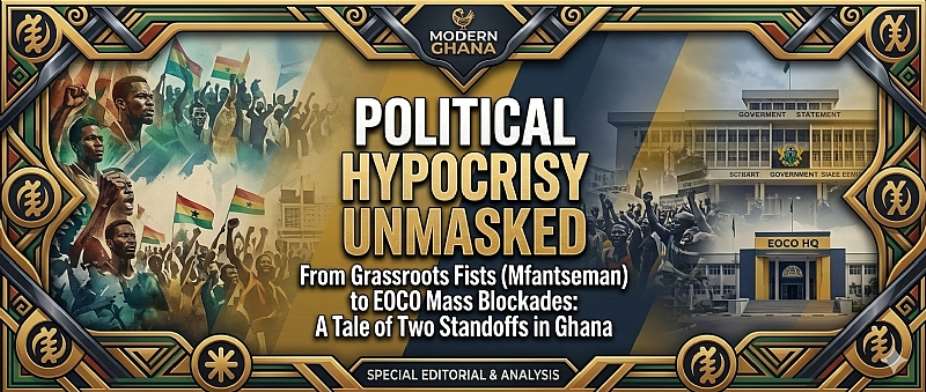
Ghana's democracy is being systematically strangled, not by a lack of laws, but by an abundance of political duplicity. The New Patriotic Party (NPP), which historically prided itself on being the champion of property rights, intellectual discourse, and the rule of law, has undergone a worrying transformation. Within 48 hours, the nation has witnessed two startling examples of institutional subversion from the highest echelons of the party down to its grassroots.
At the top, we see party leadership mobilizing masses to picket the Economic and Organised Crime Office (EOCO) headquarters, disrupting public order to shield high-profile arrestee Dennis Miracles Aboagye from a GH¢55 million corruption probe. Simultaneously, at the grassroots level, a viral video showing chaos and physical scuffles at the Mfantseman NPP constituency office exposes how internal democratic systems are violently compromised when independent rules do not favor the local elite. This glaring inconsistency reveals a dangerous playbook: accountability is a noble concept—until it applies to them.
The Grassroots Breakdown: The Mfantseman Crisis
The recent physical altercations inside the Mfantseman constituency office are not isolated incidents of random passion; they are the direct byproduct of calculated procedural manipulation:
- The Biased Venue Play: Local party administrators deliberately scheduled crucial constituency executive elections to take place at the private residence of the incumbent Constituency Chairman, who happens to be running for re-election.
- The Voter Album Sabotage: More than 180 polling station coordinators, led by spokesperson Eric Kwesi Baffoe, publicly rebelled after discovering unfair modifications and structural manipulation within the internal voters' register.
- Weaponizing the Courts: Deprived of a neutral playing field internally, local party members were forced to bypass their own dispute mechanisms and run to the High Court for an emergency injunction to halt the rigged voting center.
- The Irony of Order: A political party that demands total submissiveness from ordinary Ghanaian citizens cannot maintain basic civility or respect democratic guidelines within its own local offices.
The National Double Standard: Shielding the Elite
The behavior at the grassroots mirrors the precise pattern of institutional obstruction exhibited by the national executive body:
- The Double-Standard Deflection: When state watchdogs pursue political opponents, the ruling elite labels it a "triumph of anti-corruption." Yet, the moment EOCO lawfully detains an internal frontrunner at an international airport, national party organs decry the move as "political intimidation".
- Obstructing Independent Agencies: Mobilizing party faithful to block metropolitan traffic and pressure state investigators degrades the professional sovereignty of independent fiscal institutions.
- The Immunity Delusion: Public declarations of party-executive bids are increasingly used as an armor to pretend that any legitimate financial inquiry is a targeted political hit rather than an administrative necessity.
Institutional Recommendations: Restoring Systemic Integrity
To break this cycle of hypocrisy and prevent political entities from operating above the law, Ghana must implement rigid institutional boundaries:
- Mandate Neutral Venues for Public Elections: The Electoral Commission (EC) and national laws must explicitly prohibit any political party from hosting internal public elections within private residencies or candidate properties. All internal party votes must be held at verifiable public schools, civic centers, or state facilities.
- Codify Criminal Charges for Obstruction: Parliament must introduce strict legislation that penalizes political party executives who organize street actions, pickets, or human shields around active investigative bodies like EOCO, OSP, or police commands.
- Enforce Strict Timelines for Internal Album Access: To end the endless cycle of local voter register manipulation, all internal party registers must be audited, frozen, and distributed to all candidates exactly 30 days before any local poll, eliminating overnight structural purges.
- Depoliticize State Agency Appointments: The heads of investigative institutions must have fixed, protected tenures that span across political cycles, ensuring they can investigate public figures from any government without fear of swift executive removal or partisan retaliation.
Ghana's development cannot survive a political class that views state institutions as weapons for containment and political parties as shields for wrongdoing. The simultaneous explosions of tension—from the fists flying in the Mfantseman constituency office to the rowdy street blockades outside the EOCO headquarters—prove that the ruling party’s disrespect for independent systems is a systemic flaw, stretching from the grassroots straight to the top.
If the NPP genuinely believes in the rule of law, it must lead by example. True democratic commitment means respecting the integrity of a voter's album in Mfantseman, allowing the courts to settle venue disputes quietly, and letting EOCO investigate a GH¢55 million probe without political interference. Ghana belongs to its citizens, not to political parties. It is time to retire the hypocritical rhetoric, stop the partisan shields, and let our national institutions do their work.
✍️ Retired Senior Citizen
For and on behalf of all Senior Citizens of the Republic of Ghana 🇬🇭
Teshie-Nungua
[email protected]


 BNI investigates Yaw Ampofo Ankrah over alleged World Cup visa facilitation sche...
 EOCO arrests three over drone flights at headquarters during arrest, probe of Ma...
 NPP’s removal of NACOC from routine checks made Ghana’s borders porous – Dr. Sam...
 Police arrest three suspected kidnappers over Yendi abduction
 Ghana’s older population projected to hit 5.7m by 2050 – Gender Ministry
 4,405 teachers to be placed on Director II rank this year – GES
 Contractors begin construction of 120-bed trauma hospital at Bole – Kwakye Ofosu...
 Gov’t procurement must prioritise local farmers for school feeding – Dr. Ato For...
 Vacate by October 4 or face demolition – KMA warns Abrepo Junction occupants
 Diesel will not hit GH¢22 at pumps – NPA CEO assures


