




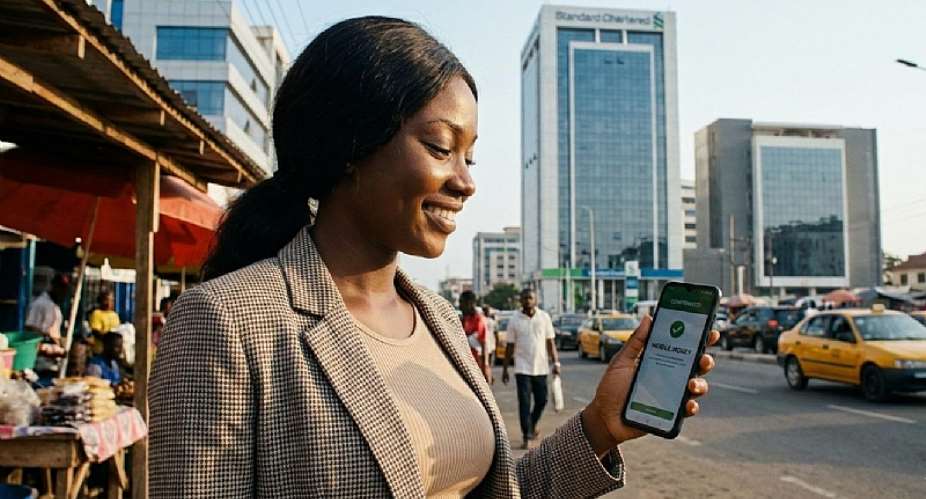
Let me start with a number that should make every Ghanaian business owner sit up and pay attention. Mobile money transactions hit 3.6 trillion cedis in October 2025 according to Accra Street Journal. That is not a typo. That is more than half of Ghana's formal payment flows . The digital economy is not coming. It is here. And it is changing how Ghanaians pay, save, borrow, and live.
.
The Mobile Money Revolution: By the Numbers
Ghana's fintech ecosystem has grown into one of West Africa's largest, with an estimated 200 fintech firms operating across payments, lending, insurtech, and regtech . The numbers behind this growth are staggering.
The Bank of Ghana reports that the number of mobile money customers has grown from 4.9 million in 2015 to 24 million active accounts by 2025 . With mobile penetration exceeding 130 percent and over 80 million registered mobile money accounts nationwide, the infrastructure is in place for digital finance to become the primary way Ghanaians manage their money .
Mobile money now accounts for half of Ghana's formal payment flows, and the numbers continue to climb. 80 percent of respondents now report using mobile money weekly, the highest level recorded since 2022 and a seven-percentage-point increase from the previous year . Meanwhile, ATM usage has fallen sharply from 34 percent in 2024 to just 16 percent in 2025 . Ghanaians are quietly ditching cash for digital alternatives.
.
Why More Accra Residents Are Using Online Lending Platforms
The expansion of fintech has opened doors for lending platforms that were previously unavailable to many Ghanaians. Companies like JUMO, Zeepay, and others have stepped in to fill gaps left by traditional banks .
The Ghana Card digital ID system, combined with the Bank of Ghana's National Payment Systems Strategy (2025-2029), has enabled seamless onboarding and service delivery across financial platforms . This means that even Ghanaians without formal credit histories can now access loans through fintech platforms using alternative data.
However, trust remains a barrier. Kasi Insight's Banking Brand Intelligence tracker found that while 95 percent of respondents are aware of specialized fintech solutions, only 15 percent are active users today, and 32 percent have used them in the past but abandoned them . The Net Promoter Score for fintech platforms is -36, compared to -7 for mobile money . The platforms that succeed will be those that build trust through transparency, fair terms, and reliable service.
.
The Rise of Investment Apps Designed for Ghanaians
Ghana's fintech ecosystem is entering a more mature phase, with growth increasingly shifting toward adjacent verticals like wealth management, insurance, and embedded finance . Digital wallets are evolving into full-service financial hubs, allowing users to borrow, invest, and pay from a single interface .
The integration of fintech into broader economic systems, such as agriculture, trade, and public services, will be critical in the next phase of growth . Investment apps are tapping into this by offering Ghanaians access to Treasury bills, mutual funds, and other investment products that were once the preserve of the wealthy.
.
How QR Payments Are Changing Retail in Accra
QR payments are gaining significant traction in Accra's retail sector. According to Ghana Interbank Payment and Settlement Systems (GhIPSS) data, GhQR transaction values grew by 80.56 percent in 2025, from 7.16 billion cedis to 12.92 billion cedis . The platform added 167,000 new agents in 2025, bringing the total count of agents on the platform to 576,000 .
The shift is driven by increased merchant adoption and promotional activities at retail outlets such as Melcom and China Mall . Accra residents are increasingly comfortable using QR codes to pay for everything from groceries to transportation. The decline of ATMs and the rise of mobile wallets make QR payments a natural next step in the digital payments evolution.
.
Why Digital Wallets Are Becoming Essential in Urban Ghana
The transition from telecom-led to ecosystem-led models is reshaping Ghana's fintech landscape . Where mobile money was once driven primarily by telcos, banks and fintechs are now taking larger roles, creating integrated platforms that offer far more than just money transfers.
Mobile money transaction volumes hit 1.8 billion in October 2025, up 18 percent year-on-year . The balance on float, the value of funds held in mobile money accounts, rose from 26.3 billion cedis in January to 28.9 billion cedis in June 2025 . This indicates that more users are keeping larger amounts of money in their digital wallets, pointing to greater trust in mobile money as a store of value .
Digital financial inclusion is expanding beyond urban areas . Agent networks are expanding, rural merchants now accept wallet payments, and SMEs are digitizing collections . The shift is clear. Digital wallets are no longer a convenience. They are a necessity.
.
The ASJ Bottom Line
Ghana's fintech boom is not just about technology. It is about access. It is about inclusion. It is about giving ordinary Ghanaians the tools they need to manage their money, grow their businesses, and build their futures.
The Digital Ghana Agenda and the Bank of Ghana's National Payment Systems Strategy (2025-2029) are placing fintech firmly within the country's long-term economic development agenda . As mobile wallets become full-service financial hubs, and as interoperability becomes mandatory rather than optional, Ghana's fintech ecosystem is building resilient, inclusive, and interconnected financial systems .
The question is not whether Ghanaians will adopt digital finance. The question is how quickly the remaining barriers, rural access, financial literacy, and trust, will fall. And if the numbers are any indication, that day is coming sooner than we think.
.


 Baffour Awuah may spend night in EOCO custody — Lawyer
 Suspend Ghana-Colombia port and visa deals over cocaine seizures — Minority
 Ghana Law Society proposes National Service for fresh lawyers
 'We cannot continue to be a Bar of Accra, by Accra, for Accra' — Ghana Law Socie...
 Stop speculation, premature conclusions; allow investigation to determine Baffou...
 Judge halts Ex-NAFCO CEO's trial until ruling on seized phones
 Manhyia South MP who resisted arrest reports to EOCO a day after arrest warrant ...
 "Show us evidence" —Upper West teacher unions demand proof of payment before end...
 Adenta: Bolt driver jailed 25 years for cutlass attack and robbery of beautician...
 EOCO drags Manhyia South MP to former law firm, residence for search


