




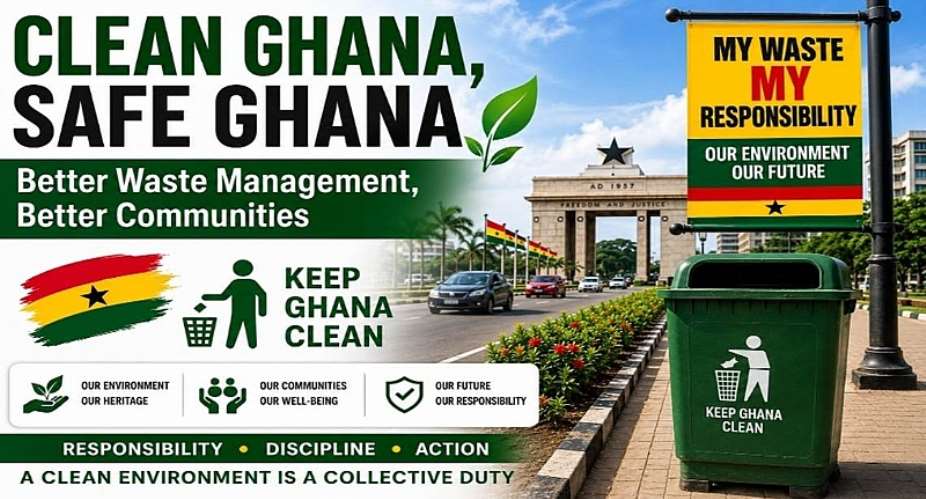
The Government’s warning to citizens against dumping rubbish into gutters, drains and public spaces is understandable and commendable. However, warnings and public appeals alone will not solve Ghana’s persistent sanitation problem. Keeping our communities clean is a shared responsibility that requires every citizen to play their part.
Ghana's sanitation challenges are not simply the result of poor individual behaviour. They also reflect shortcomings in waste management infrastructure, regulatory oversight, institutional capacity and consistent enforcement. Lasting progress will therefore require a coordinated national approach that combines public education with practical systems that enable citizens to dispose of waste responsibly.
A cleaner Ghana cannot be achieved by government alone, nor can it be achieved by citizens acting in isolation. Sustainable environmental management depends upon a partnership between government, local authorities, businesses, communities and individual citizens. Each has an important role to play in protecting the environment, improving public health and preserving the dignity of our towns and cities.
To achieve these objectives, Ghana should adopt a comprehensive national waste management policy built upon four fundamental pillars:
- Adequate waste management infrastructure and resources.
- Strong regulatory and legal controls.
- Consistent and effective enforcement.
- Sustained public education and community participation.
Government Must Provide the Necessary Infrastructure
Waste management begins with the provision of appropriate facilities.
Public waste bins should be installed and regularly emptied at markets, transport terminals, schools, hospitals, commercial centres, beaches, parks, major roads and densely populated communities. Every Metropolitan, Municipal and District Assembly should be required to provide reliable household and commercial waste collection services within its jurisdiction.
Government should also facilitate the development of properly regulated waste transfer stations, recycling plants, composting facilities, engineered landfill sites and waste-to-resource projects.
Separate collection systems for recyclable materials, organic waste and general waste should gradually be introduced, beginning with major cities and commercial centres. Organic waste from markets and households could be converted into compost for agriculture rather than being mixed with plastics and other refuse.
The private sector should be encouraged to participate through transparent public-private partnerships. However, private waste companies must be properly supervised and held to measurable service standards.
Effective waste management succeeds when responsible public behaviour is supported by accessible and reliable waste disposal systems.
Ghana Needs Stronger Laws and Regulatory Controls
The second requirement is a clear and enforceable national regulatory framework.
Waste management laws should clearly define the responsibilities of individuals, households, businesses, landlords, commercial property owners, waste contractors, district assemblies and central government agencies.
The law should prohibit:
- Dumping refuse into drains, gutters, rivers and other waterways.
- Leaving household or commercial waste in public places.
- Unauthorised disposal of construction and industrial waste.
- Burning waste in prohibited areas.
- Operating an unlicensed waste collection or disposal business.
- Failing to provide adequate waste receptacles at commercial premises, markets and public events.
Penalties should be proportionate but sufficiently serious to discourage offenders. Repeat offenders, commercial entities and persons responsible for large-scale illegal dumping should face substantially higher fines than individuals responsible for minor first offences.
Responsibility must also extend to businesses whose activities generate large quantities of plastic packaging, bottles, food containers and other disposable materials. Producer responsibility schemes could require manufacturers and importers to contribute financially to the collection, recycling and safe disposal of the products they introduce into the Ghanaian market.
Laws Must Be Effectively Enforced
Ghana already has environmental and sanitation regulations. The central problem is often weak or inconsistent enforcement.
Laws that are announced but rarely enforced eventually lose their deterrent value. Citizens observe that violations attract little consequence, and unlawful conduct gradually becomes normalised.
Environmental health officers and municipal sanitation inspectors should be adequately trained, resourced and authorised to issue infringement notices. Enforcement teams should operate regularly rather than appearing only during occasional national clean-up campaigns.
Technology should also be used. CCTV cameras could be installed at known illegal dumping locations, while citizens should be able to report offences through a national telephone line, website or mobile application. Reports could include photographs, videos, locations and vehicle registration details.
Australia provides a useful example. In New South Wales, members of the public can report littering from vehicles, and fines may be issued using the information provided. Serious illegal dumping attracts substantial penalties, including on-the-spot fines and much higher maximum court penalties for individuals and corporations.
Ghana's experience demonstrates that environmental laws are most effective when enforcement is visible, consistent and impartial. Rather, enforcement must be visible, predictable and credible. Citizens are far more likely to comply when they know that offences can be detected and penalties will genuinely be imposed and enforced.
What Ghana Can Learn from Singapore
Singapore is widely recognised for the cleanliness of its streets and public spaces. That achievement did not result from public warnings alone. It is supported by organised waste collection, cleaning services, clear laws, public education, surveillance and strict enforcement.
Under Singapore’s environmental laws, littering offenders can face court fines of up to S$2,000 for a first conviction, S$4,000 for a second conviction and S$10,000 for subsequent convictions. Courts may also impose Corrective Work Orders requiring offenders to clean public areas for up to 12 hours. Enforcement officers and surveillance cameras are regularly deployed at littering hotspots.
Singapore also provides formal channels through which members of the public can report illegal dumping, including details such as the location, time and registration number of any vehicle involved.
The Singaporean example demonstrates that clean streets result from a combination of infrastructure, disciplined administration, continuous public education, consistent enforcement and civic responsibility. Strict penalties work because they form part of a functioning system rather than being isolated political announcements.
Ghana should consider introducing community service or sanitation work orders for certain offenders, particularly repeat offenders. Requiring a person who deliberately litters to participate in supervised cleaning may have a stronger educational and social effect than a small fine that is never collected.
What Ghana Can Learn from Rwanda
Rwanda provides an important African example of what strong environmental leadership can achieve.
Rwanda banned the production, importation, sale and use of plastic carry bags in 2008. The country subsequently expanded its controls through legislation prohibiting additional plastic carry bags and single-use plastic items, subject to limited authorised exceptions. Rwanda’s Environment Management Authority has reported that enforcement contributed to visibly cleaner streets, reduced pollution and an improved environment.
Rwanda’s experience is particularly relevant because it shows that environmental discipline is not limited to wealthy Western or Asian countries. An African country can adopt clear national policies, enforce them consistently and build public support for cleaner communities.
Ghana can learn from Rwanda’s willingness to take firm action against products and practices that cause widespread environmental harm. However, restrictions should be accompanied by affordable alternatives so that households and small businesses are not unfairly burdened.
National discipline is built when government demonstrates seriousness, applies rules consistently and ensures that political influence does not protect offenders.
What Ghana Can Learn from the United Kingdom
The United Kingdom combines local council waste services with legal duties imposed on households and businesses.
Littering and illegal dumping, commonly known as fly-tipping, can attract fixed penalty notices, prosecution and substantially higher court penalties. The maximum fixed penalty available to local authorities in England was increased to £500 for littering and £1,000 for fly-tipping. Households may also be penalised for failing to take reasonable care to ensure that their waste is transferred to an authorised collector.
This principle is important. Responsibility should not end when a householder or business hands waste to another person. People should be required to use licensed waste collectors and, where appropriate, retain evidence showing how their waste was disposed of.
Ghana could establish a licensing and digital verification system for waste collectors, especially those transporting construction waste, commercial refuse and bulky household items. This would make it easier to trace illegally dumped material back to the person who generated it or the contractor who transported it.
Public Safety Must Not Be Sacrificed
Waste management policy must also protect pedestrians and road users.
A friend recently told me that she fell into an uncovered roadside gutter while stepping out of a trotro. Sadly, this was not an isolated incident. Another friend suffered a similar accident last year.
These incidents illustrate the danger presented by uncovered roadside drains. Pedestrians, commuters, children, older people and persons with disabilities are placed at risk of serious injury or death.
It has reportedly been suggested that some gutters are left uncovered because people dump rubbish into them and open drains are easier to clean. Even where waste disposal is a genuine problem, it should not be used as justification for creating another public hazard.
Ghana should not be forced to choose between clean drains and safe pedestrians. Both objectives can be achieved. Good engineering should ensure that drains remain both accessible for maintenance and safe for public use.
Roadside drains should be covered with properly engineered concrete slabs, metal grates or other secure structures. Removable access points should be incorporated at appropriate intervals so that drains can be inspected and cleaned.
In Australia and the United Kingdom, stormwater infrastructure in populated areas is generally designed to balance drainage, maintenance access and public safety. Ghana should adopt the same principle: infrastructure must be designed around the protection of human life.
Authorities should also be required to inspect, repair and replace broken drain covers. Dangerous openings should be marked and temporarily secured immediately after being reported.
Where a public authority negligently leaves an obvious infrastructure hazard unattended, there should be an effective mechanism for investigation, accountability and compensation for persons seriously injured.
Continuous Public Education Is Essential
Enforcement alone cannot create lasting change. Ghana also needs sustained public education beginning at the school level.
Environmental responsibility should be incorporated into the national curriculum. Children should be taught about littering, recycling, flooding, plastic pollution, public health and community responsibility.
Government should work with traditional leaders, churches, mosques, schools, community associations, transport unions, market organisations, the media and civil society groups.
Education must be continuous rather than limited to slogans or occasional clean-up exercises. Citizens should understand the direct connection between dumping waste into gutters and the flooding of homes, destruction of property, spread of disease and contamination of rivers and beaches.
Public institutions and political organisations must also lead by example. After public events, rallies, festivals and commercial activities, organisers should be legally responsible for cleaning the surrounding area.
Community Participation and National Clean-Up Programmes
Communities should be encouraged to participate in environmental protection, but community clean-up exercises must support—not replace—regular municipal services.
Rwanda’s experience with organised community participation demonstrates that citizens can contribute to maintaining clean neighbourhoods when responsibilities are clearly structured and supported by national leadership.
In Ghana, community sanitation committees could work with district assemblies to identify illegal dumping sites, damaged drains, overflowing bins and neglected public spaces.
Traditional authorities and local leaders could assist with education and community mobilisation. However, enforcement powers should remain subject to proper legal safeguards to avoid political victimisation or arbitrary punishment.
Institutional Accountability
Waste management responsibilities in Ghana are spread among ministries, district assemblies, environmental agencies and private contractors. This can create duplication, uncertainty and opportunities for each institution to blame another.
A National Waste Management and Public Cleanliness Authority could be considered, or an existing institution could be strengthened and given responsibility for coordinating policy, setting national service standards, monitor performance and promote accountability.
Every district assembly should publish information showing:
- The communities receiving regular waste collection.
- The number and location of public bins.
- Waste collection schedules.
- Reported illegal dumping sites.
- Enforcement actions and penalties issued.
- Expenditure on sanitation.
- Recycling and waste-recovery rates.
- Complaints received and resolved.
Public reporting would enable citizens, Parliament and the media to assess whether sanitation funds are producing measurable results.
A Practical National Action Plan
The Government could implement the proposed reforms through a phased national programme.
Immediate Actions
Within the first year, government should:
- Identify major illegal dumping and flooding hotspots.
- Install public bins in high-traffic areas.
- Repair or secure dangerous roadside drains.
- Register and license waste collection operators.
- Establish a national waste-reporting platform.
- Increase sanitation inspections and enforcement.
- Begin a sustained national education campaign.
Medium-Term Actions
Within two to three years, government should:
- Expand reliable household waste collection.
- Construct regional transfer and recycling facilities.
- Introduce source separation and organic waste programmes.
- Establish producer responsibility schemes.
- Introduce national design standards for covered drains.
- Publish annual sanitation performance reports for every district.
Long-Term Actions
Over five to ten years, Ghana should aim to:
- Eliminate uncontrolled dumping sites.
- Develop modern engineered landfill and waste-recovery facilities.
- Significantly reduce plastic waste.
- Introduce widespread recycling and composting.
- Ensure that dangerous open drains are progressively covered.
- Build a lasting culture of environmental responsibility.
Funding the Policy
Funding could be drawn from a combination of:
- Central government allocations.
- District assembly sanitation revenues.
- Polluter-pays levies.
- Producer responsibility contributions.
- Commercial waste charges.
- Environmental fines.
- Public-private partnerships.
- International climate and development finance.
However, sanitation levies must be transparently administered. Money raised for waste management should not disappear into general expenditure while communities remain without basic services.
Conclusion
Citizens have a duty not to litter, but government also has a duty to provide adequate infrastructure, establish workable rules and enforce them consistently. Public education, regulation, investment and enforcement must operate together.
Australia demonstrates the value of substantial penalties, reporting systems and institutional enforcement. Singapore shows that clean streets require organised services, strict regulation, surveillance and civic discipline. Rwanda proves that an African country can achieve major environmental improvements through decisive policies and consistent enforcement. The United Kingdom demonstrates the importance of shared responsibility throughout the waste management chain.
The experiences of Australia, Singapore, Rwanda and the United Kingdom demonstrate that cleaner communities are not achieved by chance. They are the product of thoughtful public policy, sustained investment, effective institutions and a shared commitment by both government and citizens. While each country has adopted approaches suited to its own circumstances, the underlying principles remain universal and can be adapted to Ghana's unique social, economic and cultural environment.
Ghana does not need to replicate any country exactly. Instead, it has the opportunity to develop its own model of environmental stewardship, one that reflects its values, meets its development needs and inspires future generations to take pride in a cleaner, healthier and safer nation.
Most importantly, waste management should never come at the expense of public safety. Open roadside gutters that expose pedestrians to injury are not an acceptable solution to littering. With proper planning, sound engineering and responsible waste management practices, Ghana can achieve clean drains, safe streets and vibrant communities at the same time.
A cleaner Ghana will not be built by government alone, nor by citizens acting alone. It will be built through a genuine national partnership in which government provides the leadership, infrastructure and regulatory framework, while citizens, businesses and communities embrace their shared responsibility to protect the environment. Working together, we can build a cleaner, safer and more sustainable Ghana for present and future generations.
About the Author
Mr John C. Wussah
Sydney, New South Wales, Australia
12 July 2026
X (formerly Twitter): @JohnWussah


 Two Nigerians arrested over alleged murder of compatriot in Tamale
 NPP demands Miracles Aboagye's release, condemns EOCO detention
 Dennis Miracles Aboagye arrested by EOCO at Accra International Airport
 No more removing laptops, shoes and belts at airport as GACL introduces new airp...
 Child marriage among children aged 12-17 remains high in Oti region – GSS
 KNUST student and street preacher clash over early morning noise
 How some women at Inchaban forced resident to join national sanitation day exerc...
 Massive fire engulfs alcohol warehouse at Tema Community 26
 'Unity remains our greatest strength and the surest path to victory in 2028' – B...
 Strengthen ADR to reduce court backlog, improve access to justice – Prof. Asante

