




When a nation adopts a constitution, it is doing far more than drafting another legal document. It is entering into a solemn covenant between the state and its citizens. A constitution defines the limits of power, protects the rights of citizens, establishes institutions of governance and, most importantly, ensures that no individual, however popular or powerful, stands above the law.
History demonstrates a simple but profound truth: nations that consistently respect their constitutions are generally more stable, more attractive to investors and better able to resolve political disagreements peacefully. Conversely, countries where constitutions are routinely manipulated, suspended or ignored often experience political instability, declining public confidence, economic uncertainty and, in some instances, violent conflict.
This is not to suggest that constitutional fidelity automatically guarantees prosperity. Good governance, sound economic policies, strong institutions and visionary leadership all matter. Nevertheless, the Constitution provides the framework within which these virtues can flourish.
Botswana: Stability Built on Constitutional Discipline
Few African countries illustrate the rewards of constitutional governance better than Botswana. Since independence in 1966, Botswana has experienced regular elections, peaceful transfers of power and broad respect for constitutional institutions. Presidents have observed constitutional limits, and power has changed hands without military intervention or constitutional crises.
The benefits have been remarkable. Although Botswana was among the poorest countries in the world at independence, it transformed itself into one of Africa's most stable democracies. Its prudent management of natural resources, relatively low levels of corruption and predictable legal environment have attracted investment and fostered sustained economic growth. Botswana's experience reminds us that constitutional certainty creates confidence, not only among citizens but also among businesses and international investors.
Mauritius: Democracy as an Economic Asset
Mauritius offers another compelling example. Despite limited natural resources, the island nation has consistently respected democratic institutions, constitutional governance and the rule of law. Today, Mauritius enjoys one of Africa's strongest economies, vibrant tourism, a thriving financial sector and a reputation for political stability. Its success has not been accidental. Investors are more willing to commit long-term capital where governments change through elections rather than constitutional crises.
Ghana: A Democratic Success worth Protecting
Ghana deserves recognition for its own constitutional achievements. Since the inauguration of the Fourth Republic in 1993, every elected President has eventually relinquished office in accordance with constitutional requirements. Political parties have alternated peacefully in government, while the military has remained subordinate to civilian authority.
This record has elevated Ghana's international standing. Indeed, many countries have looked to Ghana as evidence that constitutional democracy can thrive in Africa. That reputation should never be taken for granted.
Namibia and South Africa
Namibia has similarly demonstrated the value of respecting constitutional institutions since independence. South Africa, despite facing numerous social and economic challenges, has repeatedly shown that even powerful leaders remain subject to constitutional accountability. The resignation of President Thabo Mbeki in 2008 following internal constitutional processes underscored the strength of institutions over personalities.
India: Democracy through Constitutional Continuity
Outside Africa, India stands as perhaps the greatest example of constitutional endurance among developing countries. Since gaining independence in 1947, India has conducted numerous general elections involving hundreds of millions of voters.
Governments have changed. Prime ministers have come and gone. Political parties have risen and fallen. Yet the constitutional framework has remained intact. This continuity has provided confidence for domestic and foreign investors alike and has supported India's emergence as one of the world's largest economies.
Costa Rica: Peace through Constitutional Commitment
Costa Rica presents another instructive example. After abolishing its military in 1948, the country devoted greater resources to education, healthcare and democratic institutions. Today, Costa Rica enjoys one of Latin America's strongest democratic traditions. Its Constitution has become an instrument of national unity rather than political contestation.
When Constitutions Are Altered to Extend Power
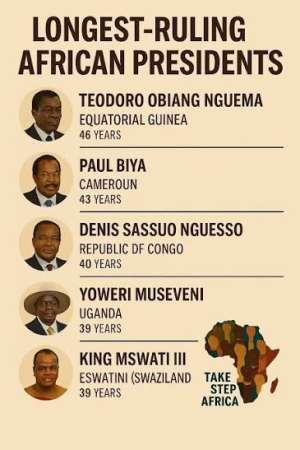
History also presents cautionary tales. Across Africa, constitutional amendments or reinterpretations that extend presidential tenure have often generated intense political controversy. The Africa Center for Strategic Studies tracks countries that have retained term limits and those where limits have been modified or removed. The outcomes vary, but the debates themselves frequently deepen political polarization.
Zimbabwe
Zimbabwe illustrates the dangers of prolonged concentration of executive authority. Over many years, constitutional changes and political developments weakened institutional checks and balances. The country subsequently experienced economic collapse, hyperinflation, declining investor confidence and significant emigration.
Although Zimbabwe's challenges cannot be attributed solely to constitutional issues, weakened institutions undoubtedly compounded the crisis. Recent proposals to extend presidential tenure have once again sparked debate about democratic governance.
Uganda
Uganda removed presidential term limits in 2005 and later abolished the presidential age limit in 2017, allowing President Yoweri Museveni to continue seeking office. Supporters argue that continuity has provided political stability. Critics contend that removing constitutional restraints has reduced political competition and heightened tensions surrounding elections. Whatever one's perspective, the Ugandan experience demonstrates how changes to constitutional safeguards can become enduring sources of national debate.
Guinea
In Guinea, constitutional changes that permitted President Alpha Condé to seek another term triggered widespread protests and deep political divisions before a military coup eventually removed his government. The lesson is sobering. When citizens lose confidence that constitutional rules apply equally to everyone, political instability often follows.
Burundi
Burundi experienced severe unrest after disputes concerning presidential tenure in 2015. Thousands fled the country. Economic activity slowed. International confidence declined. The constitutional dispute evolved into a broader national crisis.
Côte d'Ivoire
Constitutional interpretation regarding presidential eligibility in Côte d'Ivoire also became highly contentious before the 2020 elections, contributing to political unrest and election-related violence. Again, the issue extended beyond legal technicalities. It became a question of public confidence in constitutional governance.
Rwanda: A More Complex Picture
Any balanced discussion must include Rwanda. Following constitutional amendments approved by referendum, President Paul Kagame became eligible to seek additional terms. Unlike several countries where constitutional changes coincided with instability, Rwanda has recorded impressive economic growth, improved infrastructure, lower corruption in many sectors and enhanced public services. Yet critics argue that extending presidential tenure has narrowed political competition and weakened democratic pluralism.
Rwanda therefore illustrates an important point: constitutional amendments do not automatically lead to economic decline, but they often raise enduring questions about institutional resilience, democratic accountability and succession.
The Common Thread
The examples above reveal one consistent lesson. Strong constitutions do not guarantee prosperity. Weak constitutions do not inevitably produce failure. However, nations that consistently respect constitutional rules generally enjoy greater political predictability.
Predictability matters. Businesses invest where laws remain stable. Citizens cooperate where institutions command trust. Foreign investors seek environments where contracts are honoured and governments change peacefully. Development partners prefer countries where constitutional disputes are settled in courtrooms rather than on the streets.
Beyond Personalities
Constitutional debates should never revolve around individual leaders. Whether one supports or opposes a sitting President is ultimately secondary. The Constitution must apply equally to every President, every government and every political party. That principle lies at the heart of constitutional democracy.
A constitution written for one leader eventually becomes a constitution inherited by another. For this reason, constitutional reforms should always be approached with caution, transparency and broad national consensus.
My Thoughts
The experiences of Botswana, Mauritius, Namibia, India, and Costa Rica demonstrate that a deep respect for constitutional rules is a cornerstone for building stable democracies and resilient economies. Conversely, the trajectories of Zimbabwe, Burundi, and Guinea serve as stark reminders of the instability that arises when constitutional safeguards are politically contested. Meanwhile, Rwanda illustrates a complex middle ground: constitutional change can coincide with rapid economic progress, even as it continues to provoke legitimate debate over long-term democratic governance.
The overarching lesson is clear. A constitution is not an obstacle to development, but one of its greatest enablers. By restraining arbitrary power, guaranteeing peaceful succession, inspiring investor confidence, and protecting citizens from the excesses of governance, it provides the framework for progress.
When constitutions are respected, nations secure stability. When they become negotiable, uncertainty follows, and uncertainty is a luxury that no developing nation can afford.
FUSEINI ABDULAI BRAIMAH
+233208282575 / +233550558008
[email protected]


 Education Minister meets teacher unions today for threatening strike
 Galamsey: 'Either Mahama is lying or suffering amnesia for denying promise to de...
 September 28: Cedi sells at GHS12.20 on forex market, GHS11.63 on BoG interbank
 Adu-Boahen’s lawyer files no-case submission in GH¢49.1m trial
 BoG Governor Dr Johnson Asiama explains why he exited from GoldBod Board about f...
 GES becoming a source of avoidable disaffection for NDC gov’t – Edem Agbana
 Akuapem Odwira @200: 'Don’t abuse power, Ghanaians are watching us' — Osahen Afe...
 Dr. Asiama’s exit from our board was due to busy schedule, not dispute or rot – ...
 GES says NCPTA has no authority to impose prospectus purchases on schools
 2nd Deputy BoG Governor Matilda Asante-Asiedu replaces Dr. Asiamah on GoldBod bo...


