




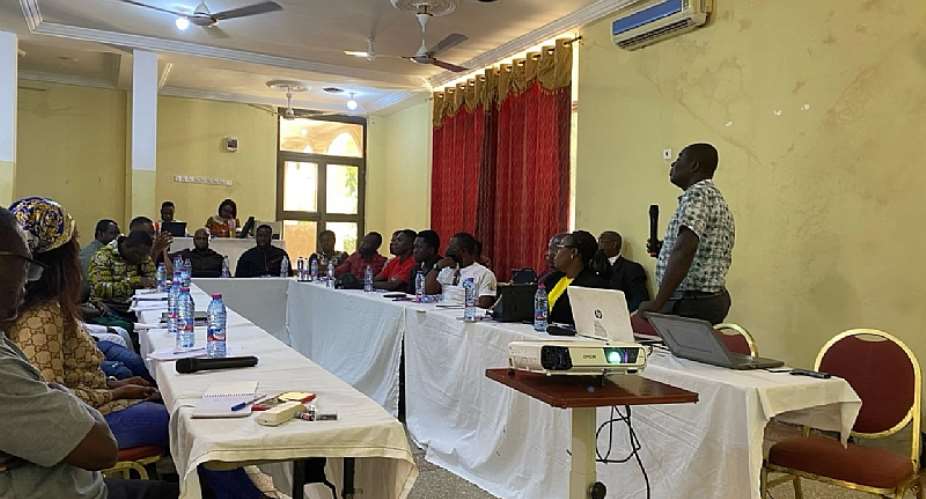
A multi‑stakeholder forum held in Sunyani in the Ahafo Region under the Oxfam in Ghana Fair Finance Project has heard a detailed report outlining widespread environmental and human rights abuses linked to Newmont Ghana Gold Limited’s operations in its Ahafo North and Akyem concessions.
The event, held on Friday, June 26, was organised by Wacam, the Centre for Public Interest Law (CEPIL) and Oxfam in Ghana. It brought together regulatory institutions, civil society organisations, traditional authorities, Persons with Disabilities (PWDs) and mining‑affected communities to strengthen human rights and governance in mining areas.
The forum sought to present key findings from a recent assessment and foster dialogue on actionable measures to promote accountability, improve governance and demand responsible mining practices.
Findings Presented
Presenting the 2024–2025 findings, lead researcher Dr. Samuel Obiri painted a stark picture of the challenges faced by residents in communities such as Terchire, Yamfo, Susuanso and Adrobaa in the Ahafo North Project Area, and Yaw Tano, New Abirem, Hweakwae, Afosu and Ntronang in the Akyem Project Area.
Key findings included:
- Land loss: 88% of respondents in Ahafo North and 92% in Akyem reported losing their lands to Newmont’s operations.
- Compensation gaps: Over 57% of affected residents in Ahafo North said they had not received any compensation, while others reported delays of more than four months.
Violation of FPIC: 85% of respondents in Ahafo North and 89% in Akyem said the Free, Prior and Informed Consent (FPIC) principle was violated. Many reported coercion or intimidation during land acquisition processes.
In Akyem, respondents said they were told by company officials or local chiefs that their land sat on a gold belt and that government had already granted Newmont a permit. In Ahafo North, about 80 respondents said their lands were taken through compulsory acquisition after they rejected compensation offers.
- Shrinking civic space: Between 60% and 75% of respondents said they could not freely associate or express opinions due to intimidation. Military and police personnel deployed to the communities were reported to have harassed, arbitrarily arrested and detained residents.
- Disproportionate impact on women and PWDs: 69.6% of women respondents said mining activities had negatively affected their economic livelihoods.
The report concluded that residents—particularly in Ahafo North—had been subjected to “modern‑day slavery” by Newmont and its assigns, and that the company’s land acquisition processes were inconsistent with sector regulations.
“The report revealed widespread human rights abuses, shrinking civic space and inadequate and unfair compensation payments,” Dr. Obiri said.
He added that despite several attempts, Newmont did not respond to the research team’s queries.
Participants’ Concerns and Recommendations
Participants questioned whether residents could legally refuse mining companies access to their land. They were told yes, but only if communities are well‑informed and prepared to assert their rights through the appropriate legal and institutional channels.
A recurring concern was that regulators often rely heavily on information provided by mining companies without adequate verification on the ground. Participants called for:
- more community consultations,
- regular field visits, and
- stronger engagement with local regulators
to ensure future assessments reflect real conditions rather than paper‑based reports.
Key Recommendations from the Study
- Review the Minerals and Mining Act, 2006 (Act 703) to address compulsory acquisition concerns.
- Ensure informed consent for all affected persons.
- Enforce strict compliance with Article 20(2)(a) of the 1992 Constitution, Section 74(1) of Act 703, and Regulation 3(b) of LI 2175, which mandate prompt payment of fair and adequate compensation.
- Legislate protections for civil society organisations working in mining communities.
- Hold regular stakeholder dialogues, with traditional authorities serving as mediators.
- Establish community advocacy groups to reduce violent confrontations.
- Verify land ownership early through traditional authorities to prevent disputes and ensure fair compensation.
- Increase public education on land rights and the health implications of mining.
- Improve communication between consultants and government officials to ensure clearer, more participatory reporting.
Earlier, in a welcome address, Mr. Augustine Niber, Executive Director of CEPIL, stressed the need for Ghana to do more to address environmental and human rights concerns associated with mining.
Forum Conclusion
The forum concluded with copies of the report distributed to participants, accompanied by a call for immediate action to address the systemic violations documented. Stakeholders demanded that government, regulators and Newmont take concrete steps to respect and protect the fundamental human rights of residents in mining‑affected communities.

 Macron promises tough punishments for rioters during nationwide day of action
 Trump endorses embattled Israeli PM Netanyahu ahead of October 27 election
 We are going to provide emergency airstrip in regions without airports — Mahama
 Nana Konadu maiden memorial mass set for October 23
 'Double standards are not helpful, wrong yesterday is wrong today' – Ablakwa on ...
 NPP has resolve internal wrangling — Bawumia
 Ghana, US Virgin Islands agree on recruitment of Ghanaian teachers, nurses
 “Soldiers Will Stay There”—Mahama Declares Permanent Military Presence in Forest...
 ‘No Borrowing Involved’ — Mahama Rolls Out US$10bn New Economy Policy
 “Ask Jean Mensa to resign first”—Tanko-Computer fires back


