




1. Introduction
In contemporary African philosophy and cultural anthropology, the discourse on personhood consistently transcends mere biological taxonomy. Unlike post-Enlightenment Western philosophical traditions that predominantly anchor personhood in individual autonomy, rational self-consciousness, or isolated metaphysical substances (Descartes, Kant), traditional African frameworks favor an existential model that is deeply relational, social, and moral. To exist biologically as a human being does not automatically grant status as a "person." Instead, personhood is a dynamic moral achievement—a state of becoming that is progressively earned through meaningful integration into a human community.
While extensive literature has documented this ontological framework among southern Ghanaian societies, most notably the Akan (Gyekye, 1992; Wiredu, 1996), there remains a critical gap regarding the ethno-philosophical systems of the societies in the northern Savannah zone. Foremost among these is the Mole-Dagbani meta-ethnic group, which includes the Mamprusi, Dagomba, and Nanumba peoples. Bound together by language, historical custom, and a shared ancestral origin tracing back to the legendary patriarch Naa Gbewaa, these communities operate within a highly integrated social ecosystem.
Using the Mamprusi people as a principal case study, this article investigates how personhood is defined, operationalized, and evaluated within the Mole-Dagbani worldview. It explores the concrete social behaviors, everyday interactions, and communal rituals where humanity is put on trial, identifying the exact actions—and critical inactions—that cause an individual to be judged as lacking personhood.
2. Theoretical Framework: Communitarian Personhood in African Philosophy
To conceptualize personhood among the Mamprusi, this study engages with the philosophical debate surrounding African communitarianism, primarily represented by the contrasting views of Ifeanyi Menkiti and Kwame Gyekye.
Radical Communitarianism (Menkiti)
"Community completely defines the person; personhood is purely acquired."
│ (The Philosophical Tension)
Moderate Communitarianism (Gyekye / Wiredu)
"Personhood is dual: a baseline biological reality + an earned moral/social status."
Menkiti (1984) advocates for a radical communitarian view, asserting that community priorities take ontological precedence over individual ones. In his formulation, personhood is completely acquired through the progressive fulfillment of communal obligations and roles. Thus, as far as the community is concerned, an individual can fail at being a person.
Conversely, Gyekye (1992) proposes a moderate communitarian framework, arguing that radical communitarianism minimizes individual moral agency and biological identity. Gyekye maintains that the individual possesses an inherent baseline personhood by virtue of their capacities for rationality and moral choice, which are then flourished and validated within the social matrix of the community.
Kwasi Wiredu (1996) adds a critical linguistic and ethical dimension to this debate by emphasizing that many African concepts of a person are descriptive and normative. In many Ghanaian languages, calling someone "not a human being" is an ethical judgment rather than an anatomical assessment.
This paper argues that the Mamprusi worldview aligns closely with a normative, moderate communitarian framework. It recognizes the biological human being (ninsaala) as possessing an inherent capacity for personhood (ninsaal tari), while treating the actualization of humanity (nirilim) as an ongoing social and moral practice.
3. Linguistic and Metaphysical Foundations: Nirilim vs. Ninsaal tari
The philosophical architecture of Mole-Dagbani personhood is embedded within its linguistic ontology. In both Mampruli and Dagbani, a clear distinction is made between the anatomical entity and the moral agent:
Ninsaala (The Human Being): This term denotes a biological member of the human species. It represents the physical substance, endowed with life (nyovuri) and breath, born of human parentage. It is a descriptive, non-normative category.
Nirilim/Ninsaal tari (Humanity/Personhood): This signifies the moral and social qualities that constitute a complete person. Both Nirilim and Ninsaal tari are not innate biological traits; they are cultivated dispositions.
When elders in a Mamprusi community observe an individual exhibiting profound greed, continuous isolation, or callous indifference to the suffering of neighbors, they do not deny the individual's physical reality as a ninsala. Instead, they declare: “O ka nirilim” (He/She lacks humanity) or “O ku ninsaal tari” (He/She is not truly a person).
This linguistic usage mirrors what Martin Odei Ajei (2007) describes as an evaluative ontological framework, where human status is directly tied to moral performance. True personhood requires a harmonious alignment of the physical self with the social values of the community.
4. The Economy of Presence: Sociocultural Manifestations of Personhood
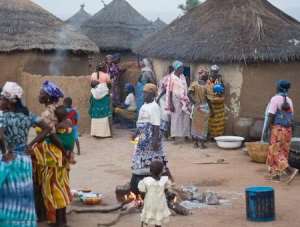
Among the Mamprusi and broader Mole-Dagbani societies, personhood is verified through concrete participation in communal life. This dynamic is best observed through what can be termed the economy of physical presence.
In these cultural contexts, communal solidarity is not an abstract sentiment; it is a physical commitment. Active presence during major life transitions—such as naming ceremonies (suuna), marriages (Po’a diri for men and Doo kulugu for women), and funerals (ku’ya)—serves as the primary currency for validating one's standing as a member of the community. Within these ethnic groups, the ultimate success of a marriage, outdooring, funeral, installation, or the enskinment (coronation) of a chief is directly measured by the sheer volume of people who attend the occasion. High attendance is not merely a social triumph; it is a public validation of the host's humanity and social capital.
| Individual Choice | Communal Consequence |
| Absence or sending money proxy | Reciprocal proxy/ (Discussion) |
| Brief, perfunctory attendance | Identical brief attendance returned |
| Full, active physical presence | Robust communal solidarity secured |
Table 1: Individual Choices and Collective Consequences in Human Relations
Within this framework, sending monetary gifts in place of physical or sending a representative in place of personal attendance is viewed as a significant social failure. While financial contributions are useful, they cannot replace the moral value of physical presence. The community carefully monitors and logs individual participation through an informal but highly accurate ledger of social accountability.
Reciprocal Penalties for Social Withdrawal
If an individual routinely chooses to send money rather than attending community naming or marriage ceremonies, the community responds with exact reciprocity. When that individual later hosts an event, the community will meet to discuss the matter, collect equivalent monetary contributions, and send the funds via a messenger—deliberately refusing to attend in person.
Similarly, if an individual practices perfunctory attendance—arriving briefly at a funeral or communal labor project only to depart immediately after making their presence known—the community returns the exact same behavior when the time comes. They will attend the individual's event briefly, sign their symbolic presence, and leave promptly. This strict structure of social reciprocity demonstrates that within the Mole-Dagbani worldview, personhood is fundamentally reciprocal. To withdraw one's physical presence from the community is an implicit rejection of the shared social contract.
5. Actions and Inactions Undermining Ninsaal tari or Nirilim: Concrete Case Studies
To fully understand how personhood is evaluated, we must examine the specific behaviors, habits, and attitudes that lead a community to determine that an individual lacks ninsaal tari or nirilim.
The Extraction of Wealth without Local Reinvestment
In modern Mamprusi society, a common tension arises between urbanized, wealthy individuals and their rural kin networks. An individual who achieves material success in distant urban centers (such as Accra or Tamale) but fails to build a physical house, frequently visit home or support extended family networks within their ancestral village is seen as not having ninsaal tari or committing a severe social infraction.
In the Mole-Dagbani perspective, wealth is given by the ancestors and God (Naawuni) not for individual hoarding, but to serve as a resource for the broader community. This is supported by Islamic teachings of arm-giving. Refusing to reinvest in one's home community is interpreted as a sign of destructive individualism that undermines the social network, resulting in a loss of respect and moral authority.
Political Implications: The Enskinment of Chiefs and Electoral Success
The significance of numbers and social presence extends beyond everyday communal relations into the realms of traditional governance and modern electoral politics. Within many traditional communities, candidates for chieftaincy are not assessed solely on lineage or material wealth; they are also evaluated based on the strength of their social networks and the extent of their community support.
A royal candidate who has accumulated substantial social capital through years of mutual assistance, active participation in communal events, attendance at funerals, and support for local youth is likely to attract large crowds to public gatherings. For elders and kingmakers, such visible public support serves as tangible evidence of ninsaal tari or nirilim—qualities associated with humanity, social responsibility, and communal leadership. In this sense, the ability to mobilize people becomes a social indicator of legitimacy and suitability for leadership.
Conversely, a wealthy or highly placed royal who remains socially detached and lacks a visible, dedicated following may be overlooked during the enskinment process. Regardless of material resources or family status, an inability to attract and sustain communal support may be interpreted as a deficiency in the social qualities expected of a traditional leader.
Moreover, this same logic extends into contemporary democratic politics. In local assembly elections, constituency contests, and other political processes, candidates often draw upon the social capital accumulated through years of community engagement. Individuals who have consistently invested in human relationships, supported communal activities, and maintained a visible presence in the lives of ordinary people are more likely to command loyalty and mobilize voters. Consequently, the networks of reciprocity, trust, and goodwill built through everyday social interactions frequently become decisive factors in electoral success or failure. Thus, whether in the enskinment of chiefs or the election of political representatives, leadership legitimacy is often rooted not merely in formal qualifications or wealth, but in the depth and quality of one's relationship with the community.
The Rejection of Everyday Hospitality
Hospitality (Beesisungu) occupies a central place in Mamprusi society and, by extension, among the Mole-Dagbani people. It is not merely a gesture of social courtesy but a deeply rooted moral obligation that expresses personhood (ninsaal tari) and affirms one’s commitment to communal life. In this cultural worldview, the arrival of a visitor immediately activates a set of ethical expectations that define both the dignity of the host and the humanity of the guest. Thus, hospitality becomes a lived expression of moral identity rather than a voluntary act of kindness.
In practical terms, when a visitor arrives at a household, the immediate offering of cold water is not optional but a culturally required ritual. This gesture extends beyond physical refreshment; symbolically, it represents life, peace, acceptance, and the recognition of shared human dignity. It is through this simple but profound act that the boundaries between “self” and “other” are softened, reinforcing social cohesion and mutual belonging.
Beyond this initial offering, hospitality may extend to the provision of food that goes beyond the household’s ordinary daily staple. In particular circumstances, a host may slaughter a fowl, prepare meat, or offer a special meal that is not part of the regular diet. Even in situations where resources are limited or such delicacies have not been consumed for a long period, this act of sacrifice underscores a fundamental cultural principle: human relationships are valued above material preservation. In this sense, hospitality becomes a concrete expression of ninsaal tari and nirilim, reinforcing ideals of generosity, sharing, and communal responsibility.
Furthermore, the cultural weight of hospitality is vividly expressed in the Mampruli phrase “vei nyan deema,” loosely translated as “I am about to be disgraced.” This expression is often uttered by an elderly person upon learning that a visitor is coming at a time when they feel unprepared to properly host them. It reflects not merely anxiety about material inadequacy but a deeper fear of moral failure. The notion of vei (disgrace or shame) reveals how seriously hospitality is taken, as failing to properly receive a guest is culturally interpreted as a weakening of one’s personhood and social dignity.
Beyond food and drink, hospitality also extends to accommodation. A visitor is typically provided with a clean and well-prepared sleeping space, often the best available room in the household. Fresh and neat bedding is arranged, and efforts are made to ensure comfort and respect for the guest. This further demonstrates that hospitality is not incidental but structured, deliberate, and morally significant.
In this way, the fear of vei (disgrace or shame) within the Mampruli cultural setting underscores the extent to which personhood is socially constructed and continuously negotiated through acts of generosity. To fail in hospitality is not simply to commit a social oversight; it is to diminish one’s moral standing and disrupt the ethical fabric of communal life. Therefore, hospitality (Beesisungu) remains a powerful cultural institution through which dignity, humanity, and social belonging are actively performed and preserved.
Conversely, individuals who consistently display indifference to visitors, conceal food to avoid sharing, or fail to welcome strangers and passersby are often socially disapproved of. Such behaviour may be interpreted as lacking ninsaal tari and may even attract labels such as beim rana, describing a hoarding disposition driven by self-interest and base instinct. Within this moral universe, the rejection of everyday hospitality is not simply discourtesy; it signifies a deeper departure from the ethical foundations of communal life, where material possession is placed above human relationship and social obligation. Consequently, it is understood as a rejection of ninsaal tari and nirilim, the core values that sustain cohesion and mutual responsibility within the community.
6. Structural Implications: The Consequences of Being "Not a Person"
The social judgment that an individual lacks ninsaal tari carries significant real-world consequences within Mamprugu and Mole-Dagbani societies. This form of marginalization does not infringe upon physical safety, but it results in a profound loss of reputation and social standing.
| Area of Social Life | Consequence for the Individual Lacking Ninsaal tari |
| Traditional Governance | Disqualification from chieftaincy (naam) positions and exclusion from prestigious councils of elders. |
| Marital & Kin Alliances | Reluctance from neighboring clans to approve marriage proposals, due to concerns over the lineage's moral reputation. |
| Conflict Resolution | Loss of institutional support from elders during property, land, or marital disputes. |
| Funerary Rites | Minimal and perfunctory execution of final burial rites, reflecting the individual's lifetime of social distance. |
Furthermore, this moral judgment directly impacts an individual's ancestral future. In Mole-Dagbani/Mamprusi cosmology, becoming an ancestor (Kpiimma) is not an automatic transition granted by old age or death. It is an elevated spiritual status reserved exclusively for those who attained full personhood during their earthly lives.
An individual who dies while judged to lack ninsaal tari or nirilim is denied full ancestral honors. Their name is not invoked during libations, and their memory is allowed to fade from the historical consciousness of the clan. This represents the ultimate philosophical penalty: a permanent exclusion from both the visible community of the living and the invisible community of the ancestors.
-
Conclusion
Within the Mole-Dagbani and Mamprusi worldviews, personhood is far more than a fixed biological category. It functions as an ongoing, publicly evaluated moral project. While an individual is born as a biological human being (ninsaala), they must actively earn status as a person (ninsaal tari) through sustained ethical engagement, structural hospitality, and consistent physical presence within the community.
The strict social rules governing attendance at life-transition rituals demonstrate that the community operates as a space of absolute reciprocity. Those who attempt to replace physical presence with financial transactions find that their social capital is reduced accordingly.
By analyzing these cultural frameworks, we see how the Mamprusi and Mole-Dagbani perspective offers a valuable alternative to individualistic models of human identity. It frames personhood as a shared responsibility, reminding us that our humanity is always tied to the humanity of those around us.
References
Aapengnuo, C. M. (2013). Power and Social Identity—The Crisis of Legitimacy of Traditional Rule in Northern Ghana and Ethnic Conflicts (Doctoral dissertation, George Mason University).
Ajei, M. O. (2007). Africa's development: the imperatives of indigenous knowledge and values. University of South Africa (South Africa).
Gyekye, K. (1992). Person and community in African thought. Person and community: Ghanaian philosophical studies, 1, 101-122.
Jecker, N. S., & Atuire, C. A. (2025). Personhood: An emergent view from Africa and the West. Developing World Bioethics, 25(2), 154-163.
Lentz, C. (2006). Ethnicity and the making of history in Northern Ghana. Edinburgh University Press.
MacGaffey, W. (2013). Chiefs, priests, and praise-singers: History, politics, and land ownership in northern Ghana. University of Virginia Press.
Menkiti, I. A. (1984). Person and community in African traditional thought. African philosophy: An introduction, 3, 171-182.
Molefe, M. (2021). The “Normative” Concept of Personhood in Wiredu’s Moral Philosophy. Filosofia Theoretica: Journal of African Philosophy, Culture and Religions, 10(1), 119-144.
Saaka, Y. (1999). Regionalism and Public Policy in Northern Ghana. Peter Lang Publishing.
Wiredu, K. (1996). Cultural Universals and Particulars: An African Perspective. Indiana University Press.
Yakubu, R. (2022). The Gods are Not Jealous: Lived Contextualization of Religious Identity and Dialogue Through Dagomba Rites of Passage (Vol. 30). Evangelische Verlagsanstalt.

 Surrogacy: Supreme Court judge warns of citizenship and inheritance challenges f...
 Ghana has a surrogacy law, but… - Supreme Court Justice
 Ghana faces challenge to persuade Brics it deserves a seat at the table
 Stop the Sermon Before the Engine Starts: Why Ghana Regulates Preaching on Movin...
 Don’t let speed of information become your judgement — Chief Justice tells new l...
 ‘Big Push’: Government assures contractors of prompt payments
 GES to develop plan to recover teaching time lost during teachers’ strike – Clem...
 'All human emotions': French astronaut Sophie Adenot's first words since returni...
 French astronaut recounts 'astonishing' emotions after return to Earth
 India's 'cockroach' movement chief detained ahead of major protest


