




Few places in Africa have been as isolated and understudied as eastern Angola, particularly the highlands of the Moxico provinces, a region rich in biodiversity, culture and history. The country's political past helps explain this isolation. Having achieved independence from Portugal in 1975 after 11 years of war, Angola descended into a civil war that lasted 27 years, one of the longest conflicts in Africa. The study area in Angola. Author supplied , CC BY
Since peace was established in 2002, development has concentrated in the capital Luanda, on the west coast. The east of the country has remained deeply marginalised, with limited access to basic services such as healthcare and education. Infrastructure is scarce and portions of the territory still have many landmines.
In these areas the state's limited presence, likely a legacy of political exclusion and geographic isolation, has allowed communities a good deal of autonomy over land and resources. This has contributed to ecological preservation but hindered social and economic development.
Isolation has also shaped something less visible: the role of fire in human survival and the woodland ecosystem.
As a team of ecologists, social scientists and political scientists from the University of Edinburgh and the University of Turin, supported by the Okavango Wilderness Project, we have been researching ties between forests and local communities in this region. Fire is one of the main tools communities use to manage the landscape – clearing fields, improving visibility, stimulating fruit growth, and aiding hunting.
In a recent paper we set out our findings about how civil war had shaped fire regimes (patterns of fire in an ecosystem) in eastern Angola. We combined analysis of satellite data on burned areas and in-depth interviews with 42 elders who lived through the conflict and still live in the area now. An elder lost a leg to a landmine. Injuries and deaths remain common, decades after the war. Lorenza Fontana , CC BY
We found something that surprised us and that runs counter to what researchers have documented elsewhere. During the war, fire activity was lower than before or after it. In most conflict zones, war has tended to be associated with higher fire activity. This is important since how “normal” fire activity is defined determines how fire is managed.
Wartime in Angola's highlands
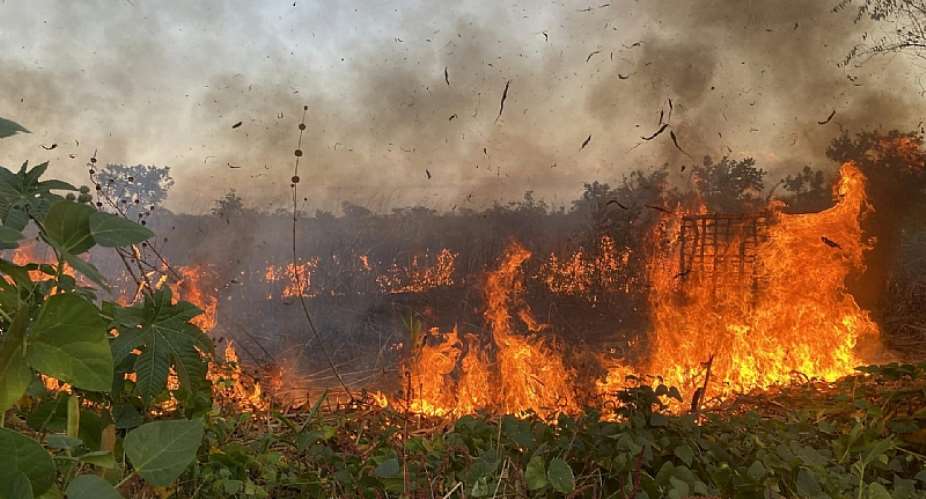
Our fieldwork took place in three villages in the Moxico highlands. Dry forests and miombo woodlands grow in the high parts. Lower down there are grasslands and rivers – the headwaters of the Okavango Delta, whose waters sustain ecosystems and communities across southern Africa. This remote area is sparsely populated and the main activities are subsistence farming and honey collection. Villagers burn fields to clear and fertilise the land. Firebreaks around the field stop the fire from spreading into the forest. Lucia Escobar Alvarado , CC BY
Local people have traditionally used fire to clear their fields and the bush for easier hunting. They use controlled burns in savannas and woodlands to reduce the risk of larger fires reaching homes, and to help keep snakes away from villages. The villagers also use smoke in harvesting honey and firewood for cooking.
Customary authorities still govern the use of natural resources. A controlled fire burns on the edge of a village. Luisa Escobar Alvarado , CC BY
Elders told us fire was used less during the war: people were constantly displaced, relying heavily on woodland products – honey, fruits, mushrooms and wild animals – for survival. A woman said:
During interviews, residents marked on maps where different war-related events took place. Lorenza Fontana , CC BYDuring the war, we had to move constantly; you built a house, stayed a month or a year, then moved again.
Armed forces strictly regulated the use of fire for cooking or hunting, since it could reveal people's location; therefore, it was often used at night, when aircraft were not around. Forest cover was needed for safety. Careless use could result in harsh punishment and even death. One respondent told us:
If you burned, that was a crime! You would get whipped!
Respondents said that during the war, forested areas expanded and got denser. Many elder women are remarkably skilled at re-enacting memories of the war. Lorenza Fontana , CC BY
Our spatial analyses of burned areas confirmed that fire decreased by an average of 36% during the war compared with the average after the war (2003 to 2018), with sharper declines in some periods. There was a 46% drop between 1991 and 1992, possibly linked to renewed violence after Unita (one of the parties in the civil war) rejected the Bicesse Accords election results. After the war ended in 2002, burned area rose 60% above the wartime average.
Fire and conflict
The case of eastern Angola shows some interesting patterns which can bring a new perspective to the relationship between fire regimes and armed conflict.
One is that most research on war and fire documents an increase in fire. This has been seen in Syria, Turkey, Iraq and Ukraine.
Our study shows the opposite: a marked decrease in fire activity during the conflict, followed by a sharp postwar recovery.
This drastic increase was likely driven by returning populations, restored livelihood practices and expanded market connections, all likely exacerbated by natural fuel accumulated during years of suppressed burning.
We read it not as an anomaly but as a return to a peacetime baseline. We suggest that it was the wartime suppression of burning that was exceptional.
This distinction is important not only for academic debates on human-fire interactions but also for fire governance and policy in the region. Taking the low-burning years of the war period as the baseline fire regime can lead to management strategies that focus on suppression, like banning early controlled burning. These can in turn disrupt fire-dependent livelihoods, overlook longer-term historical patterns, and promote narratives that are not necessarily grounded in local ecological or socioeconomic realities. Abandoned tanks and war remnants remain scattered across landscapes. Luisa Escobar Alvarado , CC BY
The effects of the war extended well beyond its end in 2002. Before the conflict, fire was managed collectively through long-standing community traditions. Wartime restrictions on burning, together with the disruption caused by the conflict, eroded these practices and the intergenerational knowledge that sustained them. As a result, fire use today is largely shaped by individual decisions rather than coordinated community management. A woman demonstrates how to set an early dry-season fire in the savanna. Lorenza Fontana , CC BY
Managing fire in context
This case carries several implications: war can reshape fire regimes in ways current literature has overlooked, and fire itself is still too often framed as a danger or disaster, rather than a crucial tool for rural communities. Managing fire in this landscape calls for approaches that fit local realities, recognising fire as a socio-political process as much as an environmental one, and placing local livelihoods at the centre of governance.
The highlands of Moxico may represent an extreme case, but they are a reminder that war's consequences for landscapes and livelihoods can be complex, unexpected and long-lasting – especially for marginalised groups.
Author's note on photos: before we take pictures with people we always ask for their consent, and we ask if we can share those pictures in different places. We obtain oral consent since most of the people we work with don't read or write.
Luisa F. Escobar Alvarado is affiliated with The University of Turin and The National Geographic Okavango Wilderness Project. We thank the support of National Geographic Okavango Wilderness Project, CONAHCYT, Davis Fund at the University of Edinburgh, the Lisima Foundation, the Wild Bird Trust, the Leverhulme Trust (IF-2023-032), the European Research Council grant FIREPOL (101076495) and NERC Large Grant SECO (NE/T01279X/1).
By Luisa F. Escobar Alvarado, Post Doctoral researcher, Università di Torino

 Bagbin backs Mahama’s call for national dialogue on social media insults
 Speaker Bagbin got it wrong by rejecting our narcotics inquiry motion - Afenyo M...
 National conversation should not become an exercise in suppressing dissent — Bag...
 ‘Don’t reward only bitter tongues, it encourages others to copy’ – Bagbin tells ...
 'I apologise for calling you rude' — NPP MP Kabiru to Speaker Bagbin
 Barker-Vormawor criticises NPP over shift from ‘intelligence’ to ‘metaphor’ on c...
 TRAFFITECH-GH: Police reschedules automated traffic enforcement rollout to Novem...
 Scrap premix subsidy and replace it with credit support – CEMSE urges gov't
 We have cut cost of capital by more than half since Mahama took office – Ato For...
 Customs intercepts three firearms, 610 rounds of ammunition at Tema Port


