




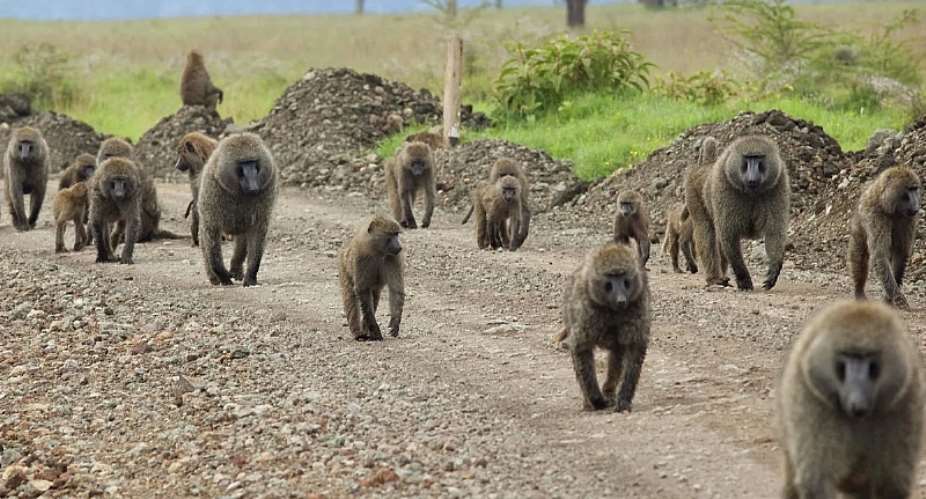
Baboons are one of the most widespread of Africa's primate groups. They range across sub-Saharan Africa and into the Arabian Peninsula.
Baboons' ability to spread across such a vast geographic area is based on their great ecological adaptability and dietary flexibility. This enables them to flourish in a wide variety of habitats, including deserts, swamps, open grasslands, woodlands and tropical forests.
I am an evolutionary anthropologist. I rely on methods and theory from the field of behavioural ecology, which focuses on how ecological conditions and evolutionary forces shape the behaviour of organisms to enhance their chances of surviving and reproducing successfully. I am particularly interested in how studies of other species, particularly closely related ones like baboons, help us understand our own human origins.
Studies of non-human primates give us insight about how evolution may have shaped the behaviour of our ancestors and how it influences our own behaviour.
Over the last 40 years, I have been involved in long-term studies of three baboon species: chacma baboons, olive baboons, and yellow baboons. In these species, groups are composed of multiple adult males, multiple adult females, and immature animals. Males leave their birth groups near the time of sexual maturity to prevent inbreeding and may live in several different groups over the course of their lives. But females remain in their birth groups, and groups consist of multiple matrilines – sets of females connected through their maternal ancestors.
We have learned that females' connections to their relatives shape their everyday lives and have long lasting effects on their survival and lifetime reproductive success (the number of surviving offspring they produce over the course of their lives).
Maternal training rules
Maternal kinship structures the lives of female baboons. Like other mammalian females, pregnant baboon mothers nourish their developing foetuses and buffer them from external stressors. After birth, mothers nurse their infants, carry them from place to place, and keep them warm and safe. After they are weaned at about 18 months, juveniles no longer depend on their mothers for food or transportation, but they maintain close ties to their mothers, spending much of their time near them and seeking their protection and reassurance when they are in danger.
Females sometimes intervene in support of their juvenile offspring, especially their daughters, when they are involved in conflicts. With their mothers' help, young females can defeat all of the females that their mothers can defeat, and this leads to the formation of dominance hierarchies in which females acquire dominance rank positions just below their mothers.
As females mature and begin to reproduce themselves, they remain closely connected to their mothers and sisters. Adult females spend much more time grooming their mothers, daughters and sisters than they spend grooming others.
Close kin maintain close social bonds as long as they live together, while relationships among unrelated females tend to fluctuate in strength from year to year.
For behavioural ecologists like me, it is not only important to describe patterns of behaviour but to try to understand why evolution has favoured them. Grooming and support are forms of cooperation. When a female grooms another female, she painstakingly parts her partner's fur and removes parasites from the skin. This is beneficial to the recipient because these parasites can cause irritation and diseases.
But the female who provides grooming gives up opportunities to forage or rest, and this may be costly.
The benefits of social bonds
Natural selection is expected to favour behaviours that increase the relative fitness of individuals, the number of surviving offspring that they produce over the course of their life time. Behaviours like grooming seem puzzling because they are costly to the actor, but beneficial to the recipient.
However, according to the theory of kin selection, altruistic interactions like grooming can evolve among genetic relatives because they share some fraction of their genes. For example, offspring acquire half of their genes from each of their parents. This may be the reason that baboons and other primates form such close ties to their kin.
It's also important to understand how females benefit from social bonds. Several lines of evidence suggest that social bonds help females cope with stress. Glucocorticoids (like cortisol in humans) are released into the bloodstream to help animals mobilise energy to respond to acute threats, like predator attacks. But chronic activation of the stress response can be harmful.
Researchers can track glucocorticoid levels in wild primates by collecting faeces from known individuals and measuring the concentrations of metabolites (small molecules produced, used, or broken down during metabolism). Results from several studies suggest that close social bonds help females cope with stressful events in their groups and the disruption of close social bonds creates stress for females.
Females' coping ability may have long-term consequences because sustained exposure to glucocorticoids decreases females' life spans.
The quality of females' social bonds may have long-term consequences too. Data from long-term studies of baboons in the Amboseli Basin, which lies along the border of Kenya and Tanzania, and in the Moremi Reserve of the Okavango Delta of Botswana, show that females that have strong and stable social connections live substantially longer than females who were more socially isolated.
It has taken decades of research by dozens of researchers at many different sites to construct this rich picture of the lives of female baboons. But there are still many questions to answer. Why are some females more sociable than others? What are the mechanisms that link social bonds and longevity? As we have learned more about the form and consequences of social bonds among baboons and other primates, we have come to appreciate the parallels between the benefit of social connections for baboons and for ourselves.
Joan Silk does not work for, consult, own shares in or receive funding from any company or organisation that would benefit from this article, and has disclosed no relevant affiliations beyond their academic appointment.
By Joan Silk, Professor, School of Human Evolution and Social Change, Arizona State University
 Consumers cannot be paying for ECG’s inefficiencies — Minority
 Release investigation report on unusual prepaid credit depletion — Minority to E...
 Rock Estate Housing project in Upper East stalls years after high-profile sod-cu...
 Full reasons ECOWAS Court dismissed Justice Torkonoo's case against Ghana
 'The law is the law' — Thaddeus Sory reacts to ECOWAS Court ruling on Torkornoo ...
 June 24: Cedi sells at GHS12.25 on forex market, GHS11.21 on BoG interbank
 Gender Ministry renews commitment to disability rights on National Day of Person...
 Due process was observed in removal of Justice Torkonoo as Ghana's Chief Justice...
 NDC is complete scam, they use 419 to rally fake promises but does nothing — Osa...
 Dankwa-Busia-Dombo tradition remains blueprint for Ghana's prosperity — Osahen A...


