




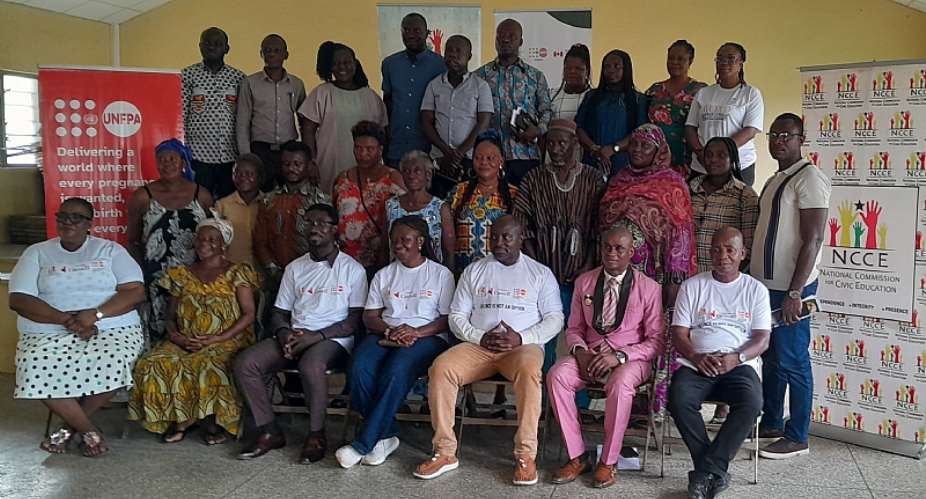
The Eastern Regional Office of the National Commission for Civic Education (NCCE) has convened a high-level stakeholder engagement to address two of the region's most pressing social challenges: Gender Based Violence (GBV) and Adolescent Sexual and Reproductive Health (ASRH).
The engagement, held on Thursday, June 18, was organised by the NCCE in collaboration with the United Nations Population Fund (UNFPA) and Global Affairs Canada. It brought together representatives from the Department of Social Welfare, Ghana Health Service and Ghana Police Service, as well as traditional authorities, assembly members, persons with disabilities, pastors and imams.
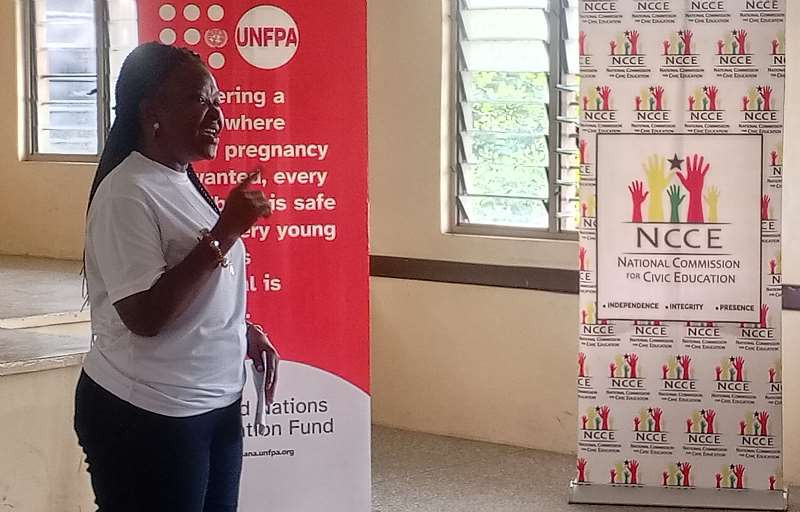
Speaking at the event, the Eastern Regional Director of the NCCE, Ms Ophelia Nana Yaa Ankrah, said the engagement was aimed at deepening understanding of the challenges confronting adolescents in the region, particularly issues relating to sexual and reproductive health, gender based violence and adolescent pregnancy.
She stressed that meaningful and lasting progress would require a collective commitment from families, community leaders and public institutions.
“The diversity of participants underscored a central message: protecting vulnerable persons requires coordinated effort across institutions, traditional structures, and community networks,” Ms Ankrah noted.
Addressing the issue of gender based violence and adolescent sexual and reproductive health, she explained that effective interventions must focus on three key areas: prevention, response and empowerment.
According to her, regular awareness programmes should be organised in schools, churches, mosques and community centres to educate the public on the different forms of GBV, including physical, sexual, emotional, psychological and economic abuse.
“We must also empower traditional and religious leaders to challenge harmful practices and norms that normalize violence or silence victims,” she stated.
Ms Ankrah further emphasised the importance of involving men and boys in efforts to prevent gender based violence.
“It is not about victims against perpetrators; we have a collective responsibility to work together to fight against the problem,” she said.
She also appealed to stakeholders, particularly the police, social welfare officers and health professionals, to handle GBV cases with confidentiality, professionalism and sensitivity, while avoiding victim blaming.
“If you suspect a GBV incident, report it to Social Welfare, the Ghana Police Service DOVVSU, or a trusted health facility. Do not confront an abuser alone. If you are an adolescent seeking SRH information, visit a youth-friendly health center or ask a trained teacher, nurse, or counselor. Your questions deserve accurate answers,” she advised.
The Eastern Regional Director of the Department of Social Welfare, Mr Isaac Koramoah Asante, opened the technical session with a presentation on gender based violence.
He defined GBV as any harmful act committed against a person's will and rooted in socially constructed differences between males and females. He explained that such acts may take the form of emotional, psychological, sexual or physical abuse.
Mr Asante noted that gender based violence affects people across all age groups, genders and social backgrounds and stressed that tackling the problem requires sustained community wide action rather than isolated interventions.
Madam Belinda Kpodo of the Ghana Health Service led discussions on Adolescent Sexual and Reproductive Health. She outlined the physical and psychological changes adolescents experience and explained how these transitions can affect their social wellbeing if they are not properly guided.
She underscored the need to equip community leaders with accurate information to support young people through these stages and reduce the risks associated with misinformation and stigma.
The Regional Crime Officer of the Ghana Police Service, ASP Augustine Asante Kusi, addressed participants on law enforcement responses to gender based violence and related offences.
He urged community members to play a more active role in the lives of children and young people, describing families and communities as the first line of protection against abuse and exploitation.
ASP Kusi assured participants that all reports made to the police would be handled with confidentiality and professionalism and encouraged victims and witnesses to report incidents promptly to facilitate timely investigations and access to justice.
The engagement concluded with participants reaffirming their commitment to translating the discussions into concrete action.
By bringing together state institutions, traditional authorities, faith leaders and civil society actors, the NCCE UNFPA partnership continues to promote a model of community participation that recognises gender based violence prevention and adolescent health as public priorities rather than private concerns.
The Eastern Region engagement forms part of broader efforts by the NCCE and UNFPA to strengthen community systems that protect rights, promote health and uphold the dignity of all residents, particularly the most vulnerable.
Participants agreed that meaningful progress can only be achieved when institutions, traditional leaders, faith based organisations and community members work together and take shared responsibility for addressing gender based violence and promoting adolescent sexual and reproductive health.





 Police arrest 186 suspects, rescue victims in 10-day anti-crime crackdown across...
 S.african Police Probe Killing Of Foreigner In Xenophobic Unrest
 Tension at Bantama NPP office as chairman accuses Asenso Boakye of political mac...
 Korle Bu succesfully performs first two off-pump heart bypass surgeries
 Disability Act lacks teeth, must be strengthened — Annoh-Dompreh
 Mental health, drug tests now mandatory for firearm licences — Interior Minister
 GoldBod directs licensed buyers to report gold purchases within five minutes
 Action will be taken on viral video showing SHS student assaulting a junior — Dr...
 NDC promised to ease cost of living yet increasing utility tariff — Kofi Tonto
 NDC is a useless govt – Miracles Aboagye fumes


