




Let me tell you a story.
In the late 1980s and early 1990s, my career as a chemical engineer took me to New Zealand. Before leaving Ghana, I had worked briefly at the Tema Oil Refinery (TOR) and Unilever. At TOR, the first female chemical engineer ever trained at the Kwame Nkrumah University of Science and Technology (KNUST) happened to be a year my senior. We did the same technical work, but because of her seniority, she earned more than I did. To me, this was just the natural order of a professional workspace: your qualifications and your experience dictated your paycheck, regardless of gender.
But then came a get-together in Christchurch that completely upended my assumptions about the "developed" world.
I met a local couple there who told me they were high school sweethearts. They had gone to school together, trained together, graduated together, and both worked as nurses in the very same hospital. Yet, as the conversation progressed, the tone shifted. Assuming I was from one of those countries they habitually underestimated, they turned the discussion toward how “we Africans subjugate women.”
Then came the real shocker—delivered completely out in the open. Despite having the exact same qualifications, identical experience, and the same employer, the wife openly admitted she made just 70 cents for every dollar her husband earned.
I genuinely did not believe it. Coming from Ghana, the concept of a systemic, institutionalized gender wage gap for the exact same role was entirely foreign to me. I was so stunned that I actually wrote a letter back home to a colleague just to double-check if I had somehow missed a similar dynamic in my own country.
I hadn’t. And decades later, stumbling upon a piece of archival footage reminded me exactly why.
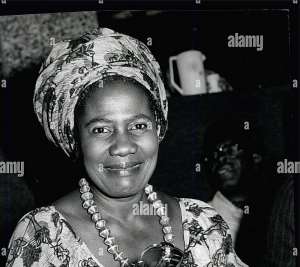
In a black-and-white video from the pre-independence era circulating on social media, a Western journalist interviews a young Ghanaian economist named Gloria Amon Nikoi (née Addae), who was then a commercial officer in the Ministry of Trade and Labour and would later become Ghana's first female Foreign Minister and then Governor of the Bank of Ghana. When the reporter patronizingly asks how women were getting on in their "struggle for equality," her response cuts straight through the Western saviour complex:
"Well, we haven’t had to struggle for equality here. We have had it, so far as I can remember... Legally, we have had the vote same time as the men had it, and we have equal pay for equal work."
When Gloria Addae noted that Ghana had "equal pay for equal work," she was describing an intentional framework built into the civil service. Historically, while Western nations spent the mid-to-late 20th century fiercely debating and passing legislative acts to ensure women received equal remuneration for the same job (such as the UK's Equal Pay Act of 1970 or New Zealand's own legislative fights in the 1960s and 70s), Ghana’s formal sector inherited and built upon a structure where civil service pay scales were strictly tied to qualification and grade—not gender.
By the time I was working at TOR and Unilever in the late 80s, structured institutional salary structures ensured that if a female engineer was a year your senior, her paycheck naturally reflected that gap. There was no systemic mechanism to dock her pay 30% simply for being a woman, which is why the "70 cents on the dollar" reality in New Zealand shocked me so profoundly.
As Miss Addae points out to the mid-century audience, the autonomy of Ghanaian women wasn’t a modern, imported concept. It was deeply rooted in both traditional and contemporary life. In the traditional sphere—particularly within matrilineal systems—women historically held substantial property rights, granting them immense societal influence.
In the economic sphere, the footage highlights the legendary "Market Women" who dominated the retail trade. Handling an estimated two-thirds of the country’s retail commerce, these women managed massive financial turnovers and built commercial empires completely independent of male oversight.
When the modern women’s empowerment movement started gaining volume in the West during the late 20th century, Western activists often wondered why their rhetoric never quite found the same frenzied traction on the African continent. They assumed it was due to a lack of awareness or entrenched subjugation.
They were wrong.
The movement didn't take root for the reasons they assumed because our starting lines were entirely different. While Western women in the 1960s and 70s were marching for the basic legal rights to open bank accounts, own property, and earn an equal paycheck, Ghana had already built a post-colonial formal sector where an engineer's salary was determined by their rank, not their sex.
My experience downunder wasn't a story of an African immigrant discovering Western enlightenment; it was the story of a Ghanaian engineer realizing that the society claiming to be advanced was actually decades behind the one I left behind.


 Ms. Emelia Affi Agbenyo must honourably resign as new EC Deputy Chairperson to p...
 Why have US-Ukraine relations soured ahead of the midterms?
 Govt to meet Free Zones Authority, Trade Ministry over Customs Act concerns
 Kojo Bamba was never my driver or bodyguard — Nana B
 Ekow Assafuah petitions OSP to probe alleged World Cup visa facilitation irregul...
 Africa attracting wrong waste management solutions – GAIA report
 Summon Kofi Adams, GTA boss over 2026 World Cup visa scandal — NPP tells Parliam...
 Obuasi SHS headmaster accused of sexual abuse is NDC constituency secretary – Ma...
 Family demands answers over death of 14-year-old student at Abomosu STEM SHS
 Osahen Afenyo-Markin reflects on loneliness of public service, says survival is ...



Comments
Thanks for sharing your experience, and bringing out the other perspective.