




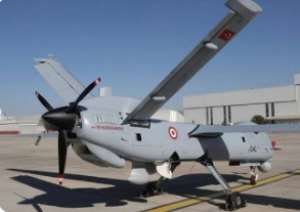
Across West Africa's Sahelian belt and coastal states alike, Turkish weapons, principally Baykar's Bayraktar drones, have become a defining feature of the region's security architecture. As France's military presence collapsed in Mali, Burkina Faso and Niger following the 2024 troop withdrawals, Ankara moved quickly to fill the vacuum, combining no-strings-attached arms sales with deepening economic and resource access. The result is a security relationship that now touches nearly every conflict-affected country in the sub region.
The Scale of the Footprint
Turkish drone manufacturer Baykar now counts Angola, Burkina Faso, Djibouti, Ethiopia, Kenya, Mali, Morocco, Niger, Nigeria, Somalia, Togo and Tunisia among its clients across the continent. Within West Africa specifically, Turkey has signed over 30 security agreements in the region, according to a September 2025 analysis from the Policy Center for the New South, while Ankara's broader African defence engagement spans agreements with more than 25 African countries including Senegal, Mali and Nigeria.
Country by Country
In Mali, Turkish hardware has become central to the junta's counterinsurgency campaign. Mali received Turkish Akinci drones in December 2024 in addition to its eight TB2 drones already in service, operating out of Bamako Air Base 101 under what analysts describe as a tightly controlled circle of senior officials.
The drones have been credited with battlefield gains, including the recapture of Kidal in late 2023, though their use has also drawn scrutiny: in April 2025, a Turkish-made Akinci drone was shot down near the Algerian border while Mali was found, for the first time, to be using MAM-T guided munitions manufactured by Roketsan .
Niger's drone fleet, built up since 2021, includes six TB2 drones, five Karayel-SU drones, and Aksungur drones. The relationship has now moved beyond hardware sales into formal training cooperation: Turkish Defence Minister Yaşar Güler and Nigerien Defence Minister Salifou Mody signed a protocol in Ankara on April 7, 2026, establishing on-site military training support within Niger, with Turkish advisors providing technical support for the TB2 and Karayel-SU fleets and assisting Nigerien commanders with small-unit coordination and armoured vehicle operations.
Burkina Faso has similarly turned to Ankara, having purchased at least six TB2s and two Turkish Akinci drones as it confronts jihadist insurgencies in the country's north and east.
Nigeria represents the subregion's most economically entangled case. Abuja has aggressively ramped up orders for Bayraktar TB2s and Hürkuş light attack aircraft to strike insurgents in the north throughout 2024 and 2025, while Nigeria and Togo now use Turkish drones to patrol their shared borders with Burkina Faso and Niger to prevent extremist incursions. The military relationship has opened doors elsewhere: a major memorandum of understanding signed between Turkey and Nigeria in October 2024 could allow Turkish Petroleum Corporation to begin offshore exploration in the Gulf of Guinea, and by September 2025 Turkish firms had moved from drone maintenance work toward broader commercial involvement in the country.
The Commercial Logic Behind the Deals
Analysts increasingly describe Turkey's African arms strategy as a form of resource arbitrage rather than conventional defence diplomacy. Turkey's defence procurement agency, the Secretariat of Defence Industries, functions less as a simple weapons broker and more as a clearing mechanism connecting drone sales to commodity access, with mining executives from firms tied to Turkish industrial conglomerates following closely behind major drone contracts to evaluate mineral assets such as lithium, gold and phosphates. In Mali, Turkish firms reportedly gained access to gold mining concessions previously controlled by European interests shortly after Baykar equipment was delivered.
Why Ankara Wins These Contracts
Turkey's appeal to Sahelian juntas and West African governments more broadly rests on a combination of low cost, fast delivery and the absence of the human-rights or governance conditions that typically accompany Western arms sales. As one Ankara-based analyst put it, Turkey functions as a unique geopolitical hybrid, a NATO member with NATO-standard military capability that nonetheless speaks the political language of the Global South. For juntas in Bamako, Niamey and Ouagadougou that have severed or downgraded ties with Paris, this combination has made Ankara the supplier of first resort.
The Human Rights Question
The expansion has not gone without criticism. Reporting on Turkey's drone sales to Sudan's military, where a roughly 120-million-dollar contract for TB2 drones and warheads was signed by Sudan's Defense Industries System months after the entity had already been sanctioned by Washington, has fuelled broader concern that Ankara shows little regard for how its exported drones are subsequently used in active conflicts. Similar concerns attach to West African deployments, where Turkish systems are now embedded in counterinsurgency campaigns with limited independent oversight of civilian harm.
Why It Matters for the Subregion
Turkey's arms penetration of West Africa marks one of the most significant realignments in the region's security architecture in decades, displacing France as the security partner of choice across the Sahel while simultaneously opening parallel economic channels in petroleum and mining. For a subregion already navigating the consequences of military takeovers, jihadist expansion and great-power competition involving Russia's Africa Corps, Ankara's drones-for-access model adds a further layer of external dependency, this time wrapped in the language of sovereign partnership rather than colonial legacy.
Mustapha Bature Sallama.
Medical/ Science Communicator,
Private Investigator, Criminal investigation and Intelligence Analysis.
International Conflict Management and Peace Building.USIP
[email protected]
+233-555-275-880
References
Africa Defense Forum. "Turkey Expands Reach as Security Partner." https://adf-magazine.com/2026/02/turkey-expands-reach-as-security-partner/
Military Africa. "Turkey and Niger formalize on-site military training and logistics." https://www.military.africa/2026/05/turkey-and-niger-formalize-on-site-military-training-and-logistics/
Atlantic Council. "Why Ankara's rising power in the Sahel could benefit the West." https://www.atlanticcouncil.org/in-depth-research-reports/issue-brief/why-ankaras-rising-power-in-the-sahel-could-benefit-the-west/
The Arab Weekly. "As drone warfare thrives in Africa, Turkey expands influence." https://push.thearabweekly.com/drone-warfare-thrives-africa-turkey-expands-influence
Africa Defense Forum. "As Drone Warfare Expands in Africa, Turkey Increases Share of the Market." https://adf-magazine.com/2025/02/as-drone-warfare-expands-in-africa-turkey-increases-share-of-the-market/
Hardpoint. "Drones for Dirt: Turkey's Strategic Arbitrage in Africa." https://hardpoint.substack.com/p/drones-for-dirt-turkeys-strategic
Turkish Minute. "Turkey's drone industry fuels African conflicts, expands geopolitical reach." https://turkishminute.com/2025/07/25/turkeys-drone-industry-fuels-african-conflicts-expands-geopolitical-reach/
Euronews. "Turkish defence firm linked to Sudan's devastating civil war after alleged secret arms ship." https://www.euronews.com/2025/03/09/turkish-defence-firm-linked-to-sudans-devastating-civil-war-after-alleged-secret-arms-ship


 Enforce surcharges, modernise audits to curb GHS100bn losses — Ghana Audit Servi...
 One third of world population exposed to harmful air pollution: monitor
 US forces leave Iraq, raising fears of Iran-backed militias amid power vacuum
 US Supreme Court lifts restrictions on third-country deportations
 'EOCO attempted arrest of Baffour Awuah was unprofessional' — James Agalga
 'Building a congregation of 20,000 will kill you' – Duncan-Williams tells young ...
 Shamima Muslim defends constitutional rights of women facing court over hate spe...
 September 29: Cedi finishes day selling at GHS12.20 on forex market, GHS11.67 on...
 ‘We’ll explore another constitutional option for narcotics probe’ – Minority on ...
 Speaker Bagbin adjourns Parliament indefinitely after rejecting narcotics probe ...


