




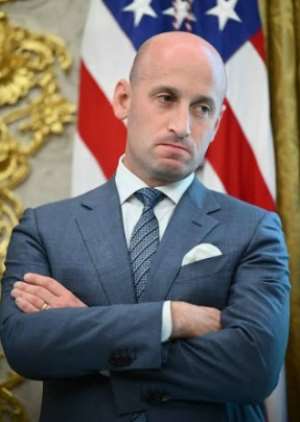
In the modern history of American political power, very few unelected officials have shaped the daily lives of millions of people as profoundly as Stephen Miller. He writes no laws. He appears on no ballot. He holds no Cabinet title that the average American voter could name on instinct.
And yet, by the broad consensus of journalists, pollsters, civil rights organizations, and even members of his own party, he has functioned for much of the second Trump administration as the effective architect of the United States government's most consequential and most contested policy agenda.
How Americans understand Stephen Miller who he is, what he wants, and what he has already done has become one of the defining questions of the current political moment.
The answer, as the data now clearly shows, is that most Americans do not like what they have come to understand.
The Numbers at the Bottom
The polling is unambiguous and, for a figure of Miller's extraordinary influence, historically unusual. A Race to the White House internal polling average covering 27 of the most recognizable political figures in the United States found that Miller sits dead last. Not near the bottom. Not in a cluster. Last. Among voters who have formed an opinion about him and 57 percent of Americans have 68 percent view him unfavorably, giving him a net favorability of negative 36 points, the worst mark on a list that includes Donald Trump, JD Vance, Pete Hegseth, and Pam Bondi.
A Quinnipiac University national poll from January 2026 found that only 34 percent of registered voters approved of Miller, against 44 percent who disapproved, with 23 percent not offering an opinion. Navigator Research polling found that a plurality of 42 percent of Americans support his firing, versus 29 percent who oppose it and 29 percent who are unsure and when more details about Miller's conduct are included, support for his firing rises significantly. These are numbers that would end most political careers. Miller has no career in the electoral sense to end. That, as Americans are increasingly learning, is precisely the point.
Who Is Stephen Miller?
Born on August 23, 1985, in Santa Monica, California, Miller's political journey began in high school, where he developed a strong affinity for conservative ideologies often at odds with his liberal upbringing. The trajectory from a wealthy Jewish family in one of America's most progressive coastal cities to the architect of the most restrictive immigration agenda in modern American history is one of the central paradoxes that observers of Miller have spent years attempting to explain.
Miller came of age in the aftermath of the 1992 Los Angeles uprising and the reelection campaign of Governor Pete Wilson, which relied on scapegoating Mexican immigrants for the state's economic recession and prompted the passage of California's anti-immigrant Proposition 187. Miller became enamored of conservative talk radio hosts such as Rush Limbaugh and Larry Elder. Under their influence, Miller increasingly expressed contrarian and intentionally provocative views at Santa Monica High School.
David Horowitz, a former Marxist turned conservative ideologue, heard Miller on Elder's radio show and saw an opportunity to groom him. Horowitz taught teenagers like Miller to use the language of civil rights to attack civil rights wielding the shield of free speech while targeting minorities. It was a formative education in the politics of inversion, and Miller absorbed it thoroughly.
Miller's politics have been described as far-right and anti-immigration. Author Jean Guerrero, who wrote the only authoritative biography of Miller, characterized his agenda as white nationalist.
He began identifying with ideologies associated with conservatism as early as the seventh grade. At Duke University, he crossed paths with white nationalist Richard Spencer.
In July 2020, the Southern Poverty Law Center added Miller to its database of extremists. The most damning evidence of Miller's ideological commitments came from his own emails. Leaked correspondence revealed that Miller promoted literature, conspiracy theories, and policies supported by white nationalist and anti-immigrant hate groups.
In a 2015 email to Breitbart, Miller suggested writing about "The Camp of the Saints," a racist French novel popular among white nationalists and neo-Nazis. Miller is a descendant of Jewish refugees a fact that investigators and commentators have noted with particular force, given that the immigration policies he champions would almost certainly have barred his own ancestors from entering the United States.
The Architecture of a Crackdown
Miller served as a senior adviser during Trump's first term and returned in 2025 as Deputy Chief of Staff and Homeland Security Adviser, having authored and pushed policies from travel bans and asylum restrictions to mass deportation planning and agency reorganization.
In his second-term role, his power has been even more direct. Miller is widely seen within the administration as the mastermind of the president's immigration policy, relentlessly pushing officials to meet goals he designates on behalf of the president. His power is evident in his daily 10 a.m. conference calls, including Saturdays, where he demands updates from agencies and exerts pressure on senior officials who deliver less-than-satisfactory results.
In his role as Deputy Chief of Staff, Miller demanded that ICE officers arrest a minimum of 3,000 people a day triple the rate from Trump's first term. The machinery he set in motion reached into communities across the country: analysts described a quieter, bureaucratic campaign attributed to Miller to strip work permits and legal status from immigrants who had complied with rules a process described as "de-documenting" that could produce labour-market shocks in sectors including construction, care giving, and technology.
The Census Bureau reported a historic decline in net immigration from 2.7 million in 2024 to 1.3 million in 2025, with a projected 321,000 in 2026. An independent analysis by a Brookings Institution team found that immigration fell into negative territory in 2025 and has continued to be negative in 2026.
For Miller, these numbers represent the fulfillment of an agenda he has pursued since his teenage years. For millions of immigrants, they represent family separations, deportations, and lives dismantled.
The Minneapolis Inflection Point
The political reckoning with Miller's methods arrived most sharply from the streets of Minneapolis. Miller reportedly goaded federal agents to "force confrontations" with anti-ICE protesters in Minneapolis, before those agents shot and killed Alex Pretti, a 36-year-old ICU nurse. Miller initially claimed that Pretti was a "would-be assassin." He was later forced to make a rare concession, admitting that the CBP agents who shot and killed Pretti "may not have been following" protocol.
The backlash was swift and came from across the political spectrum. Senator Thom Tillis, a Republican from North Carolina, called on both Miller and Homeland Security Secretary Kristi Noem to be fired, accusing them of taking Trump's strongest political issue and turning it into a liability for Republicans ahead of the midterms. "That is amateur hour at its worst," Tillis said. "Stephen Miller never fails to live up to my expectations of incompetence."
A majority of Americans came to hold negative views of ICE, with a net favorability of negative 22 a drastic decline from negative 8 in June 2025. Trump's handling of immigration hit its lowest level of his second term.
A Retreat That Was Never a Surrender
Faced with collapsing polling numbers and Republican anxiety about the midterms, the White House made visible course corrections. On May 11, 2026, President Trump dismantled several hardline immigration initiatives and reversed seasonal worker visa cuts, signalling a reported decline in Miller's influence. The administration restored control of deportation programmes to career law enforcement officials and disbanded roving Border Patrol strike forces. Monthly ICE arrests and detainee populations dropped significantly.
But those who have tracked Miller's methods closely cautioned against reading his retreat from the spotlight as a retreat from his ambitions. Since facing backlash for promoting violent tactics, Miller moved to force immigrants out through more subtle means. In calls with immigration officials, he requested information about how immigrants use credit cards, potentially as part of an effort to thwart their ability to open accounts. In Tennessee and Oklahoma, Miller appeared to have helped seed legislation requiring hospitals, public schools, and social services to report when undocumented immigrants use their services.
The cruelty, in other words, became administrative rather than operatic. The goal remained the same.
Even within the White House, however, tensions have broken into the open. Trump rejected Miller's proposal to restrict visas for foreigners attending the 2026 World Cup, a plan that was expected to cost billions in lost revenue. White House insiders said Chief of Staff Susie Wiles and President Trump himself were the main voices against the plan. One insider said of Miller: "He makes things more difficult. He thinks he is the lead on immigration, and that makes it awkward for the departments that are actually supposed to be handling these issues."
What makes the story of Stephen Miller so instructive for observers of American democracy and not only Americans is the structural reality that underlies it. As analyst Pablo Manríquez of Migrant Insider has written: "There is a man in the West Wing who has no constituency, no caucus, no state, no voters and yet he runs American immigration policy the way a landlord runs a building nobody thinks he should own."
This is the crux of the American public's growing discomfort with Miller: it is not merely that they dislike his policies. It is that they are coming to understand that a figure of his enormous power is accountable to no electorate, subject to no confirmation vote, and removable only at the pleasure of a president who built his political brand on the very agenda Miller designed. The democratic system that Americans invoke to explain their form of government has, in Miller's case, been bypassed almost entirely.
PBS NewsHour has described Miller as "one of Washington's most polarizing power brokers" whose portfolio has expanded from immigration to encompass foreign policy as well. He began as an immigration zealot; he has become something closer to a governing ideology made flesh.
What the World Should Note
For audiences beyond the United States, the story of Stephen Miller offers a cautionary study in how ideological extremism can achieve institutional permanence through bureaucratic placement rather than electoral victory. Miller did not win any election. He has survived the loss of several. His influence persists because he occupies structural positions speechwriter, senior adviser, deputy chief of staff that allows him to direct the machinery of the state without submitting to the verdict of the people.
His policies have produced demonstrable economic consequences: disruptions to agricultural labour markets, caregiving shortages, contractions in the technology sector, and the visible chilling of immigrant communities that drive significant portions of the American economy. They have also produced a political backlash that, as of this writing, has begun to trouble even the party that installed him.
The American public's understanding of Stephen Miller has evolved from vague awareness to sharp discomfort. What it has not yet produced is a mechanism sufficient to check him. That gap between public opinion and political reality is, for students of democracy everywhere, the most important thing about him.
Mustapha Bature Sallama.
Medical/ Science Communicator,
Private Investigator, Criminal investigation and Intelligence Analysis.
International Conflict Management and Peace Building.USIP
[email protected]
+233-555-275-880

 Wheelchair at the airport won’t kill case – MP reacts to Sedina’s health claims
 Bawumia failed to address indiscipline in NPP despite opportunity — Arthur Kenne...
 People around Bawumia leaked details of our meeting—Arthur Kennedy
 Sinare, Vanderpuye, Azorka tipped for NDC National Chairmanship race
 “Sedina Tamakloe’s case was NPP textbook politics” – Edudzi Tameklo
 Lapaz accident victim at 37 Military Hospital yet to be claimed, family members ...
 Ghana records over 1.3 million tourist arrivals in 2025 as sector generates $4.3...
 We want to see which prison facility housing Sedina Tamakloe – Nana Adutwum
 Social media addiction can derail your career — Prof. Agyare cautions new veteri...
 Wontumi's plea bargain is admission of guilt – Suhuyini


