




Climate change is no longer a distant global discussion reserved for conferences, scientists, and international negotiators. It is now a daily reality in Ghana, visible in our floods, erratic rainfall patterns, polluted rivers, destroyed farmlands, poor sanitation, and the alarming spread of high-tech galamsey (HTG). What happens to our local environment today directly affects our food, water, health, economy, and national security tomorrow.
This final reflection in the Nationalism Beyond Politics series focuses on why protecting Ghana’s local climate and environment must be treated as a national priority. A country cannot claim to be serious about development while destroying the very natural systems that support its people. Roads, buildings, industries, schools, hospitals, and markets all depend on a healthy environment. Without clean water, stable rainfall, fertile soils, functional drainage systems, and protected forests, national development becomes weak at its foundation.
The recent flooding in Accra should remind every Ghanaian that climate and environmental issues are no longer abstract. Within this month, parts of the capital city were flooded again after heavy rains, exposing the familiar problems of poor drainage, blocked waterways, weak planning, plastic waste, and construction in vulnerable areas. President John Dramani Mahama’s call for a national flood assessment is therefore timely and necessary. However, such an assessment must not become another routine official response that fades away after the rain stops. It must trigger a serious national dialogue on climate responsibility, urban planning, sanitation, and environmental discipline.
Accra’s flooding problem is not caused by rainfall alone. Rainfall becomes disastrous when citizens dump refuse into drains, when buildings occupy waterways, when wetlands are destroyed, when planning laws are ignored, and when authorities fail to enforce environmental regulations consistently. In other words, many of our climate-related disasters are worsened by human behavior. Nature may bring the rain, but indiscipline often turns the rain into a national emergency.
Ghana is already experiencing the effects of global climate change. Rainfall patterns are becoming increasingly unpredictable, making it difficult for farmers to plan their planting seasons. In many farming communities, especially in northern Ghana, farmers can no longer rely confidently on the old seasonal patterns that guided agricultural activities for generations. Some rain delays, some stop too early, and some come with destructive intensity. For a country where agriculture remains highly dependent on rainfall, this is not a small matter. It is a serious threat to food security, rural livelihoods, and national stability.
When farmers suffer from irregular rainfall, the whole country eventually feels the impact. Food prices rise, household budgets become tighter, rural poverty deepens, and young people become more tempted to migrate or engage in destructive livelihood activities. Climate change, therefore, affects not only the farmers in the village, but also the traders in the market, the workers in the city, the students in school, and the families struggling to buy food. This is why climate action must move from speeches into serious national behavior change.
Beyond floods and irregular rainfall, Ghana is also facing serious waste and sanitation challenges. Plastic waste continues to choke drains, pollute communities, and worsen flooding. Waste-dumping, poor waste collection, and weak enforcement of sanitation laws have turned many communities into environmental danger zones. It is difficult to speak about climate resilience when citizens continue to treat gutters, rivers, and open spaces as dumping grounds. Patriotic citizens do not wait for the government alone before keeping the environment clean.
The most dangerous environmental threat today remains HTG, which has transformed illegal mining into a more destructive, mechanized, and coordinated assault on Ghana’s land, forests, rivers, and future. Traditional galamsey was already harmful, but the current high-tech version is faster, deeper, more organized, and more destructive. Excavators, water pumps, chemicals, armed protection, and hidden networks have turned some mining areas into ecological crime scenes. Rivers that once supported farming, fishing, drinking water, and community life are now polluted with mud, mercury, cyanide, and other dangerous substances.
This is not merely an environmental issue. It is a national survival issue. When rivers are polluted, water treatment becomes more expensive. When forests are destroyed, rainfall patterns and biodiversity are affected. When farmlands are degraded, food production suffers. When young people are drawn into illegal mining, rural economies become distorted, and communities lose long-term development opportunities. HTG is therefore not only stealing gold. It is stealing Ghana’s ecological future.
To be fair, the current government has taken some steps to confront illegal mining and other environmental challenges. However, the measures must become more drastic, more coordinated, and more sustained. Ghana does not need seasonal anti-galamsey operations that make headlines for a few days and disappear. The country needs consistent enforcement, strong intelligence, prosecution of financiers, protection of water bodies, restoration of degraded lands, and community-based alternatives for affected youth.
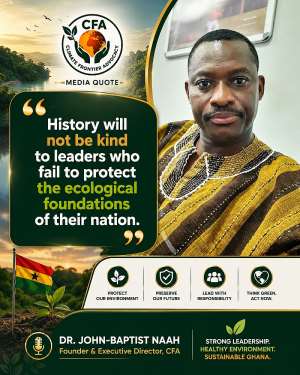
Climate Frontier Advocacy, which I lead in Ghana, believes that climate protection must become part of everyday nationalism. Protecting the environment is not only the duty of ministers, assemblies, chiefs, NGOs, or international donors. It is the duty of every citizen who drinks water, eats food, breathes air, and hopes for a safer future. Nationalism without environmental responsibility is incomplete.
Ghana must therefore build a new climate consciousness across society. Schools must teach children that sanitation, tree planting, water protection, and responsible land use are patriotic duties. Religious leaders must speak about environmental stewardship. Traditional authorities must protect land and water bodies from destruction. Political leaders must stop treating environmental crimes as negotiable matters. Citizens must also stop defending environmental wrongdoing because of party loyalty, family ties, or short-term financial benefit.
The call for a national flood assessment should become a broader call for a national climate assessment. Where are our blocked waterways? Which wetlands have been destroyed? Which communities are most vulnerable to flooding? Which rivers are most affected by HTG activities? Which farming zones are suffering most from rainfall changes? Which assemblies are failing to enforce sanitation and planning laws? These questions must guide policy action, not just public statements.
As this Nationalism Beyond Politics series concludes, Ghanaians must understand that protecting the local climate is not a luxury. It is a national priority. Climate change is global, but its impact is local. The floods enter our homes. The polluted water enters our bodies. The failed rains affect our farms. The destroyed forests affect our future. The waste we dump today returns tomorrow as disease, flooding, and suffering.
If Ghana truly wants accelerated, sustainable development, then climate protection must be placed at the center of nation-building. We cannot continue destroying our environment and later pretend to be surprised when floods, food insecurity, water pollution, and public health problems increase. The time has come for a serious national dialogue on climate responsibility, environmental discipline, and ecological justice.
The question is no longer whether climate change affects Ghana. It already does. The real question is whether Ghanaians are ready to behave like citizens of a country they claim to love. Protecting our local climate is protecting Ghana itself, and that is nationalism beyond politics.


 Surrogacy: Supreme Court judge warns of citizenship and inheritance challenges f...
 Ghana has a surrogacy law, but… - Supreme Court Justice
 Ghana faces challenge to persuade Brics it deserves a seat at the table
 Stop the Sermon Before the Engine Starts: Why Ghana Regulates Preaching on Movin...
 Don’t let speed of information become your judgement — Chief Justice tells new l...
 ‘Big Push’: Government assures contractors of prompt payments
 GES to develop plan to recover teaching time lost during teachers’ strike – Clem...
 'All human emotions': French astronaut Sophie Adenot's first words since returni...
 French astronaut recounts 'astonishing' emotions after return to Earth
 India's 'cockroach' movement chief detained ahead of major protest


