




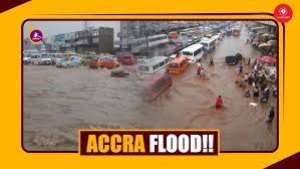
Every year, the skies open over Ghana, and like clockwork, a predictable tragedy unfolds. This year, the floods did not spare anyone. From the dense, choked settlements of Nima and Chorkor to the palatial, exorbitantly priced enclaves of East Legon and Trassaco Valley, the water levels rose with egalitarian fury. Households have been plunged into untold misery, livelihoods washed away, and millions of cedis in property destroyed. Yet, as the floodwaters recede, they leave behind an even more toxic residue: the perennial Ghanaian blame game.
While political leadership attributes the disaster strictly to the "indiscipline" of citizens and traditional rulers, the engineering community points to a deeper, structural failure. Is Accra’s flooding merely a behavioral issue, or is it a catastrophic failure of engineering and state vision? More importantly, has the time come to admit that Accra, as a capital city, is fundamentally unsustainable?
The Presidential Narrative: A Cross of Indiscipline
In the wake of the recent havoc, the official state narrative has fixed the blame squarely on human behavior. The presidency has pointed an accusing finger at traditional leaders who exploit loose customary land tenure systems to demarcate and sell plots in designated flood-prone areas, wetlands, and natural waterways. On paper, this argument carries weight. The hydrological reality is clear. When natural floodplains are paved over with concrete, the earth loses its capacity to absorb water, accelerating surface runoff.
However, to stop the diagnosis at the gates of traditional palaces is to treat a systemic cancer with a topical ointment. Indiscipline in Ghana is not an isolated, bottom-up phenomenon; it is a highly structured, top-down enterprise.
The Anatomy of Institutional Indiscipline
True indiscipline begins within the very state apparatus meant to enforce order. Corrupt government officials within various Metropolitan, Municipal, and District Assemblies (MMDAs) regularly connive with chiefs. They deliberately look the other way, falsify zoning permits, and approve structural layouts in unauthorized zones.
This institutional paralysis is heavily driven by political opportunism. Successive governments have demonstrated a profound fear of correcting wrongdoing because they dread the electoral backlash. When political survival is prioritized over urban planning, enforcement agencies are effectively neutered. The fear of losing votes has turned state regulators into passive bystanders.
The Affluent and the Ordinary: A Shared Culprit
Next in the hierarchy of indiscipline are the affluent of society. Armed with financial muscle, some wealthy individuals bypass planning laws by hook or crook, building massive structural barriers across natural drainage channels. Ironically, these very individuals are often found in the front rows of our most prestigious churches and mosques, projecting piety while their structural choices subvert the public good.
At the base of this pyramid is the ordinary citizen, whose indiscipline is most visible but perhaps most misunderstood. The indiscriminate dumping of solid waste into open drains during rainstorms is a major catalyst for urban flooding. Choked gutters turn minor showers into major deluges.
But come to think of it. Can we entirely blame the citizen when the state fails to provide the basic infrastructure of civility? Local government authorities have consistently failed to ensure that adequate dustbins are provided at vantage points and, crucially, that these bins are emptied regularly. Waste accumulation is an institutional failure as much as it is a civic vice.
The Collapse of Educational and Regulatory Safeguards
This widespread misconduct points to a deeper failure in both formal and informal education in Ghana. Our national school curricula have largely failed to instill a foundational culture of civic discipline --- the internal blueprint that compels an individual to do the right thing even when no one is watching. If civic responsibility is being taught in classrooms, the feedback from our choked streets proves it is utterly ineffective. Concurrently, the industrial drivers of this ecological crisis remain completely unchecked.
Much as health workers warn against the dangers of storing food in plastics, and soil scientists demonstrate the long-term degradation of our flora and fauna, plastic manufacturing companies continue to enjoy an unregulated field day. Regulators like the Food and Drugs Authority (FDA) and the Environmental Protection Agency (EPA) have largely turned a blind eye to the plastic menace, allowing short-term corporate profit to dictate the country's ecological future.
The Core Reality: An Engineering Crisis with Historical Roots
While indiscipline acts as a powerful catalyst, viewing the Accra floods purely through a moral lens obscures the core truth: Accra’s flooding is fundamentally an engineering problem.
This is not a new phenomenon; it is a historical trajectory that we chose to ignore. Oral history from older generations provides vital context. In the 1940s, the stretch between the current Kwame Nkrumah Circle Post Office and the PTC building was not a bustling urban center, it was a natural stream. In those days, crossing that terrain required a canoe.
The structural crisis began mid-century when the Kwame Nkrumah Circle and the surrounding ring roads were constructed. Urban developers essentially built over a natural hydrological vein without creating equivalent, resilient channels to redirect the displaced water. Over decades of rapid, unplanned urbanization, this original engineering misstep has amplified.
Learning from the Dutch Masterclass
To argue that a low-lying, coastal city cannot overcome flooding is to ignore global engineering triumphs. The Netherlands presents the ultimate template. With a significant portion of its landmass sitting below sea level, the Dutch faced existential threats far worse than Accra's.
Yet, through the visionary Delta Works, a sophisticated network of dams, sluices, locks, dikes, and storm surge barriers and their modern "Room for the River" initiative, they mastered their terrain. Instead of fighting the water with inadequate gutters, they engineered deliberate floodplains, relocated defenses, and created retention basins.
The Dutch solved their problem because they treated water management as a matter of national survival, backed by unyielding political will and cutting-edge engineering. Ghana, by contrast, relies on de-siltation exercises that amount to scratching the surface of a deep-seated structural wound. Big companies reap millions of dollars for dredging works annually. Perhaps that is what suits politicians. Always finding excuses to dip their hands in the public purse.
A Two-Phase Path Forward: Short/Medium-Term Action and Long-Term Vision
Resolving this crisis requires moving past the political blame game. It demands a highly ambitious, two-phased national strategy executed by a visionary leadership willing to take the bull by the horns.
- Phase 1: Short/Medium-Term Stabilization
In the immediate term, the state must treat urban flooding as a national security emergency:
- Enforcement of Zoning Laws: Demolish all structures blocking waterways, regardless of whether they belong to the political elite, the affluent, or ordinary citizens.
- Drainage Overhaul: Re-engineer the capital’s primary drainage systems, moving away from shallow, open gutters toward deep, subterranean, high-capacity storm drains.
- Plastic Regulation and Waste Infrastructure: Impose strict environmental taxes on plastic manufacturers to fund comprehensive, municipal recycling and waste collection programs across every district.
- Long-Term Strategy --- Relocating the National Capital
Ultimately, we must confront an uncomfortable truth. Accra is exhausted! The city is not only highly vulnerable to rising sea levels and worsening seasonal floods, but it also sits squarely on a major active seismic fault line, making it highly prone to earthquakes. The cost of continually retrofitting an unplanned, overpopulated, low-lying coastal city will eventually bankrupt the state.
Ghana must look to the bold blueprint executed by Nigeria in 1991, when they recognized that Lagos was too congested, choked, and structurally compromised to remain the seat of government, and systematically moved their capital to Abuja. A geographic evaluation suggests that the ideal zone for Ghana’s new capital lies in the center of the country, specifically within Kintampo, Yapei, and Buipe.
Why Buipe and the Central Belt Make Sense
- Geographical Centrality: Moving the capital to this region democratizes access to the seat of government for citizens from all corners of Ghana --- North, South, East, and West.
- Topographical Safety: Unlike Accra, this interior savannah belt sits on stable, higher ground, free from the immediate threats of coastal erosion, rising sea levels, and catastrophic earthquake fault lines.
- The Buipe Advantage: Buipe is already uniquely positioned as a natural inland port and industrial hub with access to the Volta Lake. It offers vast stretches of undeveloped, state-acquirable land, allowing urban planners to design a world-class, sustainable, eco-friendly smart city from scratch.
- Economic Decentralization: Relocating the administrative capital would naturally relieve the unsustainable demographic pressure on Greater Accra, sparking massive economic development, infrastructure expansion, and job creation across the middle and northern belts of Ghana.
My Thoughts: A Call for Visionary Leadership
Accra's annual floods are an indictment on our collective intelligence, our professional engineering bodies, and our political leadership. We cannot continue doing the same things and expect different results.
It will take a visionary, audacious president to look past the next election cycle, declare that enough is enough, and initiate the grand transition. Until we enforce structural discipline, revolutionize our engineering approach, and seriously plan the relocation of our administrative capital to safer, central ground like Buipe, we will remain a nation trapped in a cycle of seasonal mourning --- forever at the mercy of the rising waters.
FUSEINI ABDULAI BRAIMAH
+233208282575 / +233550558008
[email protected]

 Wheelchair at the airport won’t kill case – MP reacts to Sedina’s health claims
 Bawumia failed to address indiscipline in NPP despite opportunity — Arthur Kenne...
 People around Bawumia leaked details of our meeting—Arthur Kennedy
 Sinare, Vanderpuye, Azorka tipped for NDC National Chairmanship race
 “Sedina Tamakloe’s case was NPP textbook politics” – Edudzi Tameklo
 Lapaz accident victim at 37 Military Hospital yet to be claimed, family members ...
 Ghana records over 1.3 million tourist arrivals in 2025 as sector generates $4.3...
 We want to see which prison facility housing Sedina Tamakloe – Nana Adutwum
 Social media addiction can derail your career — Prof. Agyare cautions new veteri...
 Wontumi's plea bargain is admission of guilt – Suhuyini


