




The Illusion of Governance
Ghanaian governance has evolved into a highly profitable, self-sustaining "talk-shop" industry. Every perennial flood or ecological disaster triggers an expensive, predictable cycle of high-level dialogues, multi-million Cedi ministerial committees, and academic PowerPoint presentations. Meanwhile, the critical state infrastructure and natural buffers that protect human lives continue to decay in real-time.
As a retired civil servant, I have spent decades analyzing the inner workings of our state institutions, and my previous essays on this platform have consistently hammered home one uncomfortable truth: Ghana does not suffer from a deficit of laws, but from a total bankruptcy of political will.
Nowhere is this institutional paralysis more dangerous than the unchecked, state-sanctioned destruction of our internationally protected wetlands. The time for polite diplomacy, symbolic stakeholder workshops, and toothless ultimatums has expired. The Ghanaian public is exhausted, broke, and unequivocally declares that we have had enough of the talk. We demand a transition from elite rhetoric to uncompromising execution.
A Vignette of What We Lost: The Golden Age of the Beach Road
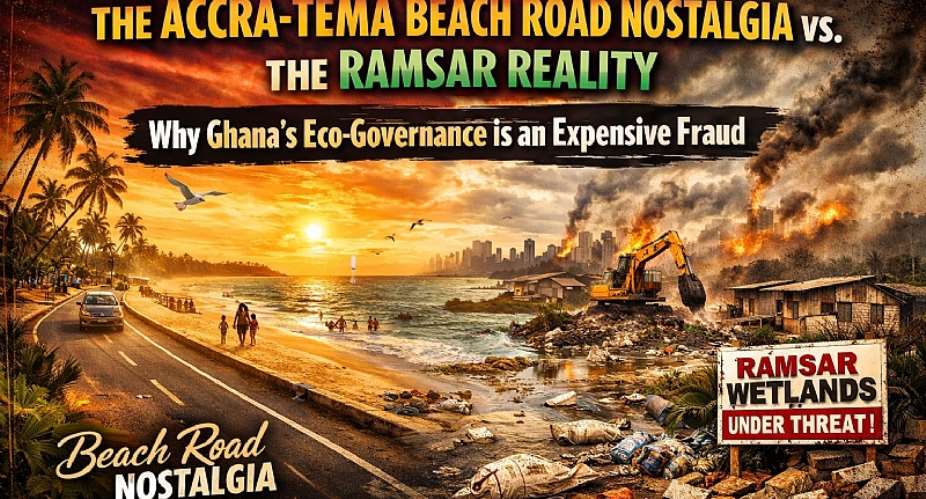
To understand the depth of our current systemic decay, one must look back at what our natural environment used to give us for free. In the late 1960s and throughout the 1970s, driving along the Accra-Tema Beach Road was not the frustrating commute through traffic and concrete dust that it is today; it was a scenic, bountiful journey through a thriving ecological paradise.
THE 1970s BEACH ROAD EXPERIENCE ├── Pristine Lagoons: Crystal clear waters teeming with marine life. ├── Roadside Markets: Direct-from-nature fresh catch at unbeatable prices. └── Abundant Species: Massive tilapia, robust mudfish, and giant prawns.
In those days, commuters could pull over anywhere near the Sakumono or Kpeshie catchments and buy baskets of glistening, freshly harvested tilapia, heavy mudfish, crabs, and giant prawns directly from local artisanal fishermen. The lagoons were pristine, deep, and constantly flushed by the tides. They were living, breathing economic engines.
Today, that beautiful, productive landscape has been replaced by a congested urban wasteland. The fresh fish stalls have vanished, replaced by illegal high-walled mansions, structural blocks, and open sewer drains. We have successfully traded our long-term food security and natural beauty for short-term real estate corruption.
The Anatomy of Ecological Plunder
We must bypass vague political generalities and confront the specific geographic fronts where the state has completely surrendered its regulatory sovereignty to lawless developers and corrupt public planners:
- The Sakumono Ramsar Site: Once a sprawling 1,364-hectare sanctuary for biodiversity, urban built-up areas skyrocketed from a mere 1.06% in 2000 to an alarming 45.26%. The May 2026 demolition exercises by the Forestry Commission and the Greater Accra Regional Security Council (REGSEC) in the Golf Course section are a welcome shock. However, it exposes a critical question: why did local authorities stand by until plush, multi-story estates blocked these international waterways?
- The Densu Delta & Dansoman Basins: The lagoons of the Densu Delta are choked with unregulated municipal waste and systemic encroachment. This environmental neglect leaves downstream, low-lying neighborhoods like Dansoman completely defenseless against catastrophic flash floods during every heavy downpour.
- The Kpeshie Lagoon Enclave: This once-vibrant coastal lagoon has been systematically backfilled by wealthy, well-connected buyers and local syndicates. This elite "land shopping" disrupts the coastal ecosystem, turning natural drainage channels into stagnant water pools and exposing local communities to severe tidal surges.
The Economic Math: Millions Flushed and Billions Forfeited
The destruction of our wetlands is not merely an environmental tragedy; it is an act of macroeconomic self-sabotage. Our leaders view wetlands as waste land, blind to both the structural liabilities they create and the massive creative and marine economies they actively crush.
1. The Catastrophic Losses of Inaction
- The Household and National Drain: Comprehensive climate vulnerability data reveals that between 2013 and 2023, floods affected over 110,000 Ghanaian households, causing direct economic losses of US$1.7 billion (approx. 20 billion Ghana Cedis). On an individual basis, flood disruption slashes a staggering $15,630 (over GHS 184,000) from an affected household's potential GDP contribution.
- The Annual Municipal Bill: In the Greater Accra Metropolitan Area (GAMA) alone, localized annual flood losses exceed GHS 200 million in damaged roads, ruined vehicular assets, and lost productivity. This is capital that could easily fund critical infrastructure, public health, or educational grants.
- The Engineering Deficit: The Ministry of Works and Housing estimates that the state requires at least 6 billion Cedis to completely re-engineer urban drainage. Yet, we waste public money on superficial, post-disaster handouts rather than investing heavily in early containment.
2. The Hypocrisy of the Seafood Crisis
We stand along our shorelines today lamenting the skyrocketing cost of fish and the dwindling supply of seafood in our local markets, entirely forgetting that coastal wetlands are the very delivery rooms of the ocean.
- The Nursery Destruction: Mangroves, estuaries, and lagoons within our Ramsar sites serve as the primary breeding grounds and nurseries for over 70% of the marine fish species caught in Ghanaian waters. By choking the Kpeshie lagoon and paving over the Densu Delta, we are systematically suffocating the fingerlings before they ever reach the open ocean.
- The Fishery Collapse: The Ministry of Fisheries and Aquaculture Development enforces stressful "closed fishing seasons" to restore dwindling marine stocks. Yet, these bans are completely undermined because the state permits developers to pave over the exact shallow-water sanctuaries where fish breed. This ecological blindness directly threatens the livelihoods of over 2.7 million Ghanaians dependent on artisanal fisheries.
3. The Forfeited Wealth of a Green Economy
While we beg for foreign bailouts, we are actively burying a multi-billion Cedi golden goose. According to global ecosystem assessments, well-managed wetlands offer massive wealth-generation potential:
- The $4.8 Billion Tourism Factor: Tourism has officially generated $4.8 billion in inflows for Ghana, outperforming cocoa and oil as a prime source of foreign exchange. Crucially, unlike extractive resources, tourism dollars circulate directly within the local hospitality, transport, and informal service sectors.
- The Wetland Economy Potential: International data indicates that sustainable wetland conservation—encompassing artisanal fisheries, carbon trading, and eco-hospitality—commands a massive economic valuation, contributing to global ecosystem services valued at up to $39 trillion globally.
- The Loss of Entertainment Spaces: By backfilling our lagoons and cementing our basins, we deny Accra the space to scale up its creative sector. Safely preserved wetlands can be integrated into high-yield, world-class ecotourism parks, boardwalk entertainment strips, zip-lining retreats, and water-sport recreational zones. Instead of "Detty December" being confined to dusty, gridlocked urban spaces, we could leverage pristine, safely managed waterfronts to secure a permanent 20% to 30% surge in seasonal diaspora tourism revenue.
THE MACROECONOMIC STAKES ├── GHS 20 Billion: National economic loss from floods (2013-2023) ├── GHS 200 Million: Capital washed away in Accra every single year ├── 2.7 Million: Ghanaian livelihoods crushed by breeding ground destruction └── $4.8 Billion: Available tourism inflows vulnerable to urban blight
The Budgetary Fraud and Institutional Complicity
As Parliament prepares to debate the national budget allocations for the Ministry of Water Resources and Sanitation, we must expose the deep financial absurdity of our national approach to flood management. Year after year, the national budget allocates hundreds of millions of taxpayer Cedis to superficial, repetitive drain-dredging and emergency flood relief.
This is an organized economic drain. While the state uses public funds to clear flood channels, Municipal Chief Executives (MCEs) and corrupt spatial planning officers line their pockets by quietly issuing building permits inside those exact same flood basins.
As I noted in my previous piece on The Anatomy of State Capture, when public regulatory power is hijacked to serve private, well-connected commercial interests, the state completely loses its moral authority. The taxpayer is forced to fund the relief, and eventually, pays even more money for delayed, reactive demolitions.
Actionable Recommendations and Suggestions
To collapse the "talk-shop" industry and restore structural integrity to our eco-governance, all primary stakeholders must immediately enforce the following policy directives:
- Criminalize Planning Complicity: Parliament must urgently pass the Land Use and Spatial Planning Amendment Bill. This framework must explicitly strip away administrative immunity and criminalize the actions of any public official, surveyor, or MCE who signs off on a building permit inside a documented Ramsar site or flood zone.
- Defund the "Sensitization" Budget: Parliament must refuse to approve any budgetary allocations for environmental "sensitization campaigns" or "consultative stakeholders' workshops." Every single Cedi of those funds must be reallocated directly into the operational budget of the Forestry Commission and NADMO for active, 24-hour drone surveillance and permanent physical boundary demarcation.
- Enforce Complete Boundary Transparency: Just as I recently advocated for independent third-party portals to curb administrative abuses in our public offices, the Lands Commission must be legally mandated to publish comprehensive, interactive digital maps of all protected eco-zones online. Citizens must have a foolproof mechanism to verify land validity instantly before buying properties.
- Commercialize, Don't Concretize: The Ministry of Tourism, Arts and Culture must partner with private eco-developers to transform our Ramsar sites into high-yield, protected recreational zones. Setting up non-invasive wooden boardwalks, regulated bird-watching hubs, and water-sport entertainment zones creates a physical presence that naturally deters illegal land grabbers while generating sustainable local jobs.
- Establish an Independent Eco-Crimes Tribunal: We must fast-track the prosecution of environmental saboteurs. The Judiciary must establish dedicated, fast-track courts to try and imprison land guards, corrupt estate developers, and municipal officials who collaborate to destroy national ecological assets.
A Commander-in-Chief's Ultimatum: The Call for Military Intervention
Because the civil machinery of state has proven itself hopelessly compromised by political patronage, we must look to the ultimate custodian of national order. I call directly upon the Commander-in-Chief of the Ghana Armed Forces, President John Dramani Mahama, to bypass the sluggish, corrupted channels of municipal bureaucracy. The presidency must deploy the absolute discipline of our military engineers.
Mr. President, exercise your executive authority by ordering the 48 Engineer Regiment (the Sappers) and the Field Engineers Corps to take complete, unhindered charge of the physical demolition, dredging, and full restoration of all compromised Ramsar sites. Let the military draw the red lines that civilian regulators are too compromised to enforce.
This intervention must be absolute, swift, and executed no matter whose ox is gored, without fear or favor. As this is your final term in high office, you are unburdened by the cautious calculations of future election cycles. Use this historic autonomy to break the back of real estate lawlessness, reclaim our natural buffers, and secure an ecological legacy for generations of Ghanaians yet unborn.
No More Soft Landings
In my recent commentary on Reengineering the Ghanaian Dream, I argued that a true, functioning democracy cannot be measured by the ritualistic act of voting every four years. True democracy is measured by the uniform enforcement of the rule of law, the preservation of our collective natural assets, and the absolute accountability of those trusted with state power.
Ghana cannot survive another decade of comfortable elite consensus-building while the very ground we stand on washes away beneath our feet. True leadership is measured by the enemies it makes in defense of the public good. To every minister, director, and stakeholder currently holding a microphone instead of an enforcement order: step up, execute your statutory duties without fear or favor, or step aside. The talking shop is officially closed.
✍️By A Concerned Senior Citizen
Retired Senior Citizen
For and on behalf of all Senior Citizens of the Republic of Ghana 🇬🇭
Teshie-Nungua
[email protected]

 Anti-LGBTQ Bill is duly passed, I believe it is too late in the day to reverse i...
 Here are areas to face power outages over maintenance works today
 RNAQ ex-wife petitions court to restrict Hajia4Reall’s closeness to her children...
 One dead, two children trapped after three storey building collapse at Adenta
 Obuasi Circuit Court jails farmer 8years over violent mining site attack at Obua...
 Health Minister summons KATH CEO over emergency centre closure
 Unauthorised structures demolished at Haatso
 Fire guts shops opposite Accra Central Police Station
 Stephen Yeboah appointed new registrar of Sunyani Technical University
 Abandoned 250-bed Sewua Regional Hospital rots as KATH battles congestion


