




The Cashless Ambush
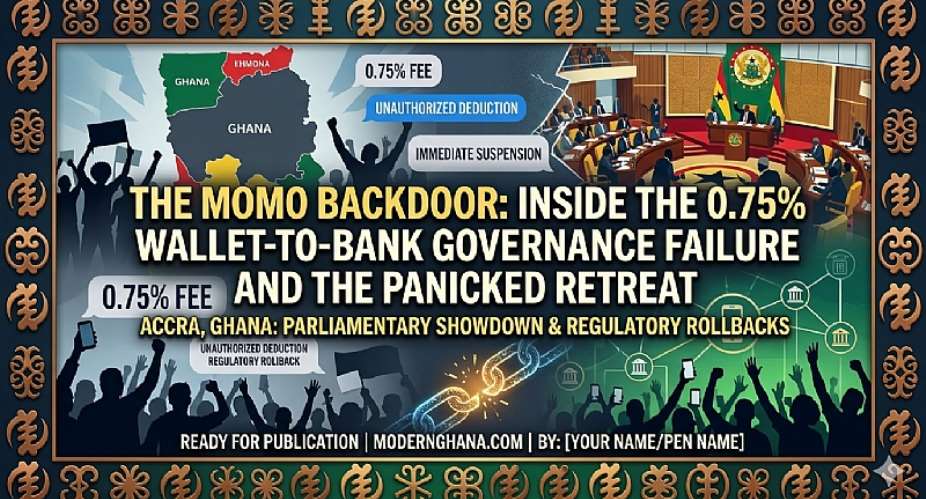
Ghana’s drive toward a cashless economy has run straight into a wall of regulatory confusion, political blame games, and sudden rollbacks. Out of nowhere, text messages flooded mobile screens announcing a new 0.75% fee capped at GH¢5 on MTN Mobile Money (MoMo) wallet-to-bank transfers. Scheduled to begin on June 1st, this unexpected announcement sparked an immediate firestorm in Parliament.
The floor of the house turned into absolute political theater. Finance Committee Chairman Hon. Isaac Adongo clashed heavily with the minority's Hon. Kojo Oppong Nkrumah over who authorized this deduction and why it was sprung on citizens without parliamentary approval. While the Bank of Ghana (BoG) has stepped in to direct an immediate suspension of the fee, this panicked retreat exposes a broken system. It proves that the everyday citizen is being treated like a financial testing ground.
1. The Parliamentary Evidence and the Rules of Debate
During the fiery parliamentary session on Tuesday, June 2, 2026, the chamber erupted over regulatory compliance. The dispute centered on a copy of the official corporate notification letter issued by mobile network stakeholders detailing the pricing adjustment schedule:
[DOCUMENTARY EXTRACT: SERVICE UPDATES INTEGRITY]
To: All Valued Customers / Financial Ecosystem Partners
Effective Date: 1st June 2026
Subject: Implementation of MoMo Wallet-to-Bank Service Fee Reviews"Please be informed that in line with cross-platform optimization and liquidity management frameworks across the digital finance sector, transfers initiated from MTN MoMo Wallets directly to commercial bank accounts will attract a standard transactional tariff of 0.75%, with total charges strictly capped at an upper ceiling of GHS 5.00 per transaction."
How the Rules of Parliament Fueled the Clash:
Under Order 93 of the Standing Orders of Parliament, MPs are strictly forbidden from introducing unverified or sub-judice material to mislead the House. This rule became the focal point of the entire showdown:
- The Minority’s Standing Order Weapon: Hon. Kojo Oppong Nkrumah used the official date and text of the corporate notification to back his claim. He argued that the document was undeniable proof of an illegal "backdoor arrangement" by the administration to bypass the House and levy consumers without legislative consent.
- The Government’s Point of Order Counter: Hon. Isaac Adongo raised a counter-argument on the floor. He used parliamentary protocol to emphasize that the opposition was mischaracterizing the text. Adongo argued that the language explicitly calls the charge a "service fee tariff" run by private sector platforms, which does not require parliamentary tax approval under the law.
2. The Core Anomalies Every Ghanaian Must Know
To understand the gravity of this policy failure, the facts must be stripped of political spin:
- Corporate Overreach: A major telecom company could confidently broadcast an official implementation date (June 1st) across millions of screens before the regulatory supervisor finalized a consensus.
- Firefighting Instead of Vetting: The central bank's intervention occurred as a late-stage emergency response to public anger, rather than a proactive vetting process before billing pipelines were modified.
- The Unfair Squeeze on the Poor: While the GH¢5 ceiling spares rich corporate transfers from huge charges, it heavily hits small informal traders who regularly move modest amounts of capital between wallets and local banks.
3. Simple Recommendations for Regulators and State Actors
If state authorities want to save what is left of public trust in electronic financial systems, they must act immediately:
- Punish Premature Announcements: The Bank of Ghana must heavily fine any corporate financial institution that broadcasts pricing changes to the public before securing explicit, signed regulatory approval.
- Keep Taxes and Private Fees Separate: The Ministry of Finance must legally ensure that network providers clearly label corporate service charges. If a cost is a service fee, its mathematical model must be published transparently so it cannot be confused with a state tax.
- Enforce a 30-Day Notice Window: Introduce a strict, mandatory 30-day public notice window before any mass pricing adjustments can take effect in the mobile money network to prevent consumer shock.
4. Easy Suggestions for the Man in the Street
Ordinary citizens do not have to sit back and watch their hard-earned money get chipped away by poor policy planning. Protect your cash with these steps:
- Use Free or Cheaper Alternatives: Switch your transaction traffic to state-backed digital utilities like the GhanaPay application or localized bank USSD platforms which offer heavily subsidized cross-network transfers.
- Keep an Eye on Your Wallet Balance: Regularly check your transaction history using service short-codes (*170#) to make sure providers are not executing unauthorized hidden deductions during this temporary freeze.
- Report Violations Directly: If you notice any network applying an unauthorized 0.75% wallet-to-bank fee despite the official central bank suspension, report the provider immediately to the Bank of Ghana Consumer Protection Unit.
Trust is the Sinking Anchor
The volatile standoff between Hon. Adongo and the opposition caucus confirms a frustrating reality for the average Ghanaian. Our regulatory system treats digital consumers as an experimental testing ground for sudden economic policies. Mobile money is not a luxury tool for the wealthy. It is the vital pipeline powering local market women, small business owners, and the unbanked population.
When state institutions allow a setup where critical financial rules can be altered overnight through unexpected text alerts, it weakens the foundation of our entire digital economy. The Bank of Ghana’s late-stage suspension order is a welcome relief, but it highlights a massive governance failure. True economic stability will only be reached when regulators, telecom firms, and political figures stop treating public wallets like a laboratory for unvetted fees. Policy transparency must come before implementation, not as a panicked response to public outrage.
✍️By A Concerned Senior Citizen
Retired Senior Citizen
For and on behalf of all Senior Citizens of the Republic of Ghana 🇬🇭
Teshie-Nungua
[email protected]

 Hamas agrees to disarm under Trump ceasefire deal
 Trump says US has not agreed to Ukraine producing Patriot missiles
 US expels dozens to African deportation hubs: lawyers
 "Do Zuba and KMA want us to turn to prostitution to feed our children?" – Distra...
 Trump and far-right seize on Spanish migration crisis
 Sedina's acquittal: Read the unanimous judgment and stop commenting 'by-heart' –...
 Report anyone offering Big Push contracts for sale to police — Roads Minister
 Gender Minister assures government support for children injured in Dzorwulu road...
 'It will not happen again' — NDC MP apologises for 'I will marry you' comment to...
 Dagbon set to enskin Kampakuya Naa Abukari Yakubu today as Regent

