





On Thursday, 4 June 2026, the serene and expansive premises of the Administrative Staff College of Nigeria (ASCON), Topo-Badagry, Lagos, came alive, as distinguished scholar, administrator, and Vice-Chancellor of James Hope University, Professor Austin N. Nosike, engaged participants of the Mandatory Training Programme for Chief Executive Officers of Federal Government Agencies and Parastatals, Cohort 14 in his capacity as the President of African Academy of Economics.
The highly anticipated session formed part of the week-long programme organized by ASCON from 31 May to 6 June 2026 under the conference theme, “Leadership for Policy Execution: From Mandate to Measurable Results.”
Scheduled between 11:00 a.m. and 12:30 p.m., Professor Nosike’s presentation attracted keen interest from chief executives, senior public sector administrators, policy experts, and development practitioners eager to explore practical strategies for strengthening institutional performance and accountability in Nigeria’s public service.
As Facilitator for ASCON Cohort 14, Professor Nosike delivered a thought-provoking paper that challenged conventional assumptions on performance challenges facing federal government agencies and parastatals. Drawing from extensive research, current policy realities and international best practices, he explained that the persistent gap between institutional mandates and measurable outcomes was not fundamentally the problem of inadequate funding but that of visibility, performance monitoring, and leadership accountability.
According to Professor Nosike, many government agencies have continued to focus heavily on reporting activities rather than demonstrating outcomes. Annual reports often contain extensive details of conducted workshops, meetings held, funds released, and beneficiaries reached, yet they provide limited evidence of actual impact on citizens and national development objectives. He maintained that the future of effective public sector management lies in the adoption of performance dashboards capable of tracking institutional achievements in real time and providing leadership with accurate information for timely decision-making.
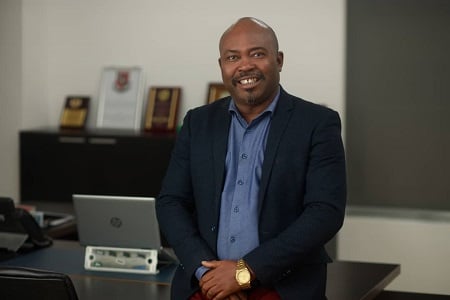
Participants listened attentively as he presented compelling examples drawn from Nigeria’s budget implementation framework, the Central Results Delivery and Coordination Unit (CDCU), the Federal Inland Revenue Service (FIRS), and such international models as Rwanda’s renowned Imihigo performance contract system. Through these examples, he demonstrated how performance dashboards have evolved into indispensable management tools capable of transforming public institutions from activity-driven organisations into results-oriented agencies.
One of the most compelling features of the presentation was Professor Nosike’s analysis of the suspension of the National Social Investment Programme Agency (NSIPA) in January 2024 following allegations of financial mismanagement. He explained how the absence of reliable real-time monitoring systems contributed to the inability of leadership to identify operational weaknesses before they escalated into national crisis. The resulting disruption affected millions of vulnerable Nigerians who depended on social intervention programmes for survival and livelihood support.
Professor Nosike emphasized that dashboards should not be viewed merely as technological innovations but as instruments of leadership. He impressed that chief executives who governed through evidence-based performance systems were overly better positioned to identify emerging challenges, improve service delivery, protect institutional reputations, and strengthen public trust. More importantly, such leaders contribute to building a culture of accountability that endures beyond individual tenures.
The presentation was a reflection of Professor Nosike’s long-standing commitment to excellence in leadership, governance, and institutional transformation. Widely respected within academic and administrative circles, he has, over the years, built a distinguished career that spans university administration, strategic management, policy development, research, and executive leadership. His wealth of experience was instrumental to his connecting theoretical concepts with the practical realities that face public institutions in Nigeria today.
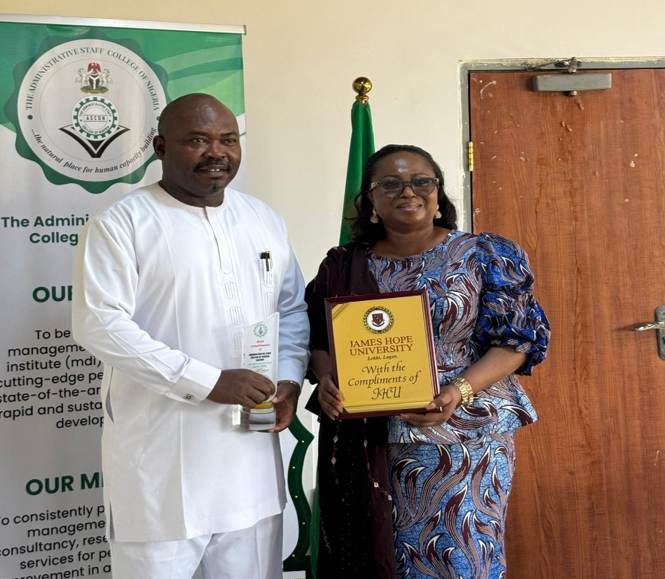
Professor Nosike ASCON Director-General Dr. Funke Adepoju-Olayomi
As the President of African Academy of Economics and Vice Chancellor of James Hope University, Professor Nosike has continued to demonstrate exceptional leadership in higher education administration. Under his stewardship, the university has strengthened its commitment to academic excellence, innovation, research development, quality assurance and global engagement. His reputation as an accomplished university administrator has earned him recognition among education stakeholders both within Nigeria and internationally.
Beyond his current positions, Professor Nosike possesses extensive experience in university governance and management. His contributions to institutional planning, organizational development, strategic leadership, and academic administration have consistently distinguished him as a visionary leader capable of navigating complex institutional environments. Colleagues and stakeholders frequently commend his ability to build consensus, inspire teams, and implement sustainable reforms that deliver measurable results. A widely travelled scholar and administrator, Professor Nosike has participated in numerous international conferences, policy dialogues, leadership forums, and academic engagements across different continents. These global experiences have enriched his understanding of contemporary governance systems and equipped him with comparative perspectives that continue to inform his contributions to public policy and higher education development. His exposure to international best practices enables him to draw valuable lessons from successful institutions around the world and adapt them to local realities.
Participants at the ASCON programme particularly appreciated his practical approach to leadership challenges. Rather than focus solely on theoretical frameworks, he provided actionable recommendations that chief executives could immediately apply within their respective organisations. His emphasis on measurable outcomes, transparency, and evidence-based decision-making resonated strongly with attendees who face increasing demands for accountability and real-time performance in the public sector.
Throughout the session, Professor Nosike encouraged agency heads to embrace a culture of continuous performance measurement and institutional learning. He stressed that effective leadership requires the courage to confront uncomfortable truths, monitor progress honestly, and make adjustments where necessary. According to him, leaders who insist on measurable results always create stronger institutions and leave lasting legacies of public value.
The interactive nature of the session further enriched the learning experience. Participants engaged actively through questions, observations, and discussions on the practical implementation of dashboard systems within government agencies. Professor Nosike responded thoughtfully to these contributions, offering insights that were based on both academic research and professional experience.
As the session concluded, participants expressed appreciation for the depth, clarity and relevance of the presentation. Many described it as one of the most impactful engagements of the training programme, especially its direct relevance to the realities of public sector leadership in Nigeria.
Professor Austin N. Nosike’s engagement with ASCON Cohort 14 reinforced the central message of the conference: that effective leadership must move beyond mandates and intentions to measurable outcomes and demonstrable impact. His presentation challenged participants to rethink traditional approaches to performance management and embrace systems that were capable of delivering greater accountability, transparency, and service excellence. By bringing together his extensive experience in university administration, higher education leadership, policy analysis, and institutional governance, Professor Nosike once again demonstrated why he remains one of Nigeria’s respected voices in leadership development and organizational transformation. His contribution to the ASCON programme will undoubtedly continue to inspire participants as they return to their various agencies with renewed commitment to achieving measurable results for the benefit of the Nigerian people.

 Anti-LGBTQ Bill is duly passed, I believe it is too late in the day to reverse i...
 Here are areas to face power outages over maintenance works today
 RNAQ ex-wife petitions court to restrict Hajia4Reall’s closeness to her children...
 One dead, two children trapped after three storey building collapse at Adenta
 Obuasi Circuit Court jails farmer 8years over violent mining site attack at Obua...
 Health Minister summons KATH CEO over emergency centre closure
 Unauthorised structures demolished at Haatso
 Fire guts shops opposite Accra Central Police Station
 Stephen Yeboah appointed new registrar of Sunyani Technical University
 Abandoned 250-bed Sewua Regional Hospital rots as KATH battles congestion


