




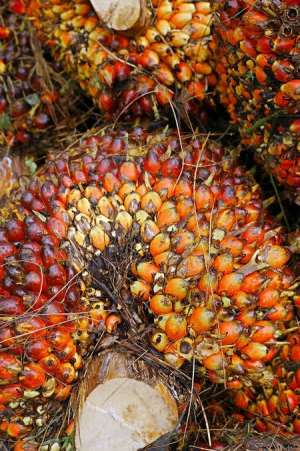
Beijing’s quiet investments are reshaping farms, processing plants, and export markets across Ghana’s oil palm belt.
While public attention often focuses on China’s involvement in Ghana’s roads, ports, and energy infrastructure, a less visible but increasingly significant investment trend is taking shape in the country’s agricultural sector. Over the past three years, Chinese companies and traders have invested millions of dollars in Ghana’s palm oil industry, targeting plantations, processing facilities, and export networks.
The strategy reflects China’s broader effort to secure reliable supplies for its vast edible oil market while positioning Ghana as a key palm oil production and processing hub in West Africa.
Investment Flowing into Farms, Mills and Trade
Unlike many large-scale infrastructure projects financed through government agreements, much of the investment in Ghana’s palm oil sector has come from private Chinese capital.
Chinese firms, particularly from provinces such as Guangdong and Hainan, have reportedly entered lease agreements for thousands of acres of land in Ghana’s Western, Central and Bono regions. Rather than pursuing outright ownership, many companies are adopting contract farming and outgrower models. Under these arrangements, local farmers receive seedlings, fertilizer, technical support and guaranteed markets, while investors secure a steady supply of fresh fruit bunches for processing.
Investment has also expanded into milling and refining operations. Since 2023, several new processing facilities equipped with Chinese technology and backed by Chinese capital have emerged in key oil palm-producing areas, including Ellembelle, Twifo-Praso and Benso. Industry estimates suggest investments ranging between $80 million and $120 million.
These facilities are designed not only to process crude palm oil but also to produce refined, bleached and deodorized (RBD) palm oil, a higher-value product with stronger export potential.
At the same time, Chinese trading companies have strengthened their presence at Tema Port, where they have become important buyers and exporters of both crude and refined palm oil destined for markets in China, India and the Middle East. Investments in storage infrastructure and logistics networks are also improving the efficiency of the supply chain.
Why Ghana Has Become Attractive
Several factors explain the growing interest in Ghana’s palm oil sector.
First is supply diversification. China imports more than seven million tonnes of palm oil annually, with the overwhelming majority sourced from Indonesia and Malaysia. As those countries increasingly prioritize domestic biodiesel production and impose export-related restrictions, Chinese buyers are seeking alternative suppliers. Ghana’s substantial oil palm resources and significant room for expansion make it an attractive option.
Second is Ghana’s strategic position within the African Continental Free Trade Area (AfCFTA). As host of the AfCFTA Secretariat, Ghana offers investors access to a rapidly integrating African market. Palm oil processed in Ghana can potentially serve consumers across West Africa and beyond under more favorable trade arrangements.
Third is competitiveness. Although Ghana’s yields remain below those achieved in Southeast Asia, lower land and labor costs, combined with improved seedlings, mechanization and modern farming practices, offer opportunities for significant productivity gains.
Potential Benefits for Ghana
If managed effectively, the influx of investment could deliver substantial economic benefits.
The sector has strong job creation potential. Modern palm oil mills can generate hundreds of direct jobs while supporting thousands of smallholder farmers through outgrower schemes. Access to finance, inputs and guaranteed markets can improve incomes and reduce uncertainty for rural producers.
The investments are also encouraging technology transfer. Improved Tenera seedlings, mechanized harvesting systems and environmentally friendly technologies such as methane capture are gradually being introduced. Partnerships involving research institutions, including the CSIR-Oil Palm Research Institute (CSIR-OPRI), could further boost productivity and sustainability.
Export earnings represent another significant opportunity. Palm oil has become one of Ghana’s leading non-traditional export products. With growing international demand and expanded processing capacity, industry observers believe export revenues could rise substantially over the next decade.
Risks That Require Careful Management
Despite the opportunities, concerns remain about how the expansion is being managed.
Land tenure issues are among the most sensitive. Long-term lease agreements in rural communities have sparked questions about compensation, local participation and future control of agricultural land. Civil society groups have urged greater transparency to ensure that farmers and communities are adequately protected.
Environmental sustainability is another critical issue. Globally, palm oil expansion has often been associated with deforestation and biodiversity loss. Ghana’s remaining forest reserves are already under pressure, making strong environmental oversight essential. Compliance with international sustainability standards will also be important if Ghana hopes to maintain access to premium export markets.
There is also the question of value addition. Ghana has historically exported raw commodities while importing higher-value finished products. Industry analysts argue that the country must avoid repeating this pattern in the palm oil sector by prioritizing refining, packaging, branding and manufacturing activities within Ghana.
A Defining Opportunity
China’s investments are not transforming Ghana’s palm oil industry overnight, but they are accelerating growth in a sector that has long been considered underdeveloped despite its potential.
For policymakers, the challenge is to strike the right balance: attracting foreign capital while safeguarding communities, protecting the environment and ensuring that more value is created domestically.
If successful, the partnership could become one of Ghana’s most significant agro-industrial success stories in recent decades. If not, it risks becoming another example of resource extraction that generates limited long-term benefits for the country.
As Ghana charts the future of its palm oil industry, the focus must remain on ensuring that investment drives sustainable development, broad-based prosperity and lasting value for local communities.


 Netanyahu says flydubai co-pilot was radicalised as UAE probes terror link
 Baffour Awuah may spend night in EOCO custody — Lawyer
 Suspend Ghana-Colombia port and visa deals over cocaine seizures — Minority
 Ghana Law Society proposes National Service for fresh lawyers
 'We cannot continue to be a Bar of Accra, by Accra, for Accra' — Ghana Law Socie...
 Stop speculation, premature conclusions; allow investigation to determine Baffou...
 Judge halts Ex-NAFCO CEO's trial until ruling on seized phones
 Adenta: Bolt driver jailed 25 years for cutlass attack and robbery of beautician...
 EOCO drags Manhyia South MP to former law firm, residence for search
 Trump 'surprised' UK granted bail to suspects in alleged airbase terror plot


