




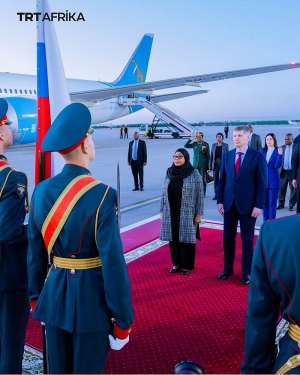
When Tanzanian President Samia Suluhu Hassan's aircraft touched down at Moscow's Vnukovo-2 airport on Tuesday, it carried more than a head of state and a business delegation. It carried the full weight of a geopolitical moment one in which an African leader, facing mounting Western pressure at home and ambitious development targets abroad, has chosen to look East for strategic ballast.
President Hassan is in Russia on a state visit running from June 3 to 5, 2026, at the invitation of Russian President Vladimir Putin. The visit was described by the Tanzanian State House as historic and the description is warranted. It is only the second time a Tanzanian head of state has visited Moscow, the first being the country's founding father Mwalimu Julius Nyerere in October 1969. Nearly six decades separate the two visits. That the intervening years spanned the Cold War, the collapse of the Soviet Union, and an entire era of Western-dominated African development architecture makes President Hassan's arrival in the Kremlin all the more consequential.
The Programme and the Pageantry
On Wednesday, President Hassan held official talks with President Putin at the Kremlin, with the two leaders meeting in both a narrow and an expanded format. The agenda covered expanding bilateral cooperation, international and regional issues, and preparations for the third Russia-Africa Summit. A number of agreements are planned in the areas of higher education, science, information and communications technology, and investment. The day concluded with a state dinner.
The welcoming ceremony was held in the Kremlin's St. George Hall the grand traditional setting reserved for state visits of the highest rank. The symbolism was deliberate: Russia was signaling to the continent and to the West that its relationship with Tanzania carries weight and receives full ceremonial recognition.
On Thursday, President Hassan will receive an honorary doctorate from Peoples' Friendship University of Russia RUDN University before travelling to St. Petersburg to address the plenary session of the 29th St. Petersburg International Economic Forum, known as SPIEF 2026, presenting Tanzania's economic transformation programme. A Russia-Tanzania Business and Investment Forum focused on the business environment and infrastructure development will also take place. The
Economics: Small Numbers, Large Ambitions
Bilateral trade between Tanzania and Russia currently stands at $307.5 million annually a figure that both governments acknowledge represents a fraction of the relationship's potential. Economic data shared during preparatory meetings revealed that mutual trade turnover increased by nearly 20 percent during the first eleven months of 2025, with Russian officials estimating that the volume could feasibly double in the near term as new commercial channels are established.
The business delegation accompanying President Hassan to Moscow is focused on cementing deals in trade, tourism, and minerals. The forum will provide Tanzania with an opportunity to present its economic reform agenda, including the implementation of the National Development Vision 2050, ongoing reforms aimed at improving the business and investment climate, the development of special economic zones, industrialization, energy, infrastructure, mining, tourism, and greater private sector participation in economic growth.
President Hassan herself framed the visit in terms of Tanzania's domestic development trajectory, saying it comes as the country prepares to begin implementing Vision 2050, which calls for greater participation from the private sector.
The Uranium Question: From Drawing Board to Reality
At the centre of the bilateral relationship sits one of Africa's most strategically significant mineral projects the Mkuju River uranium development in Tanzania's southern Ruvuma Region. What was for years described as a plan on the drawing board has, in the past twelve months, moved substantially closer to reality.
The flagship of bilateral cooperation in the mining sector remains the uranium development project at the Mkuju River, operated by Mantra Tanzania Limited, a subsidiary of the Uranium One Group, which is owned by Russia's State Atomic Energy Corporation, Rosatom. (Wikipedia) In July 2025, Rosatom commissioned a pilot uranium processing facility at the project's Nyota deposit in a ceremony attended by President Hassan herself, alongside senior government officials, community leaders, and Rosatom representatives.
The main plant construction was expected to begin in early 2026, targeting annual production of up to 3,000 tonnes of uranium. Tanzania's Minister for Minerals Anthony Mavunde said the project would make Tanzania the third-largest uranium producer in Africa, after Niger and Namibia, with the Mkuju River site estimated to hold 139 million tonnes of uranium deposits and a projected lifespan of 22 years. (Wikipedia) Full-scale development is expected to create around 4,000 jobs and stimulate infrastructure upgrades in the Namtumbo district.
Yet financing obstacles remain. Negotiations for project financing are ongoing with Russian financial institutions as well as Tanzanian banks including CRDB and NMB. However, the project's current mining licence expiry date in April 2028 has created uncertainty among potential lenders reluctant to commit to long-term financing without assurances over licence continuity.
As recently as May 13, 2026 barely three weeks before this state visit Tanzania's Deputy Minister for Minerals Dr. Steven Kiruswa delivered a firm message to Mantra Tanzania executives in Dodoma: the company must move swiftly to launch production, stressing that Tanzania could no longer afford prolonged delays on a project widely viewed as strategic to the country's mining future and broader industrial transformation.
The urgency of that message adds context to the timing of President Hassan's visit. The Kremlin meeting is not merely diplomatic theatre it is, in part, a bid to unlock the financing and political momentum the uranium project still requires.
The Geopolitical Backdrop: Western Pressure and Eastern Pivot
The visit comes at a time when Tanzania's reputation in the West has been badly damaged. Western diplomats and rights groups have accused the Tanzanian government of massacring hundreds of people during election unrest in October 2025 and of conducting a spate of abductions and murders of critics in the run-up to the vote.
Shortly after the contentious 2025 election, Russia became the first country to send a high-level delegation to Tanzania. Led by Sergei Kiriyenko, First Deputy Chief of Staff of the Russian Presidential Administration, the delegation met President Hassan on November 6, 2025, and presented a special message from President Putin. The signal was not subtle: Moscow was offering solidarity at a moment when Western capitals were expressing alarm.
The Section 7031(c) designation against a senior Tanzanian figure, the Reassessing the United States-Tanzania Bilateral Relationship Act then before the US Senate, and the European Parliament's aid freeze have closed the Western channel at the precise moment this visit elevates the Eastern one. For some analysts, the convergence of those pressures and this visit is not coincidental.
Tanzanian officials, however, insist the visit should be viewed primarily through the lens of economic diplomacy rather than geopolitical alignment, noting that Tanzania's engagement with Russia is consistent with its foreign policy tradition, which emphasizes neutrality, mutual respect, and cooperation across different political and ideological blocs.
In the broader view, Tanzania's engagement with Russia reflects a deliberate strategy of maintaining diversified partnerships while safeguarding national sovereignty and development priorities. The emphasis, in the official framing, is not ideological alignment but strategic autonomy and economic opportunity.
An African Precedent
President Hassan's visit does not exist in isolation. It is part of a wider continental recalibration that has seen African governments from the Sahel juntas to the ANC government in South Africa resist pressure to align with Western positions on the Ukraine war and on Russian sanctions, while simultaneously deepening economic and security ties with Moscow. Tanzania's approach is more measured than that of the coup-led Alliance of Sahel States, but the underlying logic is not entirely different: Africa will engage with whoever serves its development interests, on its own terms.
The Nyerere parallel is instructive. When the Father of the Nation travelled to Moscow in 1969, Tanzania was a newly independent state navigating Cold War pressures, insisting on non-alignment while pragmatically cultivating relationships with both blocs. President Hassan has framed her own visit in similar terms a strategic engagement taking place at a crucial time as Tanzania prepares to implement its National Development Vision 2050. The language has changed. The underlying logic of sovereign autonomy has not.
What changes in 2026 is the international context. The Cold War's binary has given way to a more complex multipolar disorder one in which Russia, despite its isolation from much of the Western financial system, retains significant capacity to project influence through arms, energy partnerships, and now uranium cooperation across the African continent.
Whether the deals signed in Moscow this week translate into the jobs, infrastructure, and economic transformation that Tanzania's citizens need remains to be seen. The uranium project alone, if fully realized, would represent a transformative development for one of East Africa's most resource-rich but underdeveloped regions. But between a pilot plant and 3,000 tones of annual production lies a journey of financing, construction, environmental management, and political continuity that no state visit, however historic, can guarantee.
What President Hassan's visit to Moscow does guarantee is that Tanzania's diplomatic options remain open and that Africa, in 2026 as in 1969, is nobody's satellite.
Mustapha Bature Sallama.
Medical/ Science Communicator,
Private Investigator, Criminal investigation and Intelligence Analysis.
International Conflict Management and Peace Building.USIP
[email protected]
+233-555-275-880

 Anti-LGBTQ Bill is duly passed, I believe it is too late in the day to reverse i...
 Here are areas to face power outages over maintenance works today
 RNAQ ex-wife petitions court to restrict Hajia4Reall’s closeness to her children...
 One dead, two children trapped after three storey building collapse at Adenta
 Obuasi Circuit Court jails farmer 8years over violent mining site attack at Obua...
 Health Minister summons KATH CEO over emergency centre closure
 Unauthorised structures demolished at Haatso
 Fire guts shops opposite Accra Central Police Station
 Stephen Yeboah appointed new registrar of Sunyani Technical University
 Abandoned 250-bed Sewua Regional Hospital rots as KATH battles congestion


