




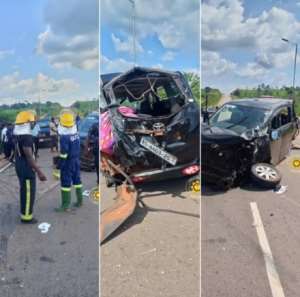
You board the vehicle and immediately sense the tension. Nobody says anything loudly, yet almost everyone feels it. One passenger quietly clutches a Bible. Another keeps glancing nervously through the windshield. A mother tightens her hold on her child. Someone forces a nervous laugh after yet another dangerous overtaking maneuver. The driver presses harder on the accelerator. The vehicle swerves. He overtakes again. For a brief moment, silence takes over.
Then suddenly, almost instinctively, several passengers mutter the same words:
“Jesus Christ!”
Welcome to the growing reality of the Toyota Voxy experience on Ghana’s highways.
What was originally designed as a family minivan has gradually transformed into one of the most feared commercial vehicles on our roads. From Accra to Kumasi, Kumasi to Tamale, and Cape Coast to Accra, thousands of Ghanaians board these vehicles every single day, hoping not just to arrive early, but to arrive alive.
It is this frightening reality that led me to coin the expression, “Killer Bean.” Not out of hatred or exaggeration, but out of repeated observation, personal experience, and growing national concern. Increasingly, whenever many Ghanaians see a speeding Toyota Voxy on the highway, one uncomfortable question comes to mind: Are we still transporting human beings, or gambling with lives?
This article is not written out of hatred for the Toyota Voxy, nor is it an attack on drivers struggling to make a living. Rather, it is a desperate call for national attention before more innocent Ghanaians lose their lives.
My concern is deeply personal.
Not long ago, I boarded a Toyota Voxy from Awutu Breku to Accra. What should have been an ordinary journey quickly became one of the most uncomfortable and frightening transport experiences I have had in recent times. The speed was excessive. The vehicle felt unstable on certain portions of the road. Every overtaking maneuver felt like a gamble between life and death. There was this constant fear that one wrong move, one burst tyre, or one slight miscalculation could end in disaster.
I arrived safely, yes, but mentally exhausted.
Then came an even more disturbing experience involving my wife.
She once boarded a Toyota Voxy from Kumasi to Accra, and according to her, the experience was nothing short of terrifying. The speed was unimaginable. At certain moments, passengers reportedly became visibly anxious and uncomfortable. Yet the driver continued to race through traffic as though human lives meant little. When she finally arrived safely in Accra, we both thanked God sincerely, not because the journey was enjoyable, but because it could easily have ended differently.
Sadly, many families have not been that fortunate.
Across Ghana, reports involving Toyota Voxy crashes continue to emerge with frightening regularity. Hardly a few weeks pass without social media videos, breaking news reports, or eyewitness accounts of another Voxy accident somewhere on our highways. The painful reality, however, is that these may only be the reported cases.
What about the accidents that never make headlines?
What about the near-fatal incidents quietly settled at police stations?
What about the passengers who survive traumatic journeys in silence simply because they arrived alive?
The National Road Safety Authority (NRSA) itself became so alarmed by the increasing trend that it established a technical committee to investigate why these vehicles were repeatedly involved in fatal accidents.
Following investigations, the NRSA concluded that the Toyota Voxy was not designed for long-distance commercial passenger transport. According to the Authority, the vehicle was originally manufactured as a family minivan for moderate urban use, not as a highway commercial workhorse carrying passengers across Ghana under harsh road conditions.
Even more disturbing was the revelation that many of the Voxy vehicles operating commercially in Ghana are converted from right-hand drive to left-hand drive through largely unregulated modifications. According to the NRSA, these conversions affect critical systems such as steering, braking, suspension, airbags, and electrical wiring, thereby compromising the structural integrity and safety of the vehicle.
Some operators further modify the suspension systems and install oversized tyres simply to adapt the vehicles to Ghana’s rough roads. Experts warn that these alterations significantly affect balance, stability, and handling, especially during high-speed travel.
In simple terms, the vehicle is being forced to perform functions it was never engineered to handle.
Yet on Ghana’s highways today, the Toyota Voxy has become king.
From Accra to Kumasi, Kumasi to Tamale, Cape Coast to Accra, Takoradi to Kumasi, and countless other routes across the country, the Toyota Voxy has become a dominant force on Ghana’s highways.
The “Killer Bean” is everywhere: overloaded, overworked, overspeeding, and often driven under intense pressure to maximize profits.
And still, passengers continue boarding them daily, partly because they are fast, accessible, and relatively comfortable compared to some traditional commercial vehicles.
But at what cost?
How many mothers have silently prayed throughout a Voxy journey?
How many passengers have sat quietly in those vehicles pretending to be calm while internally terrified?
How many drivers themselves recognize the danger, yet continue because economic hardship leaves them with little choice?
This is why the issue must go beyond blaming drivers alone.
Yes, reckless driving is part of the problem. Overspeeding is real. Dangerous overtaking is real. Driver fatigue is real. But the bigger issue is systemic failure.
Ghana’s transport sector has gradually normalized unsafe practices. Vehicles designed for family comfort are now being used for aggressive intercity commercial operations. Weak regulation, poor enforcement, corruption within inspection systems, pressure for daily sales, deteriorating road conditions, and the commercialization of human transport have all combined into a deadly national problem.
Even the NRSA recently warned that Toyota Voxy vehicles pose “an unacceptable risk” for long-distance passenger transport in Ghana. Yet despite these warnings, the vehicles continue operating daily across the country.
The irony is painful.
A vehicle designed to transport families safely within cities is now increasingly associated with fear and uncertainty on Ghana’s highways.
That is why I call it the “Killer Bean.”
Not because every Voxy will crash.
Not because every driver is reckless.
But because the pattern has become too frightening to ignore.
The conversation must therefore move beyond social media debates to urgent national action.
Government agencies must enforce transport regulations without compromise. Commercial vehicle standards must be reviewed seriously. Vehicle conversion practices must be properly regulated. Roadworthiness inspections must regain credibility. Driver training and monitoring systems must improve significantly. Above all, Ghana must rethink its overdependence on improvised commercial transport systems that often prioritize profit over human life.
As citizens, we must also stop normalizing dangerous travel experiences simply because “we arrived safely.”
Sometimes survival alone should not be mistaken for success.
The Toyota Voxy debate should awaken Ghana to a painful truth: many of our roads have become theatres of avoidable risk.
If urgent reforms are not implemented, another vehicle will emerge tomorrow as the next “Killer Bean.”
And sadly, more innocent lives will continue to pay the price.
I shall return!


 Protests against cost of living expected in Italy under heavy security
 Lula, Bolsonaro clash on living costs, corruption in final Brazil election debat...
 Ebola vaccine trial begins in DR Congo
 Trump says US may launch ‘another little Epic Fury’ attack on Iran
 ‘Too arrogant, too sure of itself’ France confronts its legacy in Africa
 Nigeria's unwritten power-sharing rule looms over presidential race
 Several killed, dozens wounded in Jordan church shooting
 ‘I killed lots of terrorists, but it didn’t make me feel better’: The trauma hau...
 Casualties feared as multi-storey building collapses in Nairobi
 Adwoa Safo's Dome-Kwabenya comeback bid must push Elikplim Akurugu to deliver mo...


