




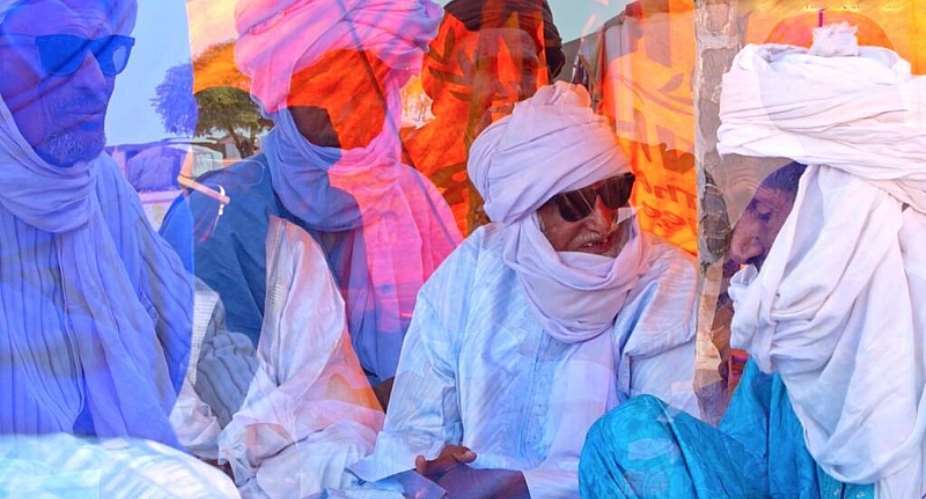
The stars of the documentary Undertows: A Tuareg Tale are between 60 and 90 years old – the uncles, friends and role models of the film's director, Intagrist el Ansari, a descendant of the Kel Ansar, the ruling tribe of the Timbuktu region in northern Mali.
Released this week in France, the film is structured as a letter to his son, and traces the history, resistance and culture of the Tuareg people.
Nomads and herders deeply connected to the land, the Tuareg have inhabited the Sahara for centuries. Today, however, their traditional way of life is under threat from political instability, drought and forced settlement.
Les Filles de Illighadad strum out a unique Tuareg sound
Traditions under threat
“Clearly, the Tuareg world as it existed until the 1980s, as I knew it, can no longer survive in that form,” the filmmaker told RFI.
“All the children of this generation, born in exile and into a scattered Tuareg world, will at some point ask themselves who they are,” he says. “The film offers some answers.”
Over the course of two hours, the documentary explores Tuareg traditions, knowledge and ways of life – particularly their nomadic culture, increasingly eroded by drought and displacement. Still from "Undertows: A Tuareg Tale".
Mali Tuareg peace deal raises hopes but faces challenges
“After the great era of caravan trade, the Tuareg world relied primarily on livestock farming,” el Ansari explains. “But the Sahel and Sahara were among the first regions to be clearly affected by climate change.
“And the major consequence for Tuareg communities has been the decimation of their herds. Without livestock, there is no longer any reason to follow the transhumance routes," he added, referring to ancient, seasonal migration paths used by shepherds.
But the erosion of Tuareg life did not begin with climate change. Colonisation and regional conflict also profoundly reshaped their society.
“There is a divide within the Tuareg world,” el Ansari says. “During colonisation, the Tuareg communities of the north were cut off from those of the south, as colonial powers reorganised Africa between North and West Africa. After decolonisation, that divide deepened further, as borders were drawn between the newly independent states.”
Undertows: A Tuareg Tale mourns this disappearing world, while displaying a determination to keep its memory alive. As el Ansari says, people disappear but their legends remain.
This article has been adapted from this article in French and this interview by Léa Boutin-Rivière.

 Accra Is Sinking Yet Again — Time to Be Truthful With Ourselves
 Fire guts rubber factory at Circle Odawna as flooding hampers firefighting effor...
 Flooding strands commuters on Winneba Cape Coast Highway
 Three feared dead after electrocution in Alajo flooding incident
 Nine missing after floods hit Awutu Senya East
 'Your mother, I should go to heaven and ask Nebuchadnezzar to stop the rain?' — ...
 Flood victim found dead along Alajo Railway track as rescue operations continue
 GMet warns more rain as flooding disrupts movement across Greater Accra
 'You sit on social media and talk nkwasiasem' — Nigel Gaisie blasts critics over...
 Osahen Afenyo-Markin accuses NDC of using GoldBod to promote illegal mining


