




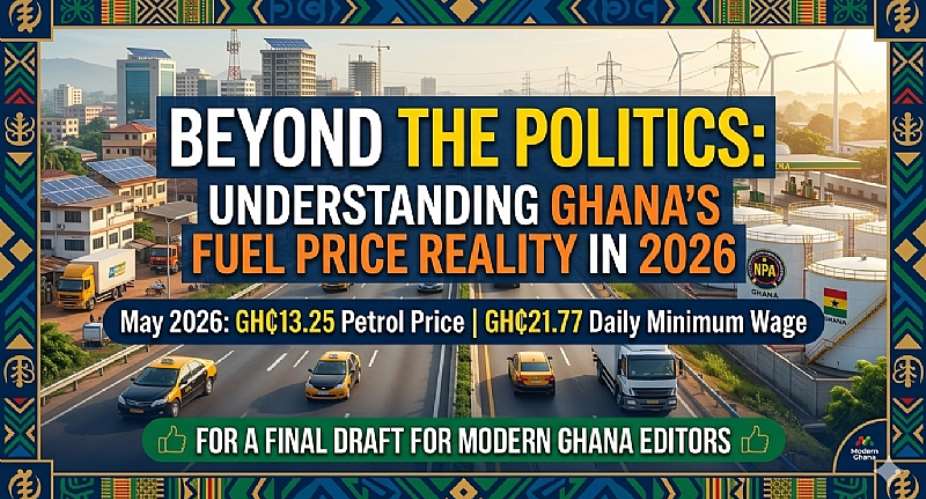
Accra, May 9, 2026
For the average Ghanaian, the "filling station" has become a place of mathematical anxiety rather than just a service stop. As the two major political parties—the New Patriotic Party (NPP) and the National Democratic Congress (NDC)—clash over who managed the pumps better, the citizen is often left buried under a mountain of partisan claims. It is time to move past the "blame game" and look at the hard facts of our energy economy.
The Political "What If": A Critical Analysis
The NPP recently claimed that fuel prices would have been lower under their tenure. However, a critical review of the data suggests a different story.
- The Inheritance: The current administration took over a market where petrol had touched GH₵17.99 in late 2022. Analysts argue that if the NPP’s tax structure—including the Sanitation and Pollution Levy and the E-Levy’s indirect pressures—had remained coupled with global volatility, prices could have easily hit GH₵30 per litre.
- The Current Cushion: As of May 2026, petrol is selling at GH₵13.25 and diesel at GH₵14.30. This "relative" stability is partly due to the government’s recent decision to absorb GH₵0.36 per litre of petrol and GH₵2.00 of diesel to counter global shocks from the Middle East conflict.
Why Is the Pump Still "Hot"? The Global & Local Drivers
Fuel prices are driven by two forces: the international price of crude and the strength of our Cedi.
- Global Conflict: The U.S.-Israeli conflict and tensions near the Strait of Hormuz have pushed Brent crude above $100 per barrel, a 33% increase over the 2026 budget assumption of $75.
- The Exchange Rate: Because Ghana imports nearly 70% of its refined fuel, every "shake" of the Cedi against the Dollar is felt at the pump. While the Cedi has shown recent stability, any depreciation immediately wipes out the benefits of falling global oil prices.
Where Does Your Money Go? The Tax Breakdown
When you pay GH₵13.25 for a litre of petrol today, you aren't just paying for fuel. You are paying for national debt and infrastructure.
- Energy Sector Shortfall Levy (ESSDRL): GH₵1.95 (The "D-Levy" aimed at energy debt).
- Road Fund Levy: GH₵0.48.
- Special Petroleum Tax: GH₵0.46.
- Industry Margins: About GH₵1.37 goes to marketers, dealers, and the Unified Petroleum Price Fund (UPPF).
The Purchasing Power Crisis: Fuel vs. Minimum Wage
The real pain isn't just the price; it’s our ability to pay it.
- In January 2026, the National Daily Minimum Wage rose to GH₵21.77.
- With petrol at GH₵13.25, a Ghanaian worker must spend 61% of their entire daily wage just to buy one litre of fuel.
- Compare this to Ivory Coast, where the minimum wage is higher, or Nigeria, where subsidies keep prices at $0.89; the Ghanaian worker is currently "feeling the heat" more than most in the sub-region.
The Way Forward: Solutions, Not Slogans
To provide lasting relief, we must demand policy shifts rather than political promises:
- Tax Trimming: A permanent reduction of at least GH₵1.65 in petroleum levies as proposed by COPEC and other think tanks.
- Strategic Reserves: Revitalizing the Tema Oil Refinery (TOR) to reduce import costs.
- Windfall Buffers: Using the extra revenue Ghana earns from selling its own crude at $100/barrel to automatically subsidize the local pump price.
A Final Plea: Stop the Politicisation
The price of fuel does not ask for your party card before it drains your wallet. When we reduce these complex economic issues to "NPP vs. NDC" talking points, we lose the ability to hold any government accountable for structural reforms. Whether Blue or Green, the math remains the same: high taxes plus a weak currency equals a struggling citizen. Let us focus on the numbers, the policy, and the survival of the Ghanaian worker.
Editor's Note: This article was compiled using verified data from the National Petroleum Authority (NPA), the Ministry of Finance, and regional economic trackers as of May 2026.
✍️ Retired Senior Citizen
For and on behalf of all Senior Citizens of the Republic of Ghana 🇬🇭
Teshie-Nungua
[email protected]

 Sandema: Funeral clash leaves four injured, army recruit loses hand
 Upper East: Residents raise concerns over Mahama’s 24-hour market policy
 Ex-Buffer Stock CEO and wife were not denied legal counsel on rearrest — EOCO
 PDS case: Lawyers detained were invited as suspects a day earlier -- EOCO
 Government explores autonomous rapid transit system to modernise intra-city tran...
 AU mourns demise of former Botswana President Festus Mogae
 Economic recovery came at a cost to BoG — Sammy Gyamfi on 2025 losses
 NPP's criticism of BoG 2025 losses disingenuous, hollow — Sammy Gyamfi
 Ghana Armed Forces to conduct counter-insurgency exercise in Bono, Upper East re...
 Site for Adaklu District 24-hour economy market handed over to contractor


