




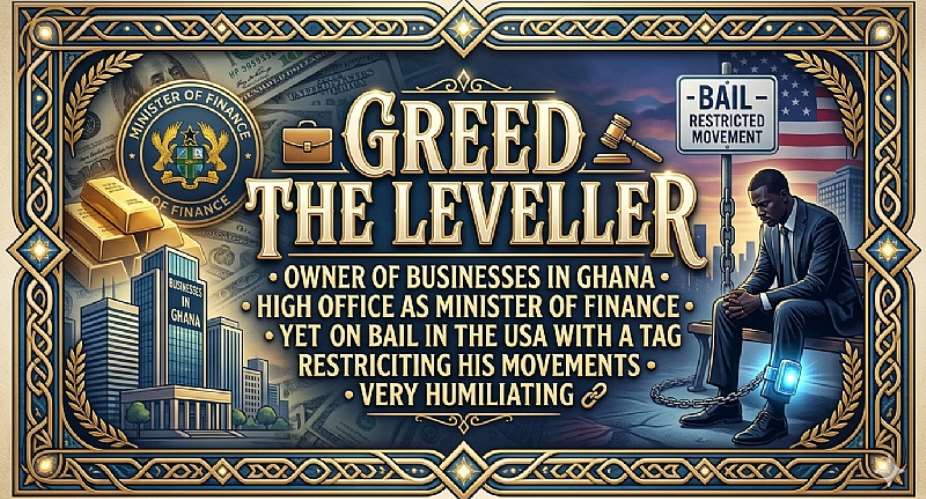
ACCRA, GHANA – The political and legal walls are closing in on Ghana’s longest-serving Finance Minister, Ken Ofori-Atta. From the sterile hallways of a Virginia immigration court to the high-stakes chambers of the Accra High Court, the man who once held the keys to Ghana’s economy now finds himself at the center of an unprecedented international legal tug-of-war.
Following his April 7 release from U.S. Immigration and Customs Enforcement (ICE) custody on a $65,000 bond, the April 27 court appearance has solidified a timeline for his potential return. With his passport seized and his movements electronically monitored, Ofori-Atta is no longer just a former minister in medical transition; he is a man caught between a complex U.S. deportation process and a staggering 78-count indictment back home.
The 78-Count Burden: Specific Charges in Ghana
While the U.S. proceedings focus on his residency status, the Office of the Special Prosecutor (OSP) in Ghana has built a massive dossier against the former minister. The charges primarily stem from five "thematic areas" of alleged financial misconduct:
- The SML-GRA Contract: Allegations of "revenue assurance" maneuvers that the OSP claims bypassed constitutional procurement requirements, resulting in multi-million dollar losses to the state.
- The National Cathedral "Seed Money": Charges relating to the alleged unauthorized release of over GH¢300 million in public funds to private consultants and contractors for the controversial project.
- The "Ambulance" Procurement: Investigation into the financial structures used to procure 307 Mercedes-Benz ambulances, which the state alleges involved inflated pricing and kickbacks.
- Tax Refund Account Irregularities: Specifically, the handling of the GRA Tax P-Fund, where the OSP alleges billions of Cedis were diverted or mismanaged under Ofori-Atta’s direct supervision.
- Conflict of Interest: Ongoing scrutiny regarding the role of DataBank—a firm co-founded by Ofori-Atta—in acting as a transaction advisor for Ghana’s international bond issuances.
The Extradition Tug-of-War: U.S. vs. Ghana
The core of Ofori-Atta's immediate future lies in the U.S.-Ghana Extradition Treaty of 1931 (inherited from the UK) and the modern 2003 Mutual Legal Assistance Treaty (MLAT).
- The U.S. Strategy: Currently, Ofori-Atta is under "removal proceedings." If the U.S. court on June 15 rules that his visa status is invalid or that he is "removable" due to the gravity of the foreign charges, he could be deported directly to Ghana without a formal extradition trial.
- The Ghanaian Strategy: The OSP is pushing for a formal extradition request should the deportation fail. This requires the "Principle of Dual Criminality"—meaning the acts he is accused of in Ghana (like money laundering or bribery) must also be recognized as crimes in the United States.
- The Political Shield: The INTERPOL decision to drop the Red Notice in February 2026, citing "political motivation," has given Ofori-Atta’s legal team a significant defense. They argue that the charges are a "political witch hunt" by the current administration, a claim that U.S. judges take seriously when considering extradition.
The Road to June 15
The adjournment of the Accra High Court case to May 26, 2026, acts as the final domestic prelude to the critical U.S. hearing in June. While Ofori-Atta’s lead counsel, Justice Kusi-Minkah Premo, insists his client is incapacitated by health challenges, the Ghanaian public’s appetite for accountability has never been higher.
A Legacy on Trial
The Ofori-Atta saga is more than a criminal trial; it is a stress test for Ghana’s institutions and its relationship with international law. Whether he returns to Accra in a private capacity to face his accusers or is escorted by U.S. Marshals, the outcome will define the limits of ministerial immunity and the reach of the Special Prosecutor.
As the June 15 court date looms, one thing is certain: the "Golden Boy" of the previous administration is facing a leaden reality. For the millions of Ghanaians who felt the pinch of his fiscal policies, the coming weeks represent the most significant moment of judicial accountability in the country's Fourth Republic history.
Greed, The Great Leveller
In the corridors of power, there is a pervasive myth that wealth and high office provide a permanent suit of armor. For Ken Ofori-Atta, a man who sat at the pinnacle of both Ghana’s financial sector and its executive government, that armor has not just been pierced—it has been stripped away.
The spectacle of a former Finance Minister—an owner of vast business interests and a scion of one of the nation's most influential families—walking through Virginia with an electronic monitoring tag strapped to his ankle is more than a legal update; it is a profound lesson in the nature of "Greed, the Leveller."
For years, Ofori-Atta was the ultimate arbiter of Ghana’s national purse. He moved through the world with the quiet confidence of a man who controlled billions and directed the economic destiny of millions. Yet today, his world has shrunk to the radius allowed by a court-mandated GPS device. The irony is staggering: a man who once navigated the complexities of the International Monetary Fund (IMF) and global bond markets now cannot navigate past his own front porch without the permission of a foreign government.
This is the ultimate humiliation of high-office hubris. It serves as a stark reminder that while power can be amassed and wealth can be hoarded, they offer no protection against the slow, grinding wheels of international justice. The "tag" is not just a piece of plastic and circuitry; it is a symbol of the loss of sovereignty—both personal and political.
In the end, the pursuit of more—more influence, more control, more "revenue assurance"—has led to a state of "less." Less freedom, less dignity, and a legacy now defined not by the budgets he read in Parliament, but by the bail conditions he must follow in exile. The levelling effect of these proceedings proves that no office is high enough to escape the gravity of accountability, and no business empire is vast enough to buy back a reputation once it is tethered to the shadow of a criminal indictment.
✍️ Retired Senior Citizen
For and on behalf of all Senior Citizens of the Republic of Ghana 🇬🇭
Teshie-Nungua
[email protected]

 Accra Is Sinking Yet Again — Time to Be Truthful With Ourselves
 Fire guts rubber factory at Circle Odawna as flooding hampers firefighting effor...
 Flooding strands commuters on Winneba Cape Coast Highway
 Three feared dead after electrocution in Alajo flooding incident
 Nine missing after floods hit Awutu Senya East
 'Your mother, I should go to heaven and ask Nebuchadnezzar to stop the rain?' — ...
 Flood victim found dead along Alajo Railway track as rescue operations continue
 GMet warns more rain as flooding disrupts movement across Greater Accra
 'You sit on social media and talk nkwasiasem' — Nigel Gaisie blasts critics over...
 Osahen Afenyo-Markin accuses NDC of using GoldBod to promote illegal mining
