




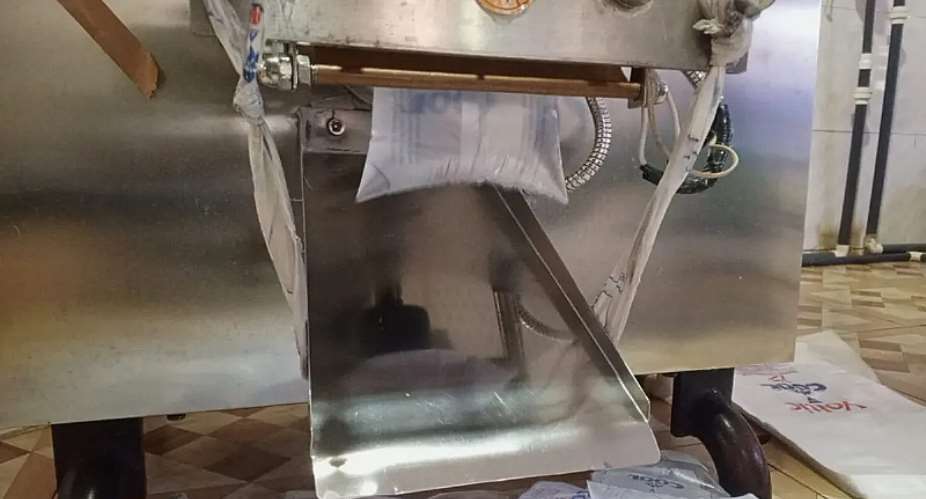
The Upper East Regional Office of the Food and Drugs Authority (FDA) has issued a stern directive to sachet water producers, mandating the use of functional Ultraviolet (UV) light sterilization to ensure public safety and water quality.
During a sensitisation programme for regional producers, the FDA emphasised that UV light is a non-negotiable component of the production process and warned that the sole reliance on filtration systems was insufficient for eliminating harmful pathogens.
Mr Abel Ndego, the Acting Upper East Regional Head of the FDA, explained to participants that while Reverse Osmosis (RO) systems were effective at removing physical particles, they were not designed to eliminate biological threats.
He said: “The reverse osmosis system is meant to separate very minute particles that are in the water but does not kill microorganisms.
“It is the UV lights, both within the Koyo machine and the water line that are responsible for killing the living microbes that escape the reverse osmosis system. This sterilization is what guarantees water safety.”
The FDA highlighted a common misconception regarding the lifespan of UV bulbs.
Mr Ndego noted that the bulbs had specific “running times” after which they lose their effectiveness, even if they appear to be glowing, and said producers must halt production immediately, if their UV lights were non-functional.
The Acting Head said facilities were now required to document every UV bulb changed for the FDA to use the records to calculate run-time and verify sterilization efficacy.
To enforce compliance, the FDA announced a fine structure for equipment failures and that facilities with non-functioning UV system would pay GH¢2,000 spot fine and the same applied to non-functioning water lines.
Mr Ndego disclosed that routine monitoring exercises by FDA officials revealed that some producers were using packaging materials belonging to other brands.
He labelled the practice “highly criminal” under the Public Health Act, describing it as a dangerous deception of the consumer, and advised producers to print their own materials rather than misappropriating others' brands.
Mr Enoch Akortia, the Regional Manager of the Ghana Standards Authority (GSA), cautioned producers against the unauthorised use of the GSA logo and urged businesses to complete the official certification process before displaying the mark of quality.
In an interview with the Ghana News Agency after the programme, a participant, Mr Joshua Akaperiba, the Manager of ‘My Choice Natural Mineral Water’ in Sandema, noted that the programme shifted the focus from profit-making to public health.
“The FDA made us understand that it is not all about the money; the safety of our consumers is key. The education will help us prioritize the right areas of our production,” he said
GNA
 Accra Is Sinking Yet Again — Time to Be Truthful With Ourselves
 Fire guts rubber factory at Circle Odawna as flooding hampers firefighting effor...
 Flooding strands commuters on Winneba Cape Coast Highway
 Three feared dead after electrocution in Alajo flooding incident
 Nine missing after floods hit Awutu Senya East
 'Your mother, I should go to heaven and ask Nebuchadnezzar to stop the rain?' — ...
 Flood victim found dead along Alajo Railway track as rescue operations continue
 GMet warns more rain as flooding disrupts movement across Greater Accra
 'You sit on social media and talk nkwasiasem' — Nigel Gaisie blasts critics over...
 Osahen Afenyo-Markin accuses NDC of using GoldBod to promote illegal mining
