




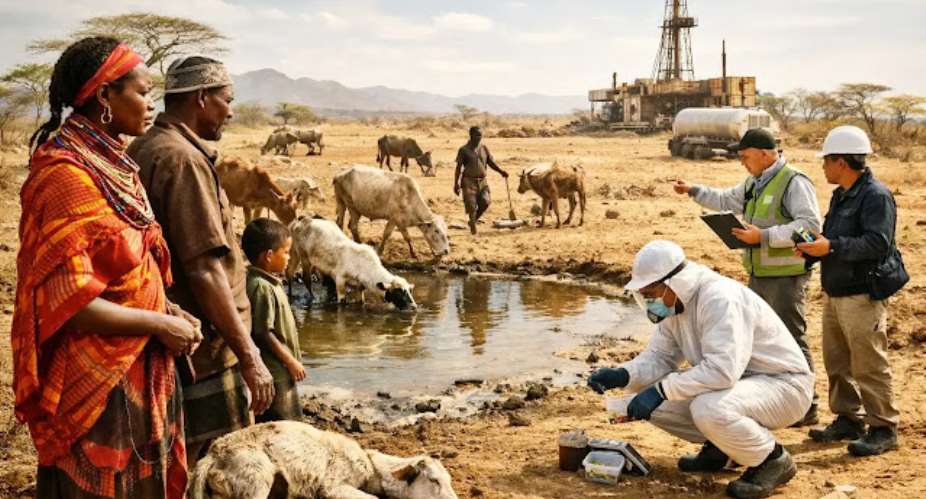
Oil exploration in northern Kenya began in the early 1980s with the promise of economic opportunity, modern infrastructure, and new energy prospects. However, for the pastoralist communities living in Marsabit and the Chalbi Desert region, the legacy of those operations has been far more painful.
According to a major lawsuit filed in Kenya, toxic waste left behind from oil exploration by Amoco, later acquired by BP, has contaminated water sources, caused widespread illness, and killed livestock essential to community survival.
Residents argue that the drilling waste, allegedly dumped in unlined pits during exploration activities between 1985 and 1993, contained harmful substances including heavy metals, radioactive materials, and industrial chemicals. Over time, these toxins seeped into groundwater, the only reliable source of drinking water for both people and animals in this arid region.
What was once seen as a path to development has instead become a slow-moving environmental disaster. For decades, families have reported unexplained illnesses, chronic respiratory problems, skin diseases, and suspected cancer cases. Many attribute these health issues to long‑term exposure to contaminated water.
Pastoralist communities, who depend heavily on livestock for food, income, and cultural identity, have also suffered devastating losses. Cattle, goats, and camels, the backbone of their economy, have died after drinking from polluted wells, pushing many households into poverty.
The lawsuit filed by nearly 300 residents claims that BP, as the successor to Amoco, bears responsibility for the toxic waste left behind. It also accuses several Kenyan government agencies of failing to regulate, monitor, or clean up the contamination, despite repeated warnings from local communities.
The High Court’s decision to allow the case to proceed marks a historic moment for environmental justice in Kenya, giving affected families hope that their suffering will finally be acknowledged.
This case highlights a broader pattern seen across Africa, where multinational corporations have historically operated with limited oversight, leaving vulnerable communities to bear the long‑term consequences.
The situation in northern Kenya is not just a legal battle; it is a human story of environmental neglect, corporate accountability, and the fight for clean water and dignity.
How This Environmental Crisis Can Be Solved
Solving this decades‑old problem requires a coordinated, transparent, and science‑driven approach. First, a comprehensive environmental assessment must be conducted to map the full extent of soil and groundwater contamination.
This should be followed by a government‑supervised cleanup program, funded by responsible parties, to remove toxic waste, rehabilitate contaminated land, and restore safe water sources.
Second, affected communities must receive medical support, including screenings, long‑term health monitoring, and treatment for illnesses linked to toxic exposure. Compensation should be provided for loss of life, livestock deaths, and economic hardship.
Third, Kenya must strengthen environmental regulations to ensure that extractive industries operate responsibly. This includes mandatory lined waste pits, independent environmental audits, and strict penalties for violations.
Finally, the voices of pastoralist communities must be placed at the center of decision‑making. Their knowledge of the land, water sources, and livestock health is essential for long‑term recovery. Environmental justice is not only about cleaning up the past; it is about protecting future generations from preventable harm.


 Reasons behind dismissal of 9 Board Chairpersons by President Mahama revealed
 About 55,000 BECE candidates disqualified from SHS placement
 Foreign Affairs Ministry reaffirms ban on middlemen in attestation services
 Zenator assumes office as Environment, Science And Technology Minister
 2026 BECE: Only 17% of candidates record aggregates between 6 and 18
 'Can your salary buy a Land Cruiser?' – Eric Carbonu challenges journalist over ...
 Private SHSs have vacancies for all 54,985 BECE candidates denied placement — GN...
 Binduri: Farmers along Kubore stretch urged to remain calm over Bagre Dam spilla...
 Travellers bringing more than two phones to Ghana may pay customs duties – GRA
 The Supreme Court Rejected The Attorney-General’s Case On The Unconstitutionalit...

