




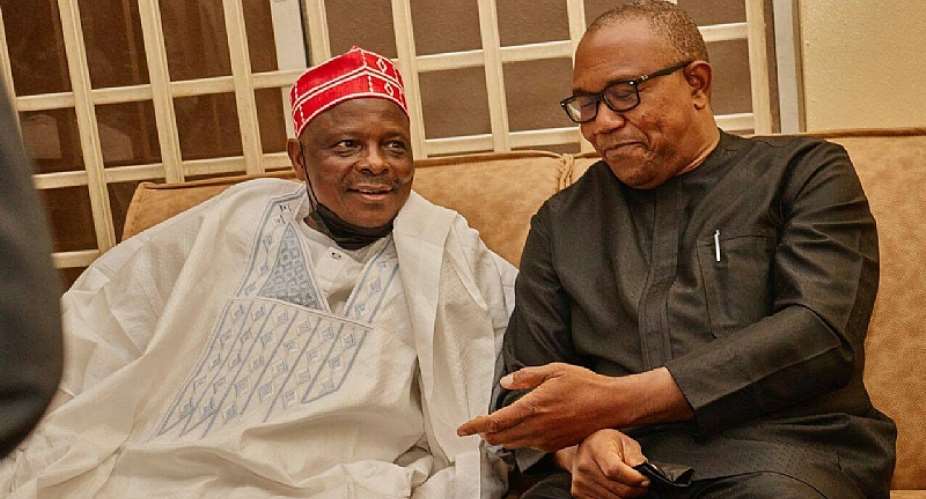
The recent “attack” of Peter Obi by Nigeria’s ambassador to Mexico, Reno Omokri, has once again stirred the already charged atmosphere that is relentlessly encompassing Nigeria’s opposition politics. His criticism of Peter Obi, framed around repeated party defections and alleged patterns of internal crisis, may appear, at first glance, to be a straightforward political attack. But, beneath the rhetoric lies a deeper and more consequential question: why does instability seem to follow in the wake of reform-minded state actors’ declaration for parties within Nigeria’s political space?
To reduce the matter to a personality issue is obviously to miss the forest for the trees. One reason this is happening is because Nigeria’s political parties are not ideologically grounded. They are mostly institutionalized vehicles for power grabbing, patronage, and elite bargaining. When a politician like Peter Obi, whose socio-political messages are consistently targeting corruption, fiscal recklessness, nepotism, and systemic inefficiency enters such a structure, friction is not only inevitable, it is almost guaranteed. Entrenched interests within these parties are neither passive nor naïve. They recognize in the man a figure who campaigns on transparency, cost-cutting, and institutional reform threatens the very foundations upon which their influence rests. Budget padding, inflated contracts, payment of ghost workers, opaque subsidy regimes, and patronage networks are not incidental features of the system, they are its operating logic. Any attempt to dismantle or even moderate these practices is perceived as “life-threatening”. And that is why, as Reno rightly pointed out, Peter Obi is their headache. But again, this is where the pattern observed by Omokri demands meaningful interpretation.
It is not that Obi brings crisis to whatever party he registers with, it is that his presence exposes their contradictions to his political principle. His insistence on accountability disrupts informal arrangements to loot the national treasury. His popularity among young Nigerians challenges established hierarchies. His refusal, at least in rhetoric, to engage in transactional politics unsettles those who depend on it. Consequently, resistance emerges in predictable forms. Internal party disputes are amplified. Alliances shift abruptly. Legal and procedural hurdles appear at critical moments. Media narratives are carefully curated to cast doubt on credibility. What is often described as “party crisis” in fact, becomes the visible manifestation of an invisible struggle between reformist impulses and entrenched moneybags’ power.
This context is essential in any understanding of Obi’s recent resignation from yet another political platform. His claim that state actors and their proxies deliberately infiltrate and destabilize parties aligns with a long-standing pattern in Nigerian politics, where the boundaries between party competition and state power grabbers are frequently blurred. Political parties, particularly those perceived as threats, become vulnerable to penetration, manipulation, and fragmentation.
The lesson here is not merely about Obi as an individual, it extends to the broader challenge of building a viable alternative political movement in Nigeria. As has been consistently argued by observers, including this writer, the notion of a “third force” cannot remain symbolic. It must evolve into a structured, resilient, and strategically coherent entity, capable of withstanding both internal and external pressures.
My early warnings to Peter Obi emphasized precisely this point. Charisma and public goodwill, while valuable, are insufficient in the face of a deeply entrenched political establishments. Sustainable political change fundamentally requires organizational dexterity, grassroots structures, trained personnel, clear policy frameworks, and independent communication channels. The suggestion of alternative media platforms, such as dedicated radio and television outlets like Obidient TV and Radio, was not merely about visibility, it was about narrative control in an environment where traditional media can be influenced or co-opted.
Equally important was my advice to Peter Obi to learn from the experiences of figures like Kingsley Moghalu, whose engagement with emerging political platforms revealed the risks of informal agreements and opaque alliances. Nigerian politics often operates on unwritten understandings, but reformist actors must not concede to such ambiguity. Documentation, transparency, and enforceable commitments are not luxuries, they are necessities that the Obidients and the Kwankwasiyya Movements must adopt. At this critical juncture, the conversation must expand beyond Obi alone to include Rabiu Kwankwaso, another influential figure with a distinct political base, particularly in Northern Nigeria.
Kwankwaso’s political machinery, rooted in the Kwankwasiyya Movement, represents one of the few organized grassroots networks outside the traditional party structures. While his ideological positioning may differ from Obi’s, there exists a convergence of interests: both operate, to varying degrees, outside the dominant duopoly that has defined Nigeria’s political landscape in the past three or more decades.
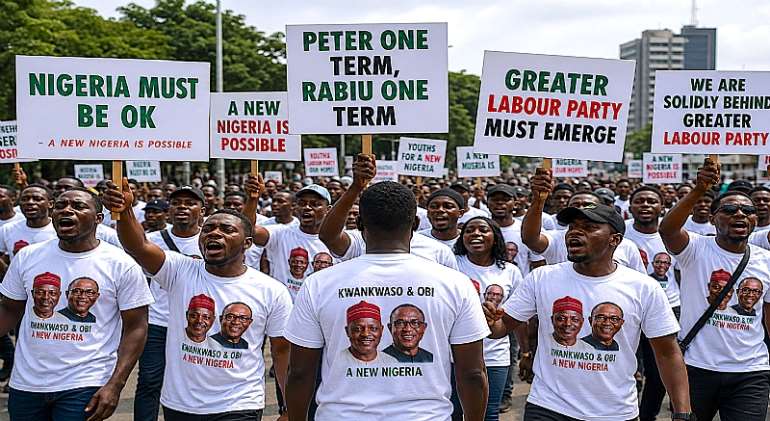
The fragmentation of opposition forces has long been the Achilles’ heel of Nigerian politics. Votes are split, energies dissipated, and yet, the status quo persists. The possibility of a strategic alliance between Obi and Kwankwaso, therefore, is not merely desirable, it has become indispensable. However, such an alliance cannot be superficial. It must be built on clear terms, mutual respect, and a shared vision of governance. A proposal of a one-term presidency arrangement for Obi and one term for Kwankwaso could be ideal and particularly noteworthy. While unconventional, it offers a pragmatic pathway to resolving the perennial issue of power rotation and regional balance. By agreeing in advance to a single tenure for each, both leaders can reassure their respective constituencies while they focus on the immediate task of systemic reform.
Beyond electoral arithmetic, the formation of a new political platform which can be tentatively conceptualized as a “Greater Labour Party” presents a compelling option. The existing Labour Party was instrumental in Obi’s 2023 campaign, but it has since demonstrated structural weaknesses and susceptibility to internal manipulation. A reconstituted platform, designed from the ground up with stronger institutional safeguards, could provide the stability that would be required for long-term political engagement. Such a platform must go beyond rhetoric. It should articulate a coherent economic agenda for addressing Nigeria’s fiscal crises, currency instability, and unemployment. It must propose actionable reforms in cost of governance, public sector efficiency, judicial and INEC independence, adopt credible anti-corruption mechanisms, prioritize human capital development, recognizing that education and healthcare are foundational to national progress.
Crucially, it must also integrate labour interests in a meaningful way. The suggestion to them of offering ministerial and ambassadorial roles to senior labour leaders would not be a mere political incentive, it would reflect an acknowledgment of Labour’s historical role in advocating for social justice and economic equity. By including labour within the governance framework, the movement could strengthen its legitimacy and broaden its appeal.
Timing, however, is of the essence. Political momentum is perishable. The window for building a credible alternative ahead of the 2027 elections is narrowing. Delays in decision-making, prolonged negotiations, or continued reliance on unstable party structures could prove costly. The political establishment is unlikely to remain idle. Efforts to co-opt, divide, or undermine emerging alliances will intensify as the electoral cycle approaches. Moreover, Obi himself must navigate a delicate balance between symbolism and substance. His image as a reformer and a man of integrity has resonated widely, particularly among young Nigerians. Yet, as has been rightly pointed out, symbolism must translate into policy. Voters increasingly demand not just inspiration but detailed plans like, how exactly will corruption be eliminated? What specific steps will be taken to stabilize the economy? How does he intend to create enough job openings, especially for the millions of young school leavers that roam the streets in search of jobs that seem to be found nowhere? How will security challenges be addressed?
These questions cannot be deferred. They must be answered with clarity and conviction. A professional campaign machinery, staffed by competent technocrats and experienced political strategists, is essential. Grassroots mobilization must be systematic rather than spontaneous. Youth engagement must extend beyond rallies to include training, mentorship, and meaningful participation in governance.
At the same time, the narrative surrounding Obi must be carefully managed. Allegations, whether substantiated or not, can shape public perception. The principle that accusations should be proved in court rather than propagated through rumour remains fundamental. Upholding this standard is not only a matter of fairness, it reinforces the rule of law, which is central to the reform agenda. Ultimately, the stakes extend beyond individual ambitions. Nigeria stands at delicate crossroads, grappling with economic hardship, social fragmentation, and institutional decay. The demand for change is palpable, but the pathway to achieving it remains uncertain. In this context, the potential collaboration between Obi and Kwankwaso represents more than a political strategy, it embodies a broader quest for renewal.
The road ahead will not be easy. Entrenched forces will resist. Internal disagreements will arise. External pressures will mount. Yet, history suggests that transformative change often begins with unlikely alliances and bold decisions. If Peter Obi and Rabiu Kwankwaso can rise above personal calculations, reconcile their differences, and commit to a shared vision, they may yet redefine Nigeria’s political trajectory. If they fail, the opportunity may slip away, leaving the field once again to the familiar patterns of power and patronage.
The choice, therefore, is stark. Continue navigating a fragmented and vulnerable political landscape, or take the risk of building something new, resilient, and transformative. For Peter Obi and Rabiu Kwankwaso, the only option left may well be the one that demands the greatest courage.

 Accra Is Sinking Yet Again — Time to Be Truthful With Ourselves
 Fire guts rubber factory at Circle Odawna as flooding hampers firefighting effor...
 Flooding strands commuters on Winneba Cape Coast Highway
 Three feared dead after electrocution in Alajo flooding incident
 Nine missing after floods hit Awutu Senya East
 'Your mother, I should go to heaven and ask Nebuchadnezzar to stop the rain?' — ...
 Flood victim found dead along Alajo Railway track as rescue operations continue
 GMet warns more rain as flooding disrupts movement across Greater Accra
 'You sit on social media and talk nkwasiasem' — Nigel Gaisie blasts critics over...
 Osahen Afenyo-Markin accuses NDC of using GoldBod to promote illegal mining
