




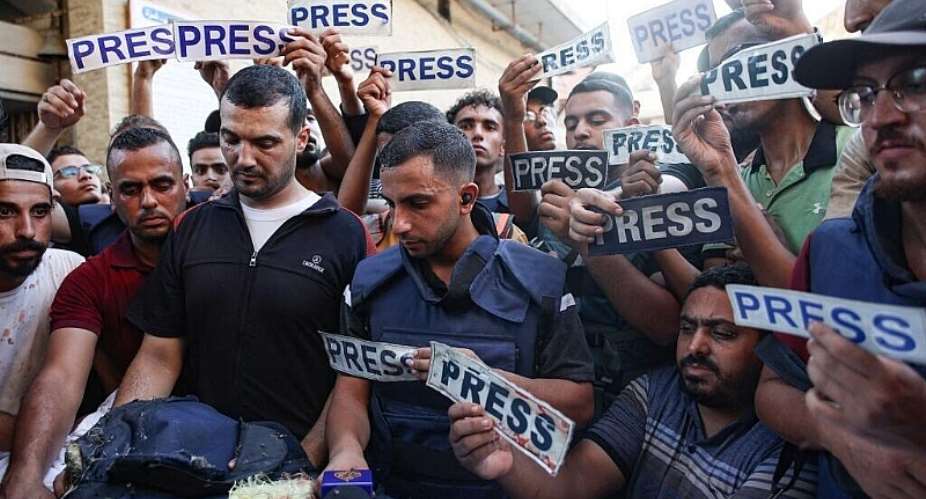
More than 300 delegates representing journalists' unions and associations from across the world are gathering in Paris for the event from 4 - 7 May, hosted by the IFJ's French trade union affiliates — SNJ, SNJ-CGT, CFDT Journalistes and Force Ouvrière.
IFJ president Dominique Pradalié, whose mandate ends on Monday, called the congress an opportunity "to debate the major challenges facing journalism today, such as surveillance and ongoing impunity for crimes against journalists, artificial intelligence, declining workers' rights, among many others."
Ahead of the event, on World Press Freedom day, RFI's Olivier Chermann asked Pradalié about why it's urgent to raise the alarm over the dangers faced by journalists.
Dominique Pradalié: The obstacles for journalists are manifold. They range from direct, specific threats to threats against one's family. These ideas of arrest, complete disappearance are not just in the Sahel or in Africa, they are happening all over the world. And as president of the International Federation of Journalists, which represents some 600,000 journalists worldwide, I must say that we have sounded a genuine alarm bell regarding the deplorable state of press freedom and the terrifying threats that haunt journalists day and night. On 1 May, we published a global monitoring report highlighting this systemic and unprecedented surveillance targeting journalists, as well as traditional phishing emails. Fake websites now coexist with state-sponsored spyware, compromising the safety of journalists and the protection of their sources, without any meaningful or active legislative or regulatory oversight. And what is happening? The result is that in 2025, 128 journalists were murdered. Dominique Pradalié, president of the International Federation of Journalists (IFJ), in the RFI studio on 3 May, 2026.
RFI: Two-thirds of these deaths are attributed to Israel, including 86 in Gaza, making it one of the deadliest places in the world for journalists. Yet the protection of journalists in war zones is guaranteed by international law. Why, in your view, are these principles so difficult to apply in Gaza today?
DP: In Gaza, a genocide is underway. To prevent any testimony, the Israeli army, the Israeli government – dominated by the far right – has decided to target all journalists. At least 250 have been killed in two years. A massacre that no one, even in their worst nightmares, would have imagined possible. You mentioned international conventions. Nothing specific exists for the protection of journalists. Absolutely nothing. They are considered civilians, that is all. Civilians are more or less protected depending on the parties involved and the nature of the wars. But journalists need specific protection. After working extensively with international lawyers, we have drawn up a convention, a text against impunity. Nothing exists at the international level against impunity for the murderers of journalists. And this text provides, in particular, for permanent annual monitoring. This means that every country, every year, will have to report on what it has done to promote press freedom. Finally, independent international teams will be deployed to investigate in countries where journalists have been killed and where justice has not been served. They will attempt to find not only the killers but also the instigators – who are never found – and bringing them to justice.
Record killing of journalists reveals rising global threat to press freedom
RFI: You regularly speak out against the impunity surrounding attacks on journalists. Is there currently any evidence available that could help establish clear accountability for these deadly acts of violence?
DP: Absolutely. I'll give three examples. In Serbia. In Greece, there have been acquittals very recently for the murderers of journalists, on the grounds that it wasn't fully proven that they had actually tried to kill them. I'll leave it to you to interpret and understand what these words might mean for the family and for the profession. These journalists were deliberately killed. The third example is in Latin America, and there are numerous examples in Mexico where they are effectively being hunted down. But I am thinking of our Lebanese colleague Amal Khalil, who was deliberately targeted, warned that she would be targeted if she continued, and who was murdered just like Shireen Abu Akleh in Jenin four years ago. In other words, governments no longer bother with any precautions whatsoever. They simply decide to eliminate inconvenient witnesses. And that is impunity, pure and simple. It is a cancer eating away at all democracies. And since journalists are part of the proper functioning of democracy, every country – France has not yet taken a stand – must publicly declare its support for an international convention against impunity. If this is not done by 2 November, the day designated by the United Nations to denounce impunity for the murderers of journalists, everything will seem like a joke. Lebanese journalist Amal Khalil, who works for the daily Al-Akhbar newspaper, reports near a destroyed bridge in Qasmiyeh, Lebanon, Sunday, 22 March, 2026.
RFI: So, we're talking about working in safety, but there are other aspects too. I'm thinking of the United States, for example, with President Donald Trump's regular rhetoric towards the media, which is consistently confrontational, consistently very harsh. There too, press freedom is under serious threat.
DP: In other words,Donald Trump is setting a bad example to the whole world. This man isn't controversial just because he is President of the United States and that is an important office. This man lies constantly. I think it was the New York Herald or the Washington Post. I can't remember which of the two, in its list covering his two terms, reported that the US president had told more than 2,000 lies. So this isn't confrontational. The press is trying to do its job, lies or no lies and the politicians on the other side are doing what they can to keep their seats and their illegal, illiberal and harmful practices for the whole world.
RFI: You are the president of the International Federation of Journalists. How can you take concrete action in the face of the increasing number of attacks on press freedom?
DP: Well, we go out into the field whenever we can. I do it very often. Members of our executive committee do it. We file complaints, and we're going to bring all these complaints together at an international level. We have a pool of international lawyers who will begin working publicly on Monday at the opening of the world congress in Paris to create specific international legal remedies for all journalists, so that they are no longer hunted down like game, but can, on behalf of everyone, fulfil their mission in the public interest.
Kidnapped, killed or silenced: Africa's journalists increasingly under threat
RFI: The safety of journalists has become a major issue. What measures can you put in place to provide concrete protection for reporters in the field?
DP: Well, there are two types of measures for journalists, before and during their trips. We run a huge number of training courses for journalists – as you will understand, we keep these discreet, and the countries involved are also discreet – to train them in warfare techniques, espionage techniques and protection techniques. And then, on the ground, we provide aid in Ukraine in particular, but also in Gaza. We have three aid centres. In Gaza, we provide protective equipment, we provide energy, and we provide all sorts of daily aid. That's part of our day-to-day work. The same is true in Sudan, and it's true in Iran too, where we do what we can. But there too, we're discreet above all else. So, we're providing training and direct support through our affiliates. We have 188 affiliates worldwide. We're not doing enough but at least we're doing something.
RFI: Is there any hope at all? Is press freedom still making progress in some parts of the world? Are there places that are still spared, or are you now facing a global and systematic decline?
DP: I won't go through all 148 countries where we have affiliates in detail, but I would say that there are indeed a number of countries, such as Uruguay, from where I have just returned. There, in the name of press freedom, they are creating a press council and a specific chamber set aside in the Uruguayan parliament. And this is something could be done everywhere for journalists to demonstrate the importance a government attaches to press freedom.
This article has been adapted from the original interview in French and slightly edited for clarity.

 Accra Is Sinking Yet Again — Time to Be Truthful With Ourselves
 Fire guts rubber factory at Circle Odawna as flooding hampers firefighting effor...
 Flooding strands commuters on Winneba Cape Coast Highway
 Three feared dead after electrocution in Alajo flooding incident
 Nine missing after floods hit Awutu Senya East
 'Your mother, I should go to heaven and ask Nebuchadnezzar to stop the rain?' — ...
 Flood victim found dead along Alajo Railway track as rescue operations continue
 GMet warns more rain as flooding disrupts movement across Greater Accra
 'You sit on social media and talk nkwasiasem' — Nigel Gaisie blasts critics over...
 Osahen Afenyo-Markin accuses NDC of using GoldBod to promote illegal mining
