




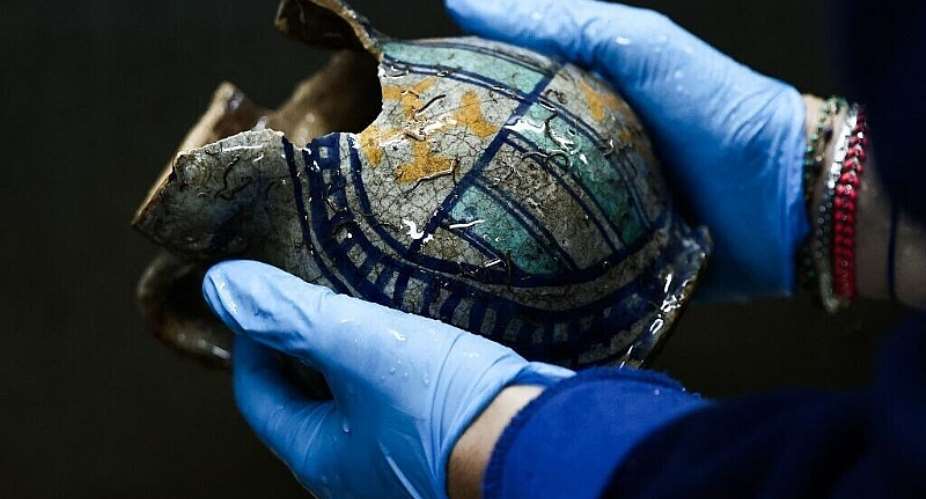
A remotely operated submarine has begun uncovering the secrets of a 16th-century shipwreck lying 2.5 kilometres beneath the Mediterranean off southern France, where researchers are delicately recovering brightly coloured ceramic treasures from the deepest wreck ever found in French territorial waters.
At a secret location off Ramatuelle on France's southern coast, the Camarat 4 sank around 500 years ago and was discovered by chance in 2025 during a French military seabed survey.
Now, Operation Calliope 26.1 is carrying out the first stage of a joint research mission on the wreck, led by Cephismer, the French Navy's deep-sea intervention unit, and DRASSM, the Culture Ministry's underwater archaeology department.
Its exact coordinates are being kept secret because of the sensitivity of the objects found on the seabed.
Wreck discovered of French steamship that sank in Atlantic in 1856
Deep descent
Launched this year, the project aims to further investigate the wreck and its cargo using a remotely operated underwater vehicle capable of descending to 4,000 metres.
Tethered by cable to a tugboat platform, the robot is equipped with several cameras and articulated arms. Two containers onboard allow teams to control the machine and monitor its live feed.
After two hours of sailing from the Var coast, the high-seas tug Jason reaches the site, where the machine is lowered into the water.
After an hour-long descent, it reaches the wreck site.
“It's extremely precise work to avoid damaging the site, to avoid stirring up the sediment,” Sébastien, head of the Calliope 26.1 mission, said. “This delicate work is also of major importance for training our sailors.”
On control screens, researchers watch the wreck emerge – the ship's structure, a cannon and hundreds of pitchers and plates decorated with floral motifs, crosses and blue, orange and green fish.
Drone discovers 16th-century shipwreck at record depth in French waters
Merchant clues
The onboard camera captures eight images per second for three hours, producing nearly 68,000 photos to build a 3D model of the wreck.
“The visibility is excellent,” said Franca Cibecchini, a maritime archaeologist at DRASSM.
“You can't really tell how deep it is. Thanks to this quality, we can say that it's likely a merchant ship carrying Ligurian faience [from northwestern Italy], so perhaps from the port of Genoa or Savona.”
Researchers say the site may offer rare evidence about 16th-century trade because its depth means it was likely untouched after it sank.
“What's also important is that this is a site where there could have been no attempt at looting after the shipwreck,” said Marine Sadania, the researcher leading operations.
“For the 16th century, we have texts that aren't very detailed about merchant ships, so this is a valuable source of information on maritime history and transport networks.”
Several pitchers and plates were recovered during the expedition for study on land.
Fragile recovery
At the DRASSM laboratory in Marseille, Sadania carefully examined one of the ceramic pieces underwater.
“This is one of the deepest objects ever recovered from a shipwreck in France,” Sadania said. “For us, it's an opportunity to test protocols for extracting these artifacts while preserving their integrity.”
Around a third of ceramics recovered from deep-water excavations later break, for reasons scientists still cannot explain.
A temporary exhibition at the Toulon Maritime Museum in November will present the mission's first findings, while the wreck itself will remain on the seabed under Unesco conservation guidelines.
(with AFP)
 Police arrest two as search intensifies for missing couple
 Three Akosombo units restored after fire incident — Energy Ministry
 'Weep not for rude CEOs, weep for your dying nation' – Kwesi Yankah tells Julius...
 UCC lecturer, TA die in accident
 Malaria deaths fall by 98% since 2011 – GHS
 Two-month salary arrears for newly recruited nurses paid — Health Ministry
 'We'll complete all Big Push projects on schedule' — Roads Minister assures
 Voltaian Basin Project: GNPC Explorco engages Yaa Naa, stakeholders ahead of dri...
 Senyo Hosi praises Ayine’s role in OSP creation, urges broader policy approach t...
 PUWU condemns ECG staff transfers, reassignment


