




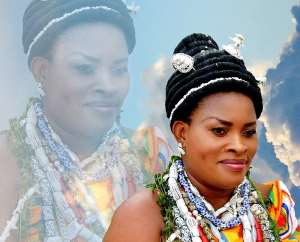
Hair has long been regarded as an important symbol of beauty, identity, and cultural expression among women in many societies.
From childhood to adulthood, women's hairstyles often reflect different stages of life, social status, and cultural belonging.
In recent years, modern trends among young women, particularly those of Generation Z and Generation Alpha, have introduced a wide range of hairstyles such as goddess braids, butterfly braids, knotless braids, mermaid braids, island twists, Fulani braids, lemonade braids, faux locs, twists, and micro braids.
Despite the growing popularity of these contemporary styles, traditional Ghanaian hairstyles continue to hold deep cultural meaning in many communities.
Among the Ga-Dangme people of the Greater Accra Region, hairstyles are more than fashion; they represent heritage, spirituality, and identity.
Naa Juyoo Oshedu Wobolor Jueteer Tsofayelor, a Ga-Dangme cultural ambassador from La Agbawe Kplen, said hairstyles among the Ga-Dangme people had historically served as symbols of maturity, social status, and cultural pride.
She explained that in Ga-Dangme cosmology, the head is regarded as sacred, representing the seat of destiny and spiritual connection.
“Hair growing from the head is therefore treated with deep respect and often carries cultural and spiritual significance,” she said.
According to her, specific hairstyles were traditionally worn to mark important life stages such as puberty rites, marriage, and widowhood.
She said some styles also signified royal lineage and authority, especially among queen mothers and priestesses during traditional ceremonies.
Naa Tsofayelor noted that hairstyles among Ga-Dangme women often communicated silent messages about a person's age, social standing, and cultural identity.
She mentioned some well-known traditional styles, including Tenbeleo, Oduku, Okikiki, Duade Tsei, Akukli, and Pesɛnpɛsɛ, each of which carries unique cultural symbolism.
She explained that the Tenbeleo hairstyle is an intricate style that reflects maturity and cultural pride, while cornrows are ancient, practical, and symbolic of unity and continuity.
She further said the Oduku style is often associated with dignity and composed womanhood, while Okikiki reflects creativity and social status.
She added that Duade Tsei features structured braiding with historical significance, Akukli symbolises royalty and spiritual authority, and Pesɛnpɛsɛ reflects patience and artistry in hairstyling.
“In earlier times, one could easily identify a woman's status or life stage simply by observing her hairstyle,” she said.
The Ga-Dangme cultural ambassador added that African hair had historically represented strength, beauty, and versatility, surviving centuries of migration, colonial influence, and cultural change.
She observed: “Our hair stands for strength, because it survived migration, climate, colonial disruption, and cultural pressure. It stands for beauty, because African aesthetics celebrate texture, geometry, and natural fullness. It stands for versatility, because from ancient braiding patterns to colonial-era adaptations and modern reinterpretations, Ga-Dangme hair has never been static.”
According to her, during the colonial era, foreign beauty standards attempted to reshape African aesthetics, but many women continued to preserve traditional hairstyles while adapting to new influences.
She said the revival of interest in natural hair and traditional braiding patterns in recent years demonstrated renewed pride in Ghanaian cultural identity.
Naa Tsofayelor emphasised the need to protect and promote traditional hairstyles as an important part of Ghana's cultural heritage.
She stated that younger generations must be taught not only how to braid traditional hairstyles but also the cultural meanings behind them.
“Hair is more than decoration. It carries our history, identity, and ancestral heritage,” she said.
She urged cultural institutions, educators, and media organisations to help preserve traditional hairstyles through education, festivals, and cultural documentation.
According to her, maintaining traditional hairstyles among younger generations would help ensure that the cultural heritage of the Ga-Dangme people continues to thrive.
GNA
 Police arrest 186 suspects, rescue victims in 10-day anti-crime crackdown across...
 S.african Police Probe Killing Of Foreigner In Xenophobic Unrest
 Tension at Bantama NPP office as chairman accuses Asenso Boakye of political mac...
 Korle Bu succesfully performs first two off-pump heart bypass surgeries
 Disability Act lacks teeth, must be strengthened — Annoh-Dompreh
 Mental health, drug tests now mandatory for firearm licences — Interior Minister
 GoldBod directs licensed buyers to report gold purchases within five minutes
 Action will be taken on viral video showing SHS student assaulting a junior — Dr...
 NDC promised to ease cost of living yet increasing utility tariff — Kofi Tonto
 NDC is a useless govt – Miracles Aboagye fumes


