




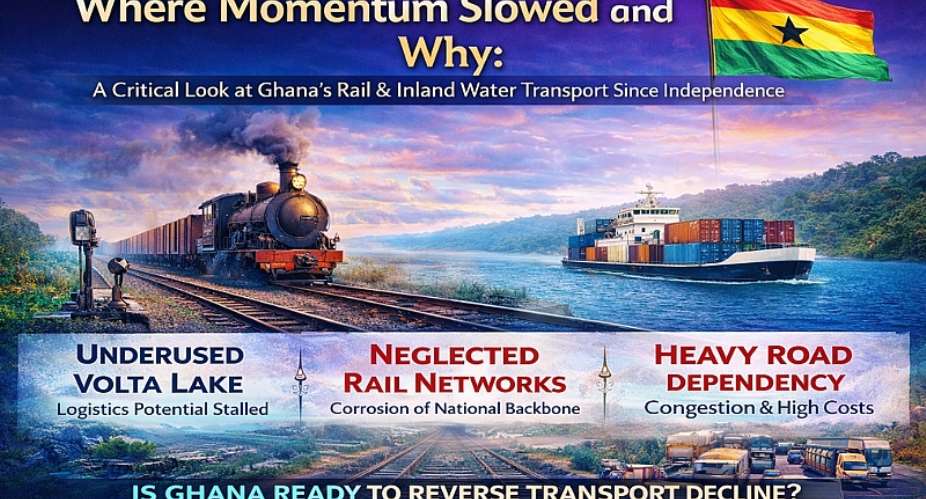
On 6 March 1957, Ghana’s Independence marked the beginning of a new national project: to transform colonial infrastructure into systems that served Ghana’s own development goals. Transportation, especially railways and inland water transport, was expected to play a central role in this transformation. Yet 69 years later, the question must be asked honestly: why did the early momentum in Ghana’s transport sector slow, and what lessons must we confront today?
The answer requires a difficult but necessary examination of policy choices, institutional shifts, and structural neglect that gradually weakened the rail and inland water transport systems that once formed the backbone of Ghana’s economic geography.
The Early Promise After Independence
At independence, Ghana inherited a railway system that, despite being designed primarily for colonial extraction, was functional and economically significant. The rail network connected mining areas and agricultural zones to ports through corridors such as:
- Takoradi–Kumasi (Western Line)
- Accra–Nsawam
- Central Line connections to the cocoa belt
These lines transported minerals, timber, and cocoa, making rail a vital logistics artery for the national economy.
Inland water transport also played an important role. After the construction of the Akosombo Dam in the 1960s, the resulting Lake Volta created immense potential for inland water transport. Plans emerged to move bulk cargo across the lake, linking northern Ghana to southern markets and ports.
At that moment, Ghana had the geographic assets and infrastructure base to develop a balanced multimodal transport system. But the trajectory soon changed.
The Rise of Road Dominance
One of the most consequential developments after independence was the gradual policy shift toward road transport dominance. The creation of the Ghana Private Road Transport Union fundamentally reshaped the mobility landscape. GPRTU organized the rapidly expanding informal bus and minibus sector, popularly known as trotro transport, which quickly filled mobility gaps across cities and rural communities.
This transformation had clear benefits:
- Roads expanded mobility quickly
- Private operators reduced pressure on government budgets
- Passenger transport became more accessible
However, the unintended consequence was that road transport gradually displaced rail as the dominant mode, even for freight, which rail could handle more efficiently.
Instead of modernizing railways, policy increasingly adapted to the success of road transport, reinforcing a cycle in which rail received less attention and fewer resources.
Institutional Fragmentation and Decline
The institutional management of the rail sector also played a role in slowing momentum. The state-owned Ghana Railway Corporation struggled with multiple structural challenges:
- Aging infrastructure
- Limited reinvestment
- Weak maintenance regimes
- Declining freight volumes
By the 1980s and 1990s, many lines had deteriorated significantly. Freight that once moved by rail shifted to trucks, accelerating road congestion, higher logistics costs, and infrastructure damage. At the same time, inland water transport development on Lake Volta remained limited despite the presence of the Volta Lake Transport Company. While the lake offered vast transport potential, investment in ports, vessels, and logistics integration remained insufficient. In effect, two strategic transport assets, railways and inland waterways, were gradually sidelined.
Why Momentum Slowed
Several deeper structural factors explain this slowdown:
1. Policy Bias Toward Roads
Road projects often offered faster political visibility and immediate economic benefits, making them attractive to governments and development partners.
2. Weak Long-Term Planning
Rail and water transport require decades-long planning horizons, but national planning cycles often prioritized short-term solutions.
3. Institutional Instability
Frequent reforms and restructuring of rail management created uncertainty and delayed sustained investment.
4. Loss of Technical Capacity
Over time, Ghana lost much of its domestic railway engineering expertise due to underinvestment in training and industry development.
5. Fragmented Transport Policy
Instead of building an integrated multimodal system, each transport mode evolved separately.
The Cost of the Decline
- The consequences of this policy path are visible today:
- Heavy reliance on road freight, increasing logistics costs
- Rapid deterioration of highways due to heavy truck traffic
- Limited regional connectivity by rail
- Underutilized inland waterways
This imbalance is particularly significant because rail and inland water transport are among the most energy-efficient and climate-friendly transport modes, a critical consideration in today’s climate policy landscape.
What Must Change: Policy Directions for the Future
For Ghana to regain momentum, reform must move beyond isolated infrastructure projects toward system-level transformation.
1. Rebuild Freight-Oriented Rail Corridors
Rail investment should prioritize bulk freight corridors, especially those connecting mines, agricultural zones, and ports.
2. Integrate Lake Volta into National Logistics
Lake Volta must be developed as a strategic inland transport corridor, supported by modern ports, vessels, and cargo logistics.
3. Strengthen Engineering Capacity
Revitalizing railway engineering education and training will be essential to sustain infrastructure development.
4. Establish a Multimodal Transport Strategy
Transport policy must explicitly integrate rail, road, ports, and inland waterways within a single logistics framework.
5. Shift Freight from Road to Rail and Water
Strategic incentives should encourage industries to move bulk cargo away from highways.
Independence and the Next Transport Revolution
Ghana’s independence was not only a political milestone; it was also an opportunity to reshape infrastructure systems for national development. In many ways, that transformation remains incomplete.
The truth is that Ghana did not lose its transport potential, it simply paused its momentum.
Today, with renewed rail projects and growing attention to logistics efficiency, the country has another opportunity to correct course. But this time, the lesson must be clear:
Transport systems decline not only from lack of money, but from lack of sustained policy commitment.
As Ghana celebrates 69 years of independence, the real question is no longer whether railways and inland waterways matter. The real question is whether the nation is finally ready to restore them to the center of its development strategy.
Author: Joseph Fuseini ([email protected])

 Korle Bu Teaching Hospital to introduce IVF and Corporate Clinic before end of 2...
 Accra West: Sarpeiman, Medie and other areas to experience power outages on Sund...
 Accra West: Faulty transformer causes outage Pokuase Amanfrom and surrounding ar...
 Restoration of Akosombo turbines not automatic solution to current dumsor — Mira...
 We have enough capacity to meet electricity demand — Energy Minister
 May 2: Cedi maintains value, sells at GHS12.15 on forex market, GHS11.20 on BoG ...
 2024 outages not due to transformer overloads — Energy Minister defends past com...
 US to withdraw about 5,000 troops from Germany
 Rebels take key military base in Mali's north
 Middle East war's impact on shipping hitting refugee aid: UNCHR


