




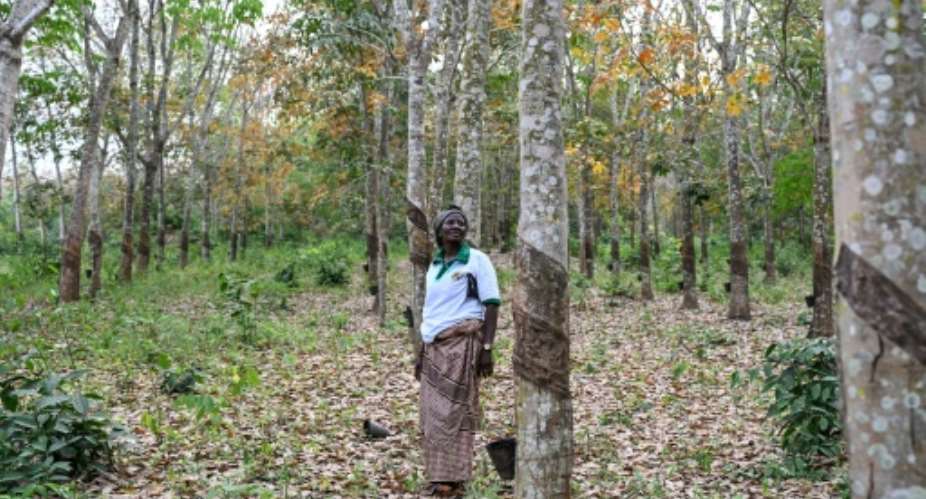
Ivorian farmer Affoua Mea decided one day she'd had enough. Despite years cultivating rubber trees on the plantation inherited from her father, her brothers still held the purse strings.
Last year, the 64-year-old bought her own piece of land thanks to an initiative aimed at closing the gender gap in agricultural land ownership in the west African country.
"The family plot belongs to all of us," she said, but added: "What they give me are crumbs. That's why I decided to start my own plantation."
Standing among the tall trees whose slim trunks are tapped for the white sap known as latex that is refined to make rubber, Mea savoured her newfound autonomy.
"I'm really independent and freer," she told AFP at the plantation in the eastern town of Bongouanou.
Farming has long been the pillar of Ivory Coast's economy, but just five percent of women own agricultural land compared to 25 percent of men, according to the Organisation for Economic Cooperation and Development.
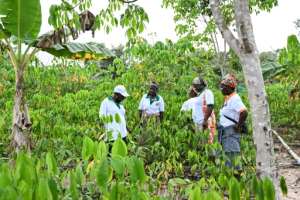 Ivorian women make up nearly half the workforce in farming but only five percent own agricultural land, figures show. By Sia KAMBOU (AFP)
Such inequality is not uncommon in sub-Saharan Africa, where women make up nearly half the workforce in the farming sector, the UN Food and Agriculture Organization says.
Mea was helped by the Association of Natural Rubber Professionals of Ivory Coast (APROMAC), which offers women subsidies to buy rubber trees, at sometimes as much as 80 percent.
Now she is in control of her finances, Mea said she won't be passing her land down to her son. "I'll leave it to my daughter," she said.
'Do what I want'
Holding a machete, her tunic knotted at the waist, Solange Kouakou, 45, also bought plants at reduced cost to cultivate the land handed down by her father near the town of Toumodi.
To fill a hectare (2.4 acres) of land, she paid 62,000 CFA francs ($110) instead of 210,000 CFA francs with APROMAC subsidies.
"A lot of women say they, too, want to do rubber trees," she said.
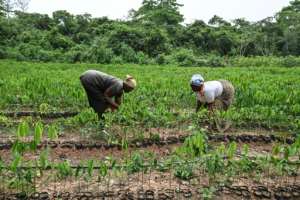 Solange Kouakou (R) and Jacqueline Tano (L) bought rubber plants thanks to subsidies offered by the Association of Natural Rubber Professionals of Ivory Coast. By Sia KAMBOU (AFP)
Owning her own land means she makes around $116 a month, which nevertheless is still only around the minimum wage.
But "women who don't have their own money, if they need to pay for something, they ask their husband... I do whatever I want", she said proudly.
Her friend Jacqueline Tano, 44, followed suit. She bought rubber plants this year for her plantation, which spans half a hectare.
Since 2009, around 2,500 women have bought rubber plants at low cost under the subsidy scheme offered to the least well-off.
APROMAC said demand had increased in the last five years when new subsidies exclusively for women were introduced.
Monthly contributions paid by producers finance the subsidy scheme.
Cultural obstacles
Women wanting to farm, however, can still face hurdles.
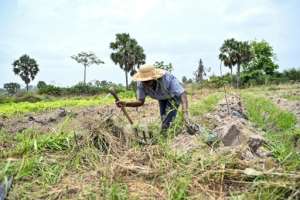 Women wanting to farm in Ivory Coast can face cultural barriers, such as an unofficial ban on inheriting land. By Sia KAMBOU (AFP)
"In some places, girls aren't allowed to inherit a plot of land", a ban that is cultural rather than set by the law, said APROMAC member Jacqueline N'Guessan, who represents the country's women rubber producers.
She negotiates with "the heads of the land, the village chiefs, the traditional leaders, or with the husbands, so that they give a small plot to their wives", she said.
"In some cases, we manage it," she said.
Other times, women sign a multi-year contract to farm a landowner's plot. "Once they have access to the land, we move on to the subsidy phase," she said.
And when the obstacles are too great, N'Guessan has set up a nursery near Toumodi that employs 15 women and whose plants are sold to recipients of subsidies.
Changes in such a key sector of Ivorian life give women a greater sense of self-esteem, she said.

 'Bring application for me to act on or continue keeping quiet and pay your hoste...
 Iceland to vote on reopening EU membership talks in close referendum
 Nigerian president orders rescue operation after mass kidnapping in mosque
 Senegal-made sickle cell treatment raises hopes, reduces costs
 Namibia to rebury remains of political prisoners returned by South Africa
 Trump sends Saudi civil nuclear agreement to Congress for review
 Danger looms over Ankobra Bridge in Jomoro
 ‘Containment is not prevention’ – National Security boss outlines 18-month maste...
 Wontumi withdraws from NPP Chairman contest
 CHRAJ, NCCE and NSS equip university leaders with tools to fight corruption and ...

